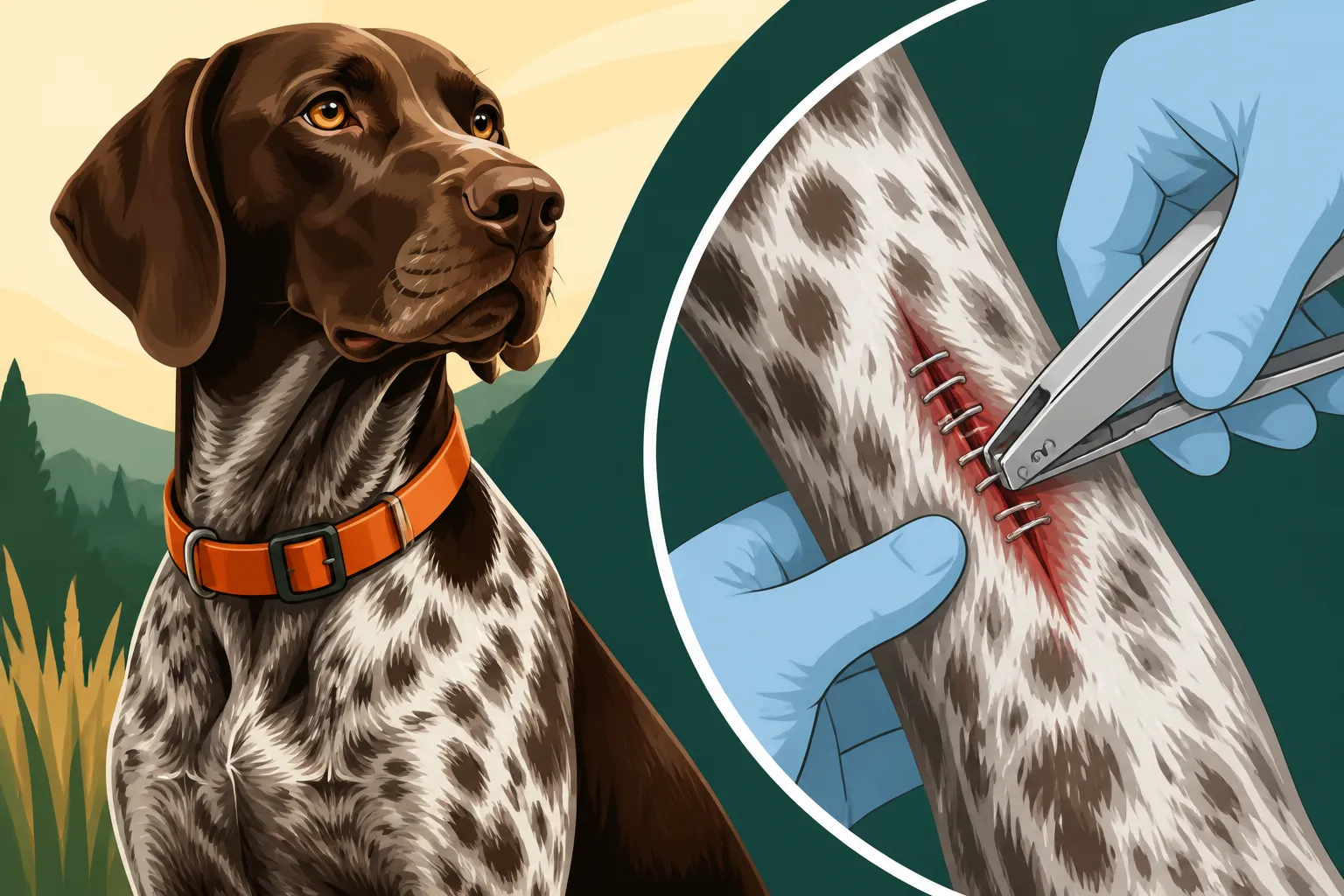
Stapling a German Shorthaired Pointer’s Field Wound
Few things can make your heart drop faster than seeing your tenacious German Shorthaired Pointer limp back to you from dense cover, or worse, find them with a nasty cut during a hunting trip or an intense trail run. These dogs are built for action, and sometimes that means they push through hazards, coming back with a tear that needs immediate attention. This guide is all about understanding when and how you might temporarily staple a GSP's field wound, and critically, why professional veterinary care is always the essential next step.
Identifying Field Wounds That Might Need Staples
When your German Shorthaired Pointer is out doing what they love, whether it's tearing through a briar patch or navigating a tangle of downed logs, injuries can happen in a flash. Not every cut is a candidate for field stapling, and knowing the difference can be critical for your dog's well-being and recovery.
Assessing the Severity and Type of Injury
The first thing you need to do, after you've managed to calm your dog and safely examine the wound, is to assess it. This isn't just a quick glance; it requires careful observation. Is it just a superficial scrape, or is it a deep, gaping laceration? A minor scratch or abrasion might just need a good cleaning and some antiseptic, whereas a deep puncture wound or a wound that's actively spurting blood is an entirely different beast. For instance, a clean, straight cut often caused by something sharp like a piece of sheet metal or glass, or even a particularly nasty brush with Barbed Wire Cuts on a Running Shorthair, might be suitable for temporary closure with staples. These types of wounds often have defined edges that can be brought back together.
However, if you're looking at a jagged tear, a heavily contaminated wound full of dirt and debris, or a deep puncture where you can't see the bottom, stapling is generally not the answer. Jagged edges are difficult to approximate properly, and closing a dirty wound can trap bacteria inside, leading to a severe infection. Puncture wounds, even if small on the surface, can be deceptively deep and cause internal damage or infection if sealed improperly. Wounds near joints, the eyes, or major arteries also demand immediate professional attention and should not be field stapled. You're trying to prevent further contamination and significant blood loss, but not at the expense of proper medical evaluation. It's about damage control until you can get to a vet, not a permanent fix.
Understanding When to Prioritize Immediate Vet Care
There are definite red flags that tell you to drop everything and head straight to the nearest veterinary clinic, regardless of whether you carry a field stapler. If the wound is bleeding profusely and you can't staunch the flow with direct pressure, that's an emergency. If you suspect bone involvement, nerve damage (perhaps your dog can't move a limb or digit normally), or tendon/ligament damage, a stapler won't help, and might even hinder proper examination by a vet. Swelling that rapidly appears, extreme pain that your dog can't settle from, or any signs of shock (pale gums, rapid breathing, weakness) are also urgent indicators.
Additionally, consider the location of the wound. Cuts on the paw pads can be notoriously tricky because of the constant pressure and movement, and they often get dirty quickly. While you might temporarily wrap a pad injury, stapling them is often less effective and can be very painful. For issues like Cut Pads on a German Shorthaired Pointer After a Long Day, a vet will likely have more advanced methods for cleaning and closing or bandaging to allow healing. Your priority in these critical situations is to get your GSP stabilized and to expert medical attention as quickly as possible. Don't waste precious time attempting a field fix that isn't appropriate.
The "When and How" of Field Stapling a GSP's Wound
Okay, so you've assessed the situation, and you believe it's a relatively clean, straight laceration that could benefit from a temporary field staple to hold the edges together until you can reach a vet. This is not a skill to take lightly, and it's something many experienced hunters or dog owners learn to do with guidance from their veterinarian or through wilderness first aid courses.
Appropriate Scenarios for Temporary Stapling
The key word here is "temporary." Field stapling is a stop-gap measure designed to protect an open wound from further contamination and to reduce blood loss on the way to proper veterinary care. You're not performing surgery; you're buying time. Ideal candidates for field stapling are:
- Fresh, clean lacerations: These are cuts that have just occurred, are relatively straight, and have minimal contamination. Think of a clean slice from a sharp branch or a fence wire.
- Skin-deep wounds: Wounds where only the skin layer is involved, and you can clearly see the underlying muscle or fat layer is intact and not deeply damaged.
- Non-weight-bearing or low-motion areas: While tricky, areas on the flank, chest, or upper legs that aren't constantly flexing or bearing a lot of movement are better candidates than, say, a knee or elbow.
- Minimally bleeding wounds: While staples can help control minor oozing, they are not a substitute for controlling severe hemorrhage. If there's arterial bleeding, direct pressure and a tourniquet (if properly trained) are needed.
What you should never staple: dirty wounds (they'll fester), deep wounds (you could trap infection or miss internal damage), puncture wounds (ditto), or wounds that are ragged and impossible to approximate neatly. Wounds involving joints, eyes, or mucous membranes are also off-limits. Remember, your goal is to prevent the situation from getting worse, not to provide a definitive cure.
Essential Tools and a Step-by-Step Approach
Having a compact, well-stocked field first-aid kit is paramount for any GSP owner, especially if your dog accompanies you into remote areas. Here’s what you’ll ideally need for a field stapling scenario:
- Veterinary skin stapler: These are specific staplers designed for animal skin, using sterile staples. Do not use an office stapler!
- Sterile gloves: To protect both you and your dog from infection.
- Antiseptic wipes or solution: Like chlorhexidine or diluted povidone-iodine.
- Clean cloth or gauze: For cleaning and drying the wound.
- Muzzle: Even the calmest German Shorthaired Pointer can react instinctively to pain. A muzzle protects you and your helper.
- Helper: An extra set of hands makes the process much safer and more efficient.
Here's a simplified step-by-step guide for temporary field stapling:
- Safety First: Muzzle your dog, if needed. This is crucial. Get your helper to gently but firmly hold your GSP, keeping them as still and calm as possible. Talk to your dog in a soothing voice.
- Clean the Area: Don your sterile gloves. Gently clean around the wound with antiseptic wipes or solution. Do not scrub aggressively directly into the wound, as this can cause more tissue damage. The goal is to remove loose dirt and hair from the surrounding skin. You can carefully clip away excess hair around the wound edges if it's interfering, but again, be gentle.
- Assess Again: Take one more look at the wound. Are the edges relatively clean and straight? Can you easily bring them together without tension?
- Approximate the Edges: Gently pinch the skin on either side of the laceration together so the edges meet perfectly. You want the skin to roll slightly outwards, exposing the clean inner edge. This is often the trickiest part, and where a helper is invaluable.
- Apply Staples: With the skin edges approximated, position the stapler over the wound. Press firmly and evenly to deploy a staple. Start at one end of the wound or in the middle and work outwards. Space the staples about 1/4 to 1/2 inch apart (about 0.6 to 1.2 cm), enough to hold the wound closed without being too tight. You want the staples to gently hold the skin, not pinch it forcefully.
- Cover and Protect: Once stapled, gently clean the immediate area again. You might apply a thin layer of antibiotic ointment (if you have veterinary-approved kind) and then cover the wound with a clean, non-stick bandage or gauze secured with vet wrap. This protects the wound from further contamination on the journey to the vet.
- Seek Immediate Veterinary Care: This is the most important step. Your field stapling is a temporary measure. Get your GSP to a vet right away. They will properly clean, assess, and definitively close the wound, or remove your staples and re-close it with sutures if that's more appropriate.
Remember, this is not a substitute for veterinary training. If you are unsure at any point, err on the side of caution and prioritize getting your dog to a professional.
Beyond the Staples: Post-Staple Care and Professional Follow-up
So, you've managed to get some staples in and protect the wound. Good job! But the journey is far from over. Field stapling is just the opening act in managing a GSP's significant injury. The real healing and proper care begin with your veterinarian.
The Immediate Necessity of Veterinary Examination
It cannot be stressed enough: field staples are a temporary fix. As soon as possible after applying them, you need to get your German Shorthaired Pointer to a veterinary clinic. When you call ahead, inform them that you've temporarily stapled a field wound so they can be prepared for your arrival.
At the clinic, the vet will thoroughly examine the wound. This often involves removing your temporary staples, meticulously cleaning the wound, and then assessing for any foreign bodies, infection, or deeper tissue damage that you couldn't see in the field. They might probe the wound, perform imaging like X-rays if bone involvement is suspected, or even take samples for culture if infection is already present. Depending on the wound's age, cleanliness, and nature, the vet may re-close it with sterile sutures, use surgical staples, or decide on a different approach if immediate closure isn't advisable (e.g., if it's too dirty and needs to drain). They will likely administer pain medication, antibiotics to prevent infection, and possibly a tetanus shot, especially if the wound was deep or contaminated. This is why having pet insurance like Healthy Paws can be a real lifesaver, as these emergency visits and subsequent treatments can quickly add up. The costs associated with "Emergency Fees for a Shorthair Cut Open in the Field" or "What a Vet Charges to Close a Shorthair's Field Cut" can be substantial, making insurance a wise investment for active dogs.
Managing Recovery and Preventing Complications
Once the vet has done their work, your role shifts to diligent at-home care. This means following all post-operative instructions precisely. You’ll typically be tasked with:
- Keeping the wound clean and dry: This might involve daily cleaning with a prescribed solution or simply keeping an eye on it.
- Administering medications: Finish all prescribed antibiotics and pain medications. Do not stop early just because your dog seems better.
- Preventing licking/chewing: Your GSP will naturally want to investigate the wound. An Elizabethan collar (e-collar, or "cone of shame") or a recovery suit is often necessary to prevent them from opening stitches or introducing new bacteria.
- Restricting activity: Even if your GSP seems fine, strenuous activity needs to be curtailed until the wound is fully healed. Jumping, running, and rough play can reopen the wound or hinder healing. This rest period is crucial for proper tissue regeneration and avoiding setbacks. If the wound was severe, like a deep laceration that required extensive closure, your vet might even recommend something akin to the rest protocols for Rehabbing a Shorthair After Cruciate Surgery, albeit on a smaller scale.
- Monitoring for complications: Watch for any signs of infection (redness, swelling, heat, discharge, foul odor), excessive pain, or if the staples/sutures start to come out. If you notice any of these, contact your vet immediately.
Staples or sutures are usually removed by your veterinarian after 10-14 days, depending on the wound's location and how quickly it's healing. Even after removal, the skin will still be fragile, so continue to protect the area and gradually increase activity as advised by your vet. Timely and thorough care, both in the field and at the clinic, is crucial for your GSP's full and speedy recovery.
Proactive Measures to Safeguard Your GSP in the Field
While knowing how to handle a field wound is important, the best approach is always prevention. German Shorthaired Pointers are powerful, driven dogs, and their enthusiasm can sometimes put them in harm's way. Taking proactive steps can significantly reduce the risk of needing to reach for that field stapler in the first place.
Preparing Your Dog and Knowing the Terrain
Before you even step foot into the field, preparation is key. First, ensure your GSP is in peak physical condition. A well-conditioned dog is less prone to fatigue, which can lead to carelessness and injuries. Regular exercise that mimics field conditions, like long runs or retrieving drills, helps build stamina and muscle. Checking your dog thoroughly before and after every outing, especially looking at paws, ears, and under the coat, is non-negotiable. This "Checking a German Shorthaired Pointer Over After a Hunt" routine should become second nature.
Secondly, know your hunting or training grounds. Scout the area for potential hazards such as old fence lines, broken glass, sharp rocks, or dense, thorny brush. If you're going into unfamiliar territory, a slower initial pass can help you identify problem spots. Remember that fallen trees and thickets can conceal dangers that a running GSP might not see until it's too late. Being aware of the environment allows you to guide your dog away from the riskiest areas when possible.
Utilizing Protective Gear and Training for Safety
Just like we wear appropriate gear for outdoor activities, so should our GSPs. For a dog that's constantly moving through varied terrain, protective equipment can make a huge difference.
- Protective Vests: A good quality, blaze orange protective vest can shield your GSP's chest and belly from thorns, sharp sticks, and even minor cuts. Brands like Browning or Cabela's offer durable vests designed for active hunting dogs. This is especially useful in heavy cover where the risk of injury to the thin GSP skin is high. Think of it as armor for your four-legged hunting partner, minimizing the likelihood of needing to deal with lacerations in vital areas. Many owners invest in "Vests and Boots for a Hunting German Shorthaired Pointer" specifically for this reason.
- Paw Protection: Your GSP's paws take a beating. Conditioning their pads over the summer months with regular walks on varied surfaces, as discussed in "Toughening a Shorthair's Pads Over the Summer", can help, but boots offer superior protection on abrasive terrain, rocky areas, or in extreme weather. Introducing boots early and making them a positive experience is crucial. Look for durable, well-fitting boots from brands like Ruffwear or Muttluks that stay on during vigorous activity. Choosing the right "Boots for a Shorthair on Rock and Stubble" can prevent painful cuts and abrasions that sideline your dog.
- Command Training: Beyond physical gear, solid obedience training is arguably the most important preventative measure. A reliable "whoa" command, a strong recall, and the ability to handle your dog at range through whistle or hand signals can keep them out of trouble. Imagine being able to call your GSP back from a dangerous creek bank or a patch of thick, thorny brush. A strong "Recall on a German Shorthaired Pointer That Is Locked On" is not just about bringing them back to heel; it's about protecting them from unseen dangers. Consistent training creates a dog that respects boundaries and listens, even when their instincts are screaming "go!"
By combining careful preparation, appropriate protective gear, and consistent training, you can significantly reduce the chances of your German Shorthaired Pointer suffering a field injury that requires emergency intervention.
Field Wound Management: Quick Reference Guide
| Feature | Suitable for Field Stapling (Temporary) | Prioritize Immediate Vet Care (No Field Stapling) |
|---|---|---|
| Wound Type | Fresh, clean, straight laceration with defined edges. | Deep punctures, dirty/contaminated wounds, jagged tears, avulsions. |
| Depth | Skin deep, superficial, no visible deep muscle or tendon damage. | Deep enough to expose muscle, bone, or internal structures. |
| Bleeding | Minor oozing, easily controlled with pressure. | Profuse, spurting arterial bleeding; difficult to control. |
| Location | Non-weight-bearing, low-motion areas (flank, chest, upper leg). | Near joints, eyes, mucous membranes, paw pads, major arteries/veins. |
| Contamination | Minimal, relatively clean. | Heavily contaminated with dirt, debris, or foreign objects. |
| Dog's Condition | Alert, responsive, otherwise stable. | Signs of shock (pale gums, rapid breathing), severe pain, lameness. |
| Goal | Temporary closure to prevent contamination and control minor bleeding. | Definitive diagnosis, proper cleaning, sterile closure, systemic meds. |
Disclaimer
The information provided in this article is for educational and informational purposes only and does not constitute veterinary advice. Always consult with a qualified veterinarian for any health concerns or before making any decisions related to your German Shorthaired Pointer's medical care. Field stapling is a temporary measure and is not a substitute for professional veterinary treatment.