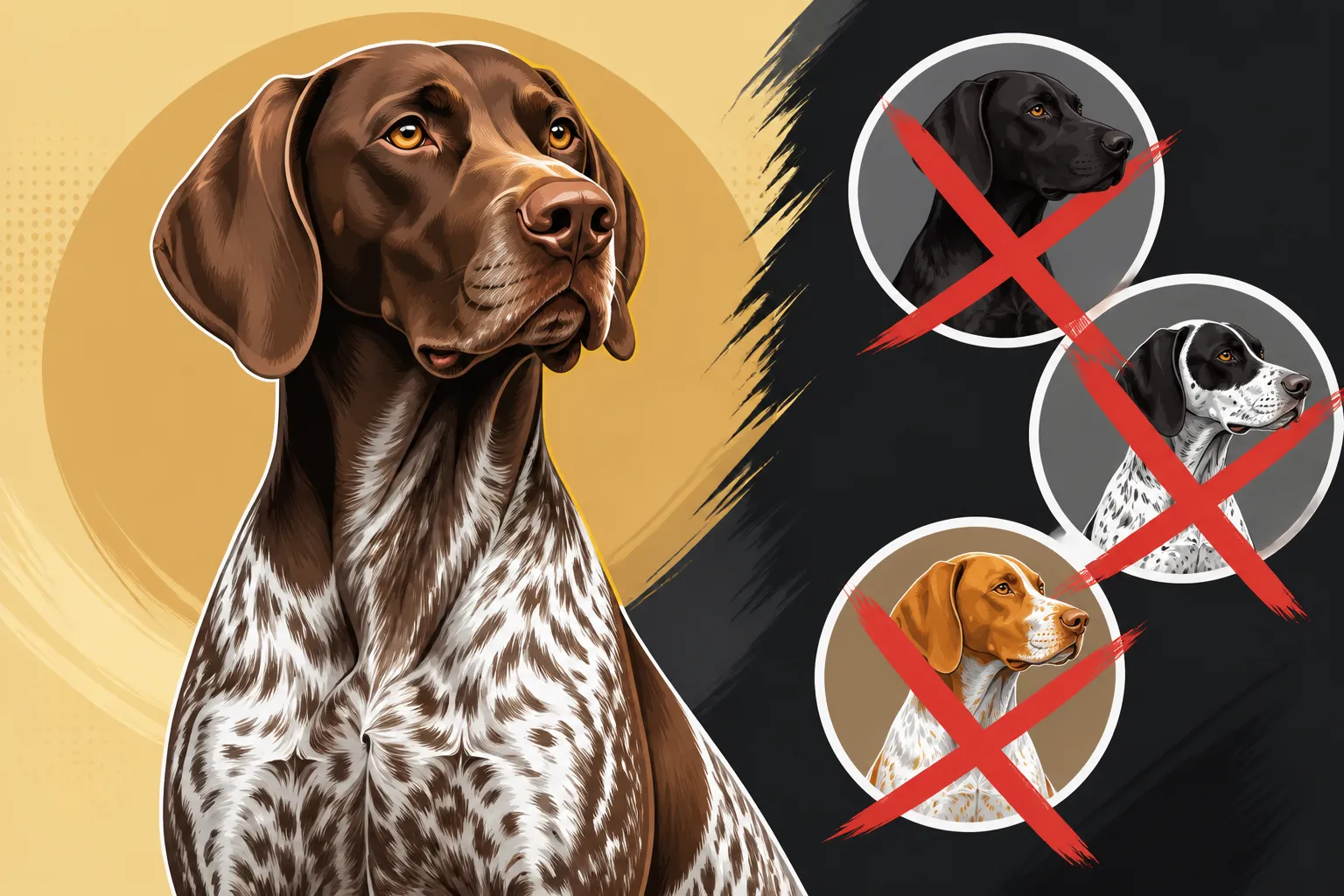
Liver, Black and the Colors That Disqualify a Shorthair
If you're looking into bringing a German Shorthaired Pointer into your life, or even just admiring them from afar, you've probably noticed their striking coats. But the world of GSP colors can be a bit more complex than just "brown and white." Many new owners or enthusiasts get confused about what colors are considered standard, which ones are rarer, and which ones, believe it or not, can actually disqualify a dog from the show ring. This guide will walk you through the rich tapestry of GSP coat colors, explaining what's accepted, what's not, and why it all matters.
Understanding the German Shorthaired Pointer Breed Standard for Color
The German Shorthaired Pointer, or GSP as we often call them, is a breed with a rich history, honed over generations to be a versatile hunting companion. The breed standard, meticulously laid out by organizations like the American Kennel Club (AKC), isn't just about looks; it reflects the breed's functional purpose and heritage. Color, believe it or not, plays a significant role in this standard, defining what is considered ideal for a purebred GSP. It’s not just about aesthetic preference; it’s about maintaining the consistent traits that define the breed.
Why Color Matters in the Show Ring (and Why it Doesn't for a Pet)
For a German Shorthaired Pointer competing in conformation events, adherence to the breed standard is paramount. Every aspect of the dog, from its gait and structure to its coat color and markings, is judged against this ideal. Disqualifying colors, as we'll discuss, can prevent an otherwise perfectly healthy and well-conformed GSP from ever earning a championship title. This can be a huge frustration for breeders who might produce an otherwise exemplary puppy with an "off" color. For show enthusiasts, understanding these nuances is crucial for success and for preserving the breed's integrity.
However, if your GSP is destined to be a beloved family pet or a dedicated hunting partner outside the show ring, these color regulations become far less critical. A disqualifying color does not, in any way, impact a dog's health, temperament, or incredible ability in the field. Your solid black GSP, while not show-eligible, will still be an exceptional bird dog, a loyal companion, and a tireless athlete. The love and bond you share with your dog transcend any arbitrary color rules. It’s important to remember that the standard is a guide for breeding and showing, not a judgment of a dog's inherent worth as a companion.
The Core Colors: Liver and White
Historically and currently, the predominant and most widely accepted colors for the German Shorthaired Pointer revolve around liver (often called "brown" by those unfamiliar with the specific dog term) and white. This classic combination is what most people picture when they think of a GSP. Liver is a rich, reddish-brown hue that can range from a lighter, almost milk-chocolate shade to a deep, dark mahogany. White provides a striking contrast, often serving as the canvas upon which these liver markings are displayed.
This combination of liver and white is deeply rooted in the breed's origins. When the German Shorthaired Pointer was first being developed in Germany, breeders focused on creating a versatile hunting dog that was not only adept in the field but also visually distinct. The German Kennels the Shorthair Was Built In certainly had preferences that solidified this color palette. The liver pigment is strong and historically consistent in the lines that formed the modern GSP. This preference was carried over when the breed was introduced to America and entered the AKC stud book.
When you look at a litter of GSP puppies, the variations within liver and white can be quite enchanting. You’ll see puppies with large patches of liver, some with intricate ticking, and others with a blend that looks almost marbled. Each pattern is unique, but the underlying colors of liver and white are constant. It's truly a beautiful and functional coat, offering some camouflage in natural environments while still being distinct enough for hunters to spot their dogs.
The Nuances of Liver and White Markings
The classic German Shorthaired Pointer is recognized by its liver and white coat, but within this fundamental palette, there's a fascinating array of patterns and presentations. It's not just "liver and white" but how that liver and white manifests across the dog's body that makes each GSP unique and adheres to the breed standard. Understanding these variations helps you appreciate the subtle beauty and genetic diversity within the accepted color schemes.
Solid Liver: A Classic Look
While often associated with significant white markings, a German Shorthaired Pointer can also be solid liver. This means the dog's entire coat is a uniform shade of liver, with no white markings at all. It's a striking and elegant appearance, showcasing the richness of the liver pigment without interruption. Solid liver GSPs are fully accepted by the breed standard and are seen in both show and hunting lines.
These dogs often have darker pigment on their noses and eye rims, completing the monochromatic look. Many find the solid liver coat to be incredibly handsome, giving the dog a powerful and streamlined appearance. If you're looking for a dog with a sleek, consistent coat color, a solid liver GSP certainly fits the bill. They stand out in a different way from their patched or ticked counterparts, exuding a certain quiet strength in their uniform coloring.
Liver and White Patterns: Patched, Ticked, and Roan
Most German Shorthaired Pointers feature a combination of liver and white, expressed in various patterns. These patterns add character and individuality to each dog, making them instantly recognizable.
-
Patched: A patched GSP has large, distinct areas of solid liver color on a predominantly white background. Think of it like a map with large landmasses of liver against an ocean of white. These patches are clearly defined, often appearing on the head, back, and flanks. The white areas are usually pure white, or may have minimal ticking, which are small spots of liver within the white. This pattern creates a bold, clean contrast.
-
Ticked: Ticking refers to small, distinct spots or flecks of liver within the white areas of the coat. Imagine someone flicking tiny specks of paint onto a white canvas. A GSP might have a white base coat with moderate ticking, where the spots are clearly visible and separated, or heavily ticked, where the spots are so numerous they almost create a shaded appearance. This pattern often starts subtly in puppies and becomes more pronounced as they mature, sometimes causing owners to wonder Whether a Shorthair Puppy Changes Color as They Grow. It's a very common and beautiful presentation.
-
Roan: Roan is a denser, more uniform distribution of colored hairs intermingled with white hairs, creating a blended or marbled effect. Instead of distinct spots like ticking, roaning creates an almost salt-and-pepper appearance that can give the white areas a greyish or muted liver tone. A "liver roan" GSP might appear to have large areas of solid liver, with the white portions of its body having a soft, diluted liver hue due to this intermingling of hairs. This gives the coat a wonderfully unique texture and depth. Sometimes, people mistake a heavily roaned dog for a solid-colored dog if the roaning is dense enough. The difference between ticked and roan can sometimes be subtle, with ticking being more about individual spots and roan being more about an overall blend.
It's common to see GSPs with a combination of these patterns, such as a large liver patch on the head, a solid liver saddle on the back, and heavily ticked or roaned white areas on the legs and belly. These variations are all cherished and perfectly within the breed standard, making each German Shorthaired Pointer a visually interesting individual.
The Acceptance of Black in German Shorthaired Pointers
While liver and white might be the traditional poster children for German Shorthaired Pointers, the presence and acceptance of black coats in the breed have a fascinating history and are a well-established part of the modern standard. For a long time, black was a point of contention among GSP enthusiasts, but today, black and white GSPs are recognized and celebrated.
The Historical Debate Around Black Shorthairs
Go back far enough in the breed's history, and black German Shorthaired Pointers were considered "non-standard" or even undesirable by some factions, particularly in their country of origin. The early development of the GSP in Germany heavily emphasized the liver coloration, drawing on various hunting breeds to achieve the desired traits. Some purists believed that black indicated a deviation from the original lines or an undesirable outcross. This historical bias sometimes led to black puppies being culled or simply not registered, a stark contrast to today's more inclusive approach.
However, as the breed evolved and spread internationally, particularly with its arrival and acceptance in the United States, attitudes began to shift. It became evident that black pigmentation naturally occurred within the GSP gene pool. Breeders on this side of the Atlantic recognized that black dogs possessed all the same fantastic qualities – intelligence, athleticism, and versatility – as their liver counterparts. Over time, through diligent breeding and advocacy, black and white GSPs gained official recognition. The 1930 AKC Entry of the German Shorthaired Pointer saw the breed gain recognition, and eventually, the standard evolved to include black as an accepted color. This acceptance opened up the breed to a wider genetic pool and celebrated the beauty of all healthy, well-bred German Shorthaired Pointers, regardless of their dominant pigment.
Black and White Markings: Patched, Ticked, and Roan
Just like their liver and white cousins, black German Shorthaired Pointers come in a beautiful array of patterns. These patterns contribute to the unique look of each dog and are fully accepted within the breed standard. The depth and sheen of a black GSP's coat can be truly stunning, especially when combined with crisp white markings.
-
Patched Black and White: A patched black and white GSP will have large, distinct areas of solid black against a predominantly white background. These strong, clean black patches often appear on the head, ears, back, and flanks, creating a dramatic contrast. The white areas are typically pure white, sometimes with minimal ticking. This pattern highlights the bold nature of the black pigment, making for a very eye-catching dog.
-
Ticked Black and White: Ticking in a black and white GSP manifests as small, scattered black spots or flecks within the white portions of the coat. The density of the ticking can vary greatly, from sparse, delicate speckles to a heavy dusting that gives the white areas a greyish, almost shadowy appearance. These spots become more visible as the puppy matures, adding depth and texture to the coat.
-
Black Roan: Black roan refers to an even mix of black and white hairs, creating a blended, almost smoky or charcoal-like effect in what would otherwise be the white areas of the coat. Unlike ticking, which consists of distinct spots, roaning produces a more uniform, integrated appearance. Solid Black and Black Roan German Shorthaired Pointers are both gorgeous, and the roan pattern is particularly striking, often giving the dog a unique silver-sheen quality that photographs beautifully. It's a truly distinctive presentation of the black pigment.
These patterns, whether patched, ticked, or roan, create visually stunning dogs that embody the GSP's elegance and athleticism. They are equally capable in the field and cherished in the home, proving that beauty and performance aren't limited to a single color scheme.
Solid Black: Still a Rarity
While black and white, black patched, or black roan GSPs are accepted, solid black German Shorthaired Pointers remain less common than their liver counterparts. A solid black GSP would have an entirely black coat, with no white markings whatsoever, similar to how a solid liver GSP has no white. This uniform, glossy black coat is quite striking and makes for a very handsome dog.
The rarity of solid black isn't due to any genetic defect or issue; it's simply less common in the breed's genetic expression compared to the liver pigment and the prevalence of white spotting genes. These dogs meet the breed standard in terms of color, assuming all other structural and temperamental requirements are met. You might encounter one at a dog park or out in the field, and they often turn heads with their sleek, powerful appearance.
It's worth noting that even though they are less frequently seen, a solid black GSP is every bit a German Shorthaired Pointer, possessing all the same energy, intelligence, and hunting drive as any other color variation. For those who appreciate a bold, singular color, a solid black GSP is a truly magnificent specimen.
Disqualifying Colors and Markings in the AKC Standard
While the German Shorthaired Pointer breed standard embraces a range of liver and black presentations, it's equally important to understand what colors and markings are not permitted in the conformation ring. These are known as disqualifications, and while they don't affect a dog's health or suitability as a pet, they prevent the dog from competing for championship titles.
The Exclusion of Tan Points and Tricolor
One of the most clear-cut disqualifications in the German Shorthaired Pointer breed standard is the presence of tan points. Tan points refer to distinct patches of tan or reddish-brown coloration that appear on specific areas of the body, typically above the eyes, on the muzzle, chest, and legs. This pattern is often associated with breeds like the Doberman Pinscher or Rottweiler, but it is explicitly considered an undesirable trait in GSPs. A GSP with tan points would essentially be a "tricolor" dog if it also had black or liver and white. Why Tan Markings Disqualify a German Shorthaired Pointer really comes down to preserving the breed's distinct appearance.
The reason for this disqualification harks back to the breed's origins and the desire to maintain a specific genetic purity and aesthetic. The presence of tan points suggests ancestral influence from breeds not intended in the GSP's development, or at least a genetic expression outside the accepted norm. For breeders, avoiding tan points is a key part of responsible breeding practices to ensure their puppies adhere to the standard. While a dog with tan points might be a wonderful companion, it simply won't be eligible for conformation shows.
Why Solid White is a Disqualification
Just as solid liver and solid black are accepted, one might assume solid white would also be permitted. However, a German Shorthaired Pointer that is entirely or predominantly white is considered a disqualification in the show ring. The standard explicitly calls for pigmentation beyond just the skin, meaning the coat itself must have a significant amount of liver or black color. Why a Solid White Shorthair Cannot Be Shown is less about health and more about the historical ideal for the breed's appearance.
A truly solid white GSP is rare, as most dogs with a lot of white will still have some ticking or patches of color. The concern with excessive white in some breeds can be linked to deafness, but this is not typically cited as the primary reason for the GSP standard's stance. Instead, it's about maintaining the distinctive color patterns that characterize the breed. The liver or black markings, whether in patches, roan, or ticking, are integral to the recognized GSP look. Therefore, a dog that lacks these prominent color patterns, appearing overwhelmingly white, would be out of standard for conformation purposes.
Other Faults Related to Pigmentation
Beyond the major disqualifications of tan points and solid white, there are other pigmentation faults that, while perhaps not outright disqualifying, are considered undesirable and can penalize a dog in the show ring. These relate to the color of the nose, eyes, and even the skin around the eyes.
-
Flesh-Colored Nose: A German Shorthaired Pointer's nose should ideally be solid liver or, in the case of black dogs, solid black. A flesh-colored nose, or a "butterfly nose" (where parts of the nose are pink and parts are pigmented), is considered a fault. The rich pigmentation of the nose leather is part of the desired overall aesthetic and ties into the dog's coat color. A light-colored nose suggests a lack of strong pigmentation that is preferred in the breed.
-
Light Eyes: The GSP standard specifies that eye color should ideally be dark brown, matching or complementing the coat color. Light yellow or "bird of prey" eyes are considered a fault. Dark, intelligent eyes contribute to the GSP's keen and alert expression, which is highly valued. Paler eyes can give a softer or less intense look that deviates from the breed's traditional image.
-
Eyelids and Lips: Just like the nose, the pigmentation of the eyelids and lips is important. They should be well-pigmented, usually liver or black, matching the dog's primary color. Pink or unpigmented eyelids and lips can be considered faults, again pointing to a less intense overall pigmentation that goes against the standard's preference for a robust, well-defined appearance.
These pigmentation details, while seemingly minor, all contribute to the overall picture of a breed-standard German Shorthaired Pointer. Reputable breeders strive for strong, correct pigmentation in all their dogs, as it reflects the health and consistency of their lines.
Beyond the Standard: Understanding Color Genetics
Delving into the genetics of German Shorthaired Pointer colors can be incredibly fascinating, especially for breeders and owners curious about why their dogs look the way they do. Understanding the science behind coat colors helps demystify the appearance of liver, black, and various patterns, explaining why certain combinations appear or are rarer. It’s a complex interplay of genes, but we can break down the basics to shed some light on this colorful topic.
The Basic Genetics of Liver and Black
At the most fundamental level, the primary colors of liver and black in German Shorthaired Pointers are determined by a few key genes, particularly those at the B (brown) and K (dominance black) loci.
-
The B Locus (Brown/Black): This is perhaps the most crucial gene for our discussion. The B locus determines whether a dog can produce black pigment or only brown (liver) pigment.
- B (dominant allele): Allows the production of black pigment. A dog with at least one 'B' allele (BB or Bb) will have black in its coat (if other genes allow it to be expressed).
- b (recessive allele): Leads to the production of brown (liver) pigment only. A dog must inherit two 'b' alleles (bb) to be liver-colored.
This means that a liver GSP is genetically 'bb' at this locus, while a black GSP is either 'BB' or 'Bb'. This also explains why two liver GSPs can only produce liver puppies, but two black GSPs could produce liver puppies if both carry the 'b' allele (Bb x Bb = BB, Bb, bb).
-
The K Locus (Dominance Black): This locus determines whether a dog is solid black, brindled, or has agouti patterns (like sable or tan points).
- K^B (dominant allele): This is "dominance black." If a dog has at least one K^B allele (K^B K^B or K^B k^y), it will be solid black (assuming it's also B_ at the B locus). This is what makes a dog uniformly black.
- k^y (recessive allele): Allows other patterns (like fawn, sable, or tan points) to be expressed.
In German Shorthaired Pointers, the K^B allele is present, which allows for solid black or black patches. However, the breed standard disqualifies dogs with tan points, which would be governed by a k^y k^y genotype at this locus, along with other genes. This means breeders typically select against the k^y allele that would allow tan points to appear.
This genetic dance between the B and K loci dictates the base color of a German Shorthaired Pointer, setting the stage for the patterns to be laid on top.
Explaining Ticking, Roan, and Solid Patterns
Beyond the base color, other genes control how that color is distributed, leading to the patched, ticked, and roan patterns we see.
-
The S Locus (White Spotting): This locus controls the amount and pattern of white markings on a dog.
- S (dominant allele): Solid colored, minimal white.
- s^i (Irish spotting): Moderate white, often seen as a white chest, blaze, and feet.
- s^p (piebald spotting): Irregular white patches on a colored background. This is the common gene responsible for the white areas in GSPs.
- s^w (extreme white piebald): Almost entirely white, with only small patches of color. This genotype could lead to the "solid white" GSPs that are a disqualification.
Most GSPs carry alleles that result in some degree of white spotting, which creates the canvas for ticking and roaning.
-
The T Locus (Ticking/Roan): This gene is responsible for the speckled or blended appearance within the white areas.
- T (dominant allele): Causes ticking or roaning. If a dog has even one 'T' allele (Tt or TT) and also has white spotting (s^p or s^w at the S locus), it will develop ticking or roaning in its white areas.
- t (recessive allele): No ticking or roaning. A dog must be 'tt' to have clear white areas without any speckles.
The difference between ticking and roaning is thought to be influenced by either modifiers at the T locus or other genes that affect the density and distribution of the colored hairs within the white patches. Ticking tends to be more distinct spots, while roaning is a more even intermingling of colored and white hairs, giving that blended look. This is why some GSPs can have crisp white patches, while others are heavily roaned or ticked.
Genetic Testing for Color: What it Can Tell You
For serious breeders, understanding the genetic makeup of their German Shorthaired Pointers is crucial for making informed breeding decisions and predicting litter outcomes. Genetic testing for coat color has become increasingly accessible and can provide valuable insights.
Commercial laboratories offer DNA tests that can identify a dog's genotype at the B, K, S, and T loci, among others. For example, a breeder can test a black GSP to see if it carries the recessive 'b' allele (Bb). If two 'Bb' black dogs are bred, they have a statistical chance of producing liver puppies. Similarly, testing can confirm if a dog carries the allele for tan points (k^y) even if it doesn't express them due to other dominant genes, allowing breeders to make choices to avoid producing disqualified colors.
These tests are simple, usually requiring only a cheek swab. The results can help breeders ensure they are producing puppies that align with the breed standard, especially for those involved in conformation. For pet owners, while not strictly necessary, knowing your dog's genetic color profile can be a fun way to understand a bit more about their unique appearance and lineage. Ordering a Cone Degeneration Test on a Shorthair Puppy is an example of another genetic test that breeders do, showing the breadth of genetic understanding available to owners and breeders today. Reputable breeders often utilize these tools to make the most responsible choices for their lines.
Practical Considerations for German Shorthaired Pointer Owners
Beyond the aesthetics and the show ring, the color of your German Shorthaired Pointer can have a few practical implications for daily life, though these are often minor compared to the dog's overall health and temperament. Understanding these points can help you be a more informed and prepared GSP owner.
Does Color Affect Health or Temperament?
This is a question many prospective owners ask, and it's an important one. For German Shorthaired Pointers, the answer is generally no. There is no scientific evidence to suggest that a GSP's liver or black coloration, or any of the accepted patterns like ticking or roan, is directly linked to specific health issues or temperament traits within the breed. A solid liver GSP is just as likely to be healthy and possess the typical GSP temperament as a heavily black-ticked dog.
The focus for any GSP owner should always be on the dog's overall genetic health, the reputation of the breeder, and the individual dog's temperament, rather than its coat color. Concerns about health risks linked to coat color often arise in other breeds (like the increased deafness risk in predominantly white Boxers or Dalmatians, or merle-related issues in others), but these are not characteristic issues for German Shorthaired Pointers based on their accepted color palette. You still need to be diligent about general health concerns like Hip Dysplasia in a Hard Running German Shorthaired Pointer or The Bloat Risk a Shorthair Carries Into Every Season, regardless of coat color.
Temperament is primarily a product of genetics (the parents' temperaments and the breeder's selection) and early socialization. A well-bred, well-socialized GSP will exhibit the breed's characteristic intelligence, boundless energy, loyalty, and affectionate nature, regardless of whether it's liver and white or solid black. So, when choosing a GSP, prioritize health clearances, pedigree, and the puppy's individual personality over chasing a specific "rare" or aesthetically preferred color.
Sun Protection for White-Marked Shorthairs
One area where color can have a practical impact is sun sensitivity, particularly for German Shorthaired Pointers with extensive white markings. Dogs with large areas of white fur and pink skin are more susceptible to sunburn, just like fair-skinned humans. This is especially true for areas with sparse hair, such as the bridge of the nose, ear tips, and belly.
If you have a predominantly white GSP, or one with significant white on their face or ears, it's wise to take precautions, especially if they spend a lot of time outdoors in direct sunlight, like during a long day in the field or at the lake.
- Sunscreen: Pet-safe sunscreens are available (check with your vet for recommendations) and can be applied to vulnerable areas. Be sure to use products specifically formulated for dogs, as human sunscreens can contain ingredients toxic to pets if licked. Brands like Chewy carry a good selection of these types of specialized pet products.
- Shade: Always ensure your GSP has access to ample shade, whether it's from trees, a pop-up canopy, or a dog box.
- Limit Exposure: On days with intense sun, try to schedule outdoor activities for early morning or late afternoon when the UV index is lower.
- Protective Gear: For working dogs, specialized vests or gear can offer some sun protection for the body, though it's less practical for the face.
Paying attention to these details can help prevent uncomfortable sunburns and reduce the long-term risk of skin cancer, which can affect any dog, but particularly those with less natural pigmentation protection. Sun Protection for a White Marked Shorthair provides more detailed advice on this topic.
Finding a Reputable Breeder for Desired Colors
If you have a strong preference for a particular GSP color – perhaps you've always dreamed of a solid black, or you adore the intricate patterns of a liver roan – it's crucial to seek out a reputable breeder. A good breeder will prioritize health, temperament, and adherence to the overall breed standard above all else, including specific color preferences.
When discussing color with a breeder:
- Ask about their lines: A knowledgeable breeder will be able to tell you what colors they typically produce and might even be able to discuss the genetic background of their breeding pairs regarding color. They should be transparent about which colors are accepted by the standard and which are not.
- Prioritize health clearances: No matter the color, always inquire about health clearances for the parent dogs, such as OFA certifications for hips and elbows, eye certifications, and cardiac exams. A stunning coat color means little if the dog is prone to debilitating health issues. You can learn more about this by reading The Five Tests Behind a German Shorthaired Pointer CHIC Number.
- Observe temperament: Spend time with the parent dogs if possible, and observe the puppies. A well-socialized puppy with a sound temperament will bring far more joy to your home than one chosen purely for its color.
- Beware of "Rare" Color Claims: Be very wary of any breeder who advertises "rare" or "exotic" GSP colors and charges extra for them. This is often a red flag, as it suggests they are prioritizing appearance (and profit) over health and adherence to the established breed standard. For example, Whether a Black German Shorthaired Pointer Costs Extra should not be the case with a reputable breeder. The accepted colors are not "rare" in a way that should command a premium.
A reputable breeder will be honest about what they produce and will focus on finding the right puppy for the right home, regardless of specific color demands. They will ensure their dogs embody the true spirit of What Versatile Actually Means for a Shorthair.
The Beauty of Every German Shorthaired Pointer
When it comes down to it, the German Shorthaired Pointer is a magnificent breed, celebrated for its intelligence, athleticism, and unwavering loyalty. While discussions around coat colors and breed standards are important for preserving the breed's aesthetic and genetic integrity, it's vital to step back and appreciate the core qualities that make every GSP so special. Their unique personalities, boundless energy, and undeniable charm far outweigh any specific shade or pattern of their fur.
Celebrating the GSP's Versatile Nature
The true hallmark of a German Shorthaired Pointer lies in its incredible versatility. These dogs were bred for a purpose – to be exceptional, all-around hunting companions capable of pointing, retrieving from land and water, and tracking. Their physical prowess, mental acuity, and eagerness to please are what define them, not just the color of their coat. Whether you're watching a liver and white GSP lock onto a pheasant or a black roan GSP retrieve a duck from icy water, their drive and natural ability are evident.
This versatility extends beyond the hunting field. GSPs excel in a multitude of dog sports, from agility and obedience to dock diving and nose work. They are also phenomenal family pets for active households, forming deep bonds with their human companions. Their athleticism and intelligence mean they require significant mental and physical exercise, but the reward is an incredibly engaged and devoted friend. The rich history of the GSP, originating from dogs bred to do it all, is something to be celebrated in every individual of the breed.
Focusing on Health and Temperament Over Color
Ultimately, the most important considerations when acquiring a German Shorthaired Pointer, or any dog for that matter, should be health and temperament. A dog that is physically sound and emotionally stable will bring years of joy, companionship, and fewer vet bills than one chosen solely for its looks. Responsible breeders understand this implicitly. They dedicate countless hours and resources to health testing their breeding stock, meticulously researching pedigrees, and providing optimal care and socialization for their puppies.
When looking for your next GSP, prioritize a breeder who:
- Can provide verifiable health clearances for both parents.
- Is open and transparent about the health history of their lines.
- Raises puppies in a stimulating, clean, and loving environment.
- Focuses on breeding for sound temperament and working ability.
- Asks you plenty of questions to ensure you're a good fit for one of their puppies.
The color of a GSP is simply the wrapping paper on an incredible gift. Whether that paper is solid liver, black and white ticked, or liver roan, the precious contents inside – the intelligent mind, the loyal heart, and the tireless spirit – are what truly matter. Embrace the variety, but always put health and happiness first. You can always check trusted online retailers like Chewy for quality dog food, toys, and other essentials that will contribute to your GSP's overall well-being, regardless of their beautiful coat color.
Disclaimer
This article is for general informational purposes only and does not constitute professional advice. Laws, prices and regulations vary by location and change over time. Consult a qualified professional for guidance on your specific situation.