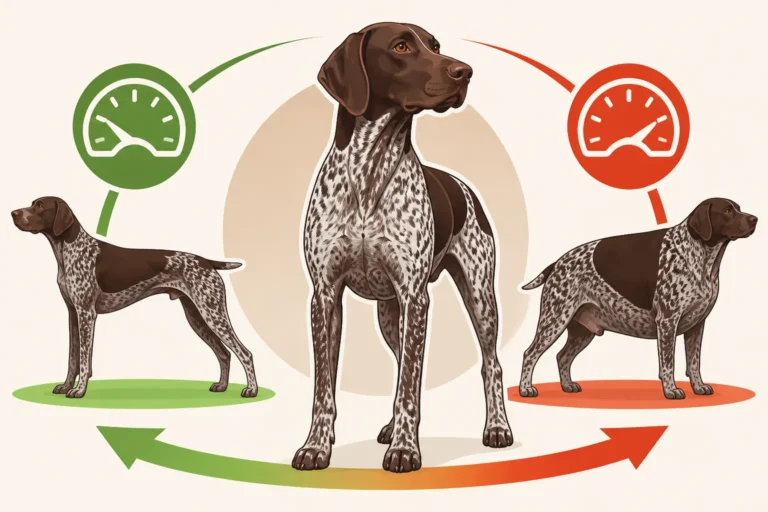
The German Shorthaired Pointer Against the Brittany
Choosing between a German Shorthaired Pointer and a Brittany can be harder than it looks: both are athletic, affectionate bird dogs, yet they differ in size, working style, coat care, and the amount of dog they bring into a home. This guide compares those everyday realities so you can decide which breed better fits your activity level, space, and plans for training.
German Shorthaired Pointer vs Brittany at a glance
Both breeds were developed as hunting dogs, and either may thrive with an active owner who enjoys training and outdoor time. The biggest practical difference is often scale: German Shorthaired Pointers are generally taller and heavier, while Brittanys are more compact. But choosing the smaller breed does not mean choosing a low-energy dog. A Brittany still needs meaningful daily exercise and mental work.
| Trait | German Shorthaired Pointer | Brittany |
|---|---|---|
| Typical size | About 21 to 25 inches tall and 45 to 70 pounds | About 17.5 to 20.5 inches tall and 30 to 40 pounds |
| Original work | Versatile hunting, including pointing, retrieving, and tracking | Upland bird hunting, especially pointing and retrieving |
| General working style | Often athletic and expansive, with the range shaped by breeding and training | Often agile and close-working, though individuals vary |
| Coat | Short, dense coat with relatively simple routine grooming | Flat or wavy coat with feathering that needs regular checking |
| Home fit | Best with an owner ready to provide substantial activity and structure | Smaller in the house, but still needs a busy, engaged routine |
| Training considerations | Can be independent, energetic, and highly driven by scent or birds | Often responsive, but can be sensitive to harsh or confusing handling |
These are broad tendencies, not guarantees. A dog’s inherited temperament, early experiences, health, and training all matter. Two dogs of the same breed can differ markedly in confidence, independence, range, and ability to settle indoors.
The size difference changes daily life
A German Shorthaired Pointer can take up more room in a car, on a sofa, and in a narrow hallway. A young, excited GSP may bump into people or sweep a coffee table with its tail before it has learned to move carefully indoors. Larger size also means you need to be comfortable handling a powerful dog on leash, particularly if it spots a rabbit or catches the scent of birds.
A Brittany is more compact and may be easier to lift into a vehicle or accommodate in a smaller crate. That can be a genuine advantage if you travel frequently or have limited storage space. Still, a compact body does not automatically make a Brittany easier to manage. A restless Brittany can be just as persistent about seeking activity, and either breed can pull hard if leash manners are not taught.
Before deciding, imagine an ordinary weekday rather than a perfect weekend: the dog needs to get outside, practice settling, and receive attention even when you are tired or busy. For a fuller look at the home and schedule a GSP tends to suit, see The Household a German Shorthaired Pointer Actually Fits and Whether a First Time Owner Can Handle a Shorthair.
Both are sporting dogs, not casual couch companions
A walk around the block may be a nice part of the day, but it is rarely a complete activity plan for a young, healthy dog from either breed. These dogs have been bred to use their bodies and noses. A satisfying routine might combine a brisk walk or run, structured training, scent games, and supervised outdoor exploration. The right amount varies with age, conditioning, weather, and health.
There is also a difference between physical exhaustion and a dog that has learned to relax. Running a dog until it is overtired can leave it sore without teaching calm behavior. Short training sessions, food-search games, and practicing a mat or crate routine can help round out exercise. For a realistic picture of the time commitment, The Two Hours a Day a German Shorthaired Pointer Needs is useful background, though an individual dog’s needs will not fit neatly into a fixed daily number.
Hunting style and training differences
The German Shorthaired Pointer is known for versatility. The breed’s traditional work includes pointing upland birds and contributing to retrieving and tracking tasks. A Brittany is also a serious bird dog, often valued for agility and a style that can suit hunters who want a more compact dog working in closer partnership.
Those descriptions are starting points, not field guarantees. Bloodlines, training, experience, terrain, and the handler’s preferences influence how far a dog ranges and how it responds to cues. If hunting is part of your plan, ask breeders or rescue contacts about the actual dogs’ working style rather than relying only on breed labels.
A GSP may bring more size and range to the field
Many German Shorthaired Pointers are built to cover ground quickly. That can be exciting in open country, but it also means the handler needs reliable communication and a thoughtful plan for safe off-leash work. Recall, check-cord skills, and an appropriate introduction to birds are not optional extras if you hope to hunt with the dog. They are part of building a partnership.
The GSP’s versatility may appeal to someone who wants one dog to participate in several types of outdoor work. That same drive can be demanding for a household that mainly wants a companion for occasional hikes. A dog that has strong hunting instincts may also become very interested in neighborhood wildlife, scent trails, or birds moving through the yard. Training and secure management help, but they do not erase instinct.
If the meaning of “versatile” is part of what draws you to the breed, What Versatile Actually Means for a Shorthair explains why that reputation involves more than being energetic or athletic.
A Brittany may be compact without being low-drive
A Brittany’s smaller frame can make it a convenient hunting companion in thick cover or a vehicle with limited space. Many owners also appreciate how readily the dog can move between outdoor activity and family life when its exercise, training, and rest needs are met. But a Brittany is still a working breed, and boredom can show up as barking, pacing, chewing, or restless attention-seeking.
Some Brittanys are sensitive to raised voices or abrupt corrections. That does not mean they cannot handle structure; it means training is usually more productive when it is consistent, clear, and reward-based. German Shorthaired Pointers also benefit from fair, carefully timed training, especially when they are excited by scent or movement. With either breed, repeating a cue while the dog is already racing toward something interesting is not a substitute for teaching the cue in easier settings first.
If you want to compare other sporting breeds with similar appeal, The German Shorthaired Pointer Against the English Pointer, The German Shorthaired Pointer Against the Vizsla, and The German Shorthaired Pointer Against the Weimaraner offer useful contrasts.
Exercise, grooming, and home care
The day-to-day care difference is not simply “short coat versus feathered coat.” Both dogs need routine attention to nails, ears, teeth, skin, and paws, and both can bring dirt and shed hair indoors. The details of their coats differ, though, and that can affect how much brushing and post-outing checking you do.
Exercise needs require a practical weekly plan
Think about what you can provide across the whole week, including rainy mornings, long workdays, and winter evenings. A secure yard is helpful, but it is not a replacement for interaction. Letting a dog run around alone may not provide the engagement or training that helps it settle. Some days can include longer outings; other days can lean more on sniffing games, obedience practice, and structured play.
A GSP’s size and athleticism can make its activity feel especially demanding if it is not taught to switch off indoors. A Brittany may be easier to fit physically into a smaller home, but it still needs regular opportunities to move and use its mind. If you live in an apartment or have no fenced yard, consider how you will provide safe exercise and training rather than assuming one breed will simply adapt to limited activity. Whether a Shorthair Fits a House With No Yard explores that question for GSP owners.
For days when outdoor exercise is limited, plan a handful of short activities rather than expecting one puzzle toy to solve everything. Hide kibble for a supervised search, practice simple obedience cues, or teach the dog to settle on a mat. Chewy is one place owners may browse for food puzzles or basic training supplies, but the useful part is choosing an activity that matches the dog’s skill level and supervising it appropriately. A toy can support a routine; it cannot replace companionship or training.
Coat and maintenance are different, but neither is effortless
The German Shorthaired Pointer’s short coat is relatively easy to brush, but short hairs can still shed and stick stubbornly to fabric. A rubber grooming mitt can help loosen loose hair. After time in brush, fields, or long grass, check the dog’s paws, ears, and coat for burrs, cuts, ticks, or grass seeds. Thin-coated dogs may also need protection from cold or rough vegetation depending on the conditions.
The Brittany’s coat has more feathering, particularly around the legs, chest, and tail. That longer hair can collect burrs and seeds and may need brushing to prevent tangles. Pay special attention after walks through fields or woodland. The ears on both breeds should be checked regularly, particularly after swimming or wet-weather outings, because moisture and debris can cause irritation.
Chewy may offer grooming mitts, brushes, and other routine supplies, but the right tool depends on the dog’s coat and tolerance for handling. Introduce brushing gradually, reward calm behavior, and keep sessions short at first. If a dog develops persistent itching, scaling, redness, or a bad-smelling ear, routine grooming is not a substitute for veterinary care.
Which breed is a better fit for you
The more useful question is not which breed is “better,” but which dog’s needs match your real household. If you are choosing a puppy, ask about the parents’ temperaments and working habits, and look for health information relevant to the line. If you are considering an adult or rescue dog, ask how that individual behaves at home, around other animals, and when left alone. A smaller dog may still be too active for your routine; a larger dog may settle beautifully with the right structure.
Choose a German Shorthaired Pointer if its strengths suit your life
A GSP may be a strong fit if you enjoy an athletic dog, want to explore hunting or other structured outdoor activities, and can make time for training as well as exercise. It may also suit someone who likes working with a dog that can participate in a broad range of field tasks. In exchange, you need to be prepared for its size, energy, prey interest, and need for daily engagement.
It may be a tougher match if your ideal dog is content with brief walks and long stretches alone, or if you are not comfortable managing a strong, fast-moving dog. That does not mean every GSP is unmanageable. It means you should judge the individual and the likely adult temperament carefully, rather than expecting exercise needs to disappear once the dog has a yard.
Choose a Brittany if compactness and field partnership matter
A Brittany may suit you if you want a smaller sporting dog and appreciate an agile hunting companion that can participate in active family life. Its size may make travel and everyday handling more convenient. Many households value that practicality, especially when the dog is expected to join regular hikes, training sessions, or field outings.
Do not choose a Brittany solely because it looks more manageable. It still needs activity, training, company, and coat checks. If you are often away or have little time for engagement, its smaller size will not prevent frustration or unwanted behavior. Chewy can be a convenient place to compare everyday enrichment and grooming items, but no purchase can make up for a schedule that leaves a high-energy dog without enough interaction.
Ask better questions before committing
Whether you are talking with a breeder, foster caregiver, or rescue, ask questions that reveal how a particular dog lives and works. “Is the dog energetic?” is too broad to be helpful. Ask what the dog does after exercise, how it responds to birds or wildlife, whether it can settle indoors, and how it behaves when handled for grooming or a veterinary exam.
Use questions such as these:
- What does a normal day look like for this dog?
- How does the dog respond to unfamiliar people, dogs, and household noise?
- What training has the dog already received, and what situations remain difficult?
- How does the dog behave when it is left alone for a reasonable period?
- Are there known health concerns in the dog or its close relatives?
- If hunting matters to you, what work has the dog actually done, and how does it handle birds, water, and recall?
The answers should help you picture ordinary life, not just a highlight reel. A well-matched dog is one whose needs you can meet on a normal Tuesday, not only during a weekend in the field. Chewy may help with practical supplies after you have made your choice, but the most important preparation is an honest plan for exercise, training, care, and companionship.
Disclaimer
This article is for general informational purposes only and does not constitute professional advice. Laws, prices and regulations vary by location and change over time. Consult a qualified professional for guidance on your specific situation.