Puppy Classes Before a Shorthair Starts Field Work
It's an exciting time when you bring home a German Shorthaired Pointer puppy, full of boundless energy and that eager-to-please sparkle in their eyes. But let's be honest, that boundless energy can quickly turn into a household tornado if not channeled properly, especially if you envision a future for them in the field. This guide dives deep into why puppy classes are not just a cute rite of passage, but an absolutely crucial foundational step for your Shorthair before you ever even think about introducing them to birds or serious field work.
Why Foundational Puppy Classes Are Non-Negotiable for a Future Field Dog
Many new German Shorthaired Pointer owners, especially those with hunting aspirations, are eager to jump straight into field training. They might think "my puppy is a natural, they don't need basic stuff." However, skipping foundational puppy classes is like trying to build a beautiful custom home without first pouring a solid concrete slab. You might get the walls up, but the whole structure will eventually show cracks, lean, and ultimately fail under pressure. For a breed as intelligent, driven, and energetic as the German Shorthaired Pointer, a strong foundation is paramount.
A well-socialized and obedient GSP is not just a better pet, it's a better hunting partner. Imagine trying to teach your dog advanced retrieves or intricate quartering patterns when they haven't even mastered walking politely on a leash or coming when called in a distracting environment. It's a recipe for frustration and can actually hinder their potential in the field. Puppy classes lay the groundwork of communication, trust, and self-control that every successful field dog needs.
Furthermore, these early experiences shape your Shorthair's entire outlook on the world. A confident, well-adjusted puppy is less likely to develop fear-based behaviors or reactivity, which can be devastating for a hunting dog that needs to be steady under various unpredictable conditions. The investment in time and effort now will pay dividends for The Twelve to Fourteen Years a German Shorthaired Pointer Gets you'll share, both at home and in the great outdoors.
Building Essential Life Skills and Socialization
Puppy classes aren't just about 'sit' and 'stay,' though those are certainly part of it. They're about exposing your young German Shorthaired Pointer to a variety of sights, sounds, people, and other dogs in a controlled, positive environment. Think about it: a future bird dog needs to be comfortable with loud noises, strange environments, and new people, including other hunters and dogs. If your GSP is fearful or reactive towards new stimuli because they weren't properly socialized, how will they handle the chaos of opening day or the crack of a shotgun?
These classes teach your puppy how to interact appropriately with their peers, learning crucial dog-to-dog communication skills. This is vital, especially if your GSP will eventually hunt alongside other dogs, which is common in many field scenarios. Without this early, positive exposure, you might find yourself with a dog that's either overly timid or aggressively dominant towards other canines, neither of which makes for a harmonious hunting trip. Moreover, it teaches them to ignore distractions, a skill that will transfer directly to holding a point when birds flush or ignoring a barking dog in the next blind.
Beyond socialization, puppy classes focus on practical life skills. Learning to walk on a loose leash, coming when called, and staying in a designated spot are not just polite manners; they are safety commands. A German Shorthaired Pointer that can reliably respond to "come" or "whoa" when they're off-leash in unfamiliar territory could literally save their life, whether it's from a fast-approaching vehicle or dangerous wildlife. These skills are far easier to instill in a malleable puppy than to fix in an adolescent or adult dog with established bad habits.
Bridging the Gap Between Home and Field Training
There's a common misconception that field training starts the moment you introduce a bird wing or a blank gun. In reality, effective field training is built upon a bedrock of obedience, focus, and a strong bond between dog and handler, all of which are cultivated in puppy classes. These early group sessions help your GSP learn to focus on you despite distractions, a skill that will be invaluable when you're trying to communicate commands over wind and distant gunshots.
For instance, a GSP learning to stay in a down-stay while other puppies play is practicing the same mental discipline they'll need to "whoa" on point in front of a flushing pheasant. The ability to calmly accept handling from various people, a skill often practiced in puppy classes, translates directly to a dog that can be confidently handled by a vet, a groomer, or even a fellow hunter admiring their work. This early exposure helps them become accustomed to different touches and being examined, which is useful for checking for Foxtails and Grass Awns in a Hunting Shorthair after a long day in the field.
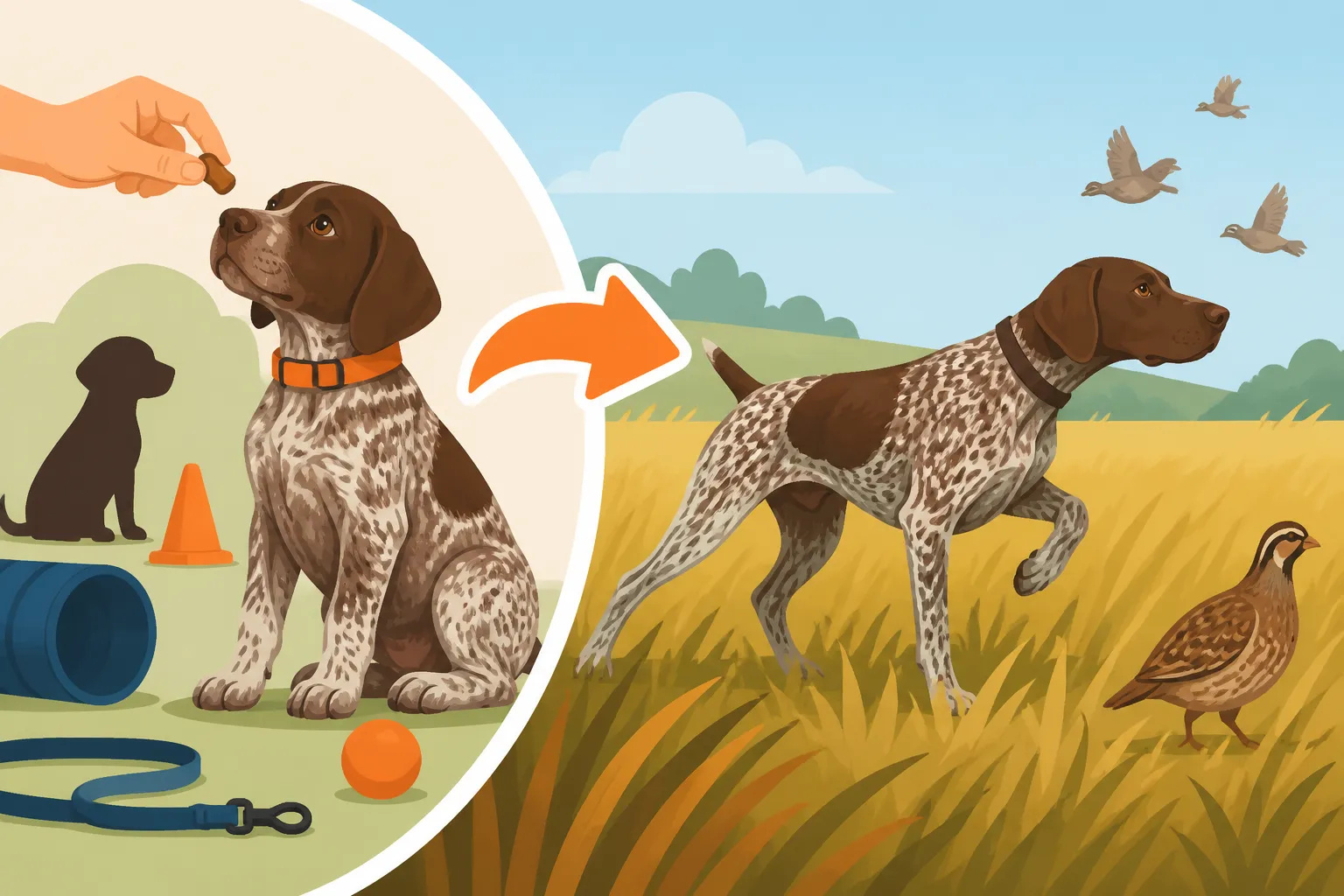
Think of puppy class as the primer coat before you apply the vibrant colors of specialized field training. It ensures that when you do introduce those more advanced concepts, your German Shorthaired Pointer is receptive, understands how to learn, and most importantly, trusts you implicitly as their guide. It's a crucial step that ensures your Shorthair doesn't just perform in the field, but truly partners with you.
What to Look for in a Quality Puppy Class for Your GSP
Not all puppy classes are created equal, and for a German Shorthaired Pointer destined for the field, you'll want to be particularly discerning. The goal isn't just to pass a test, but to develop a confident, well-mannered, and responsive dog ready for future challenges. Look for instructors who understand sporting breeds and their inherent drive, as they'll be better equipped to guide you and your GSP effectively.
The ideal class will emphasize positive reinforcement methods, focusing on rewarding desired behaviors rather than punishing mistakes. This builds a strong, willing partnership, which is essential for a dog that needs to think and react independently in complex field scenarios. Harsh methods can suppress a GSP's natural enthusiasm and create fear, which is the last thing you want in a hunting companion.
Also, consider the class size and environment. Smaller classes often mean more individualized attention from the instructor, which can be invaluable for navigating the unique quirks of a GSP puppy. A clean, safe training space, free from overwhelming distractions, allows your puppy to learn effectively before gradually introducing more challenging environments.
Curriculum Components Critical for a Sporting Breed
When evaluating puppy classes, scrutinize the curriculum. For a German Shorthaired Pointer, you'll want to see a strong emphasis on basic obedience commands like "sit," "stay," "come," and "down." But beyond that, look for modules that incorporate recall games, teaching your puppy to come reliably even with distractions. This is a life-saving skill for any dog, but especially for a GSP who might be tempted to follow a scent trail. Many classes use long lines to practice recall safely, ensuring your puppy learns the lesson without ever feeling truly lost or out of control.
Another critical component is proper leash manners. A GSP needs to learn to walk politely beside you, both on a leash and eventually off-leash. While you might not be hunting with a leash, the ability to control your dog easily in transit, around other people, or in sensitive areas is indispensable. This means working through common puppy behaviors like nipping and jumping, redirecting that energy into appropriate actions. You can find excellent durable leashes and training aids on sites like Chewy, making sure you have the right equipment for successful training.
Moreover, look for classes that introduce novel objects, surfaces, and sounds. Exposure to different textures underfoot, walking over grates, or being comfortable with objects dropping nearby helps desensitize your GSP to the unpredictable nature of the field. A dog that's seen it all in a controlled setting is far less likely to be spooked by unexpected noises or obstacles when out hunting.
Socialization Beyond Just Other Dogs
While dog-to-dog socialization is important, a truly comprehensive puppy class for a German Shorthaired Pointer will extend beyond that. It should involve positive interactions with various types of people: men, women, children, people wearing hats, people using crutches, etc. A hunting dog encounters many different individuals, and you want your GSP to be friendly and confident, not fearful or overly boisterous. Teaching A Sixty Pound Shorthair Around a Toddler is a crucial skill for family safety and public outings.
Equally important is exposure to different environments. Some classes might offer outdoor sessions or field trips to expose puppies to new smells, sounds, and ground textures. If your class doesn't, make a point to do this yourself, taking your puppy to pet-friendly stores, quiet parks, and different types of terrain. The broader their positive experiences, the more resilient and adaptable your GSP will be.
Finally, a good class will touch on handling and husbandry. This means getting your puppy comfortable with being touched all over, having their paws handled, and their ears examined. This not only makes vet visits and grooming easier but also allows you to thoroughly check your dog for Cut Pads on a German Shorthaired Pointer After a Long Day or other injuries after a hunt without resistance. This builds a positive association with examination that will be beneficial throughout their life.
How Puppy Classes Set the Stage for Advanced Training
Think of puppy class as teaching your German Shorthaired Pointer the alphabet and basic grammar. They learn to understand your language, respond to your cues, and navigate the world politely. Without this fundamental understanding, trying to teach them advanced field commands is like asking them to write a novel before they even know how to form a sentence. The concepts learned in puppy class are the building blocks for every single complex task you'll ask of them later.
For example, the "stay" command taught in puppy class becomes the foundation for "whoa," which is absolutely critical for a pointing dog. The "come" command, practiced diligently with distractions, forms the basis of a reliable recall when your GSP is ranging far out in a field. Even simply walking politely on a leash translates into better control when you're moving through dense cover or approaching a game bird.
These early successes also build confidence in your puppy and strengthen your bond. Your GSP learns that paying attention to you leads to good things, and you learn how your specific dog best responds to cues. This mutual understanding is the cornerstone of any successful working relationship, making subsequent, more specialized training much smoother and more enjoyable for both of you.
Establishing Reliability with Basic Commands
Reliability is the name of the game, especially when it comes to a German Shorthaired Pointer that will be working off-leash in varied environments. Puppy classes instill that crucial reliability by practicing commands repeatedly in different settings and with increasing distractions. It's one thing for your GSP to "sit" in your quiet living room, and quite another to "sit" while another puppy is tugging on a toy nearby. This progressive challenge builds solid, dependable responses.
Consider the "down" command. In a puppy class, your GSP learns to lie down and stay, even when excited. This command is more than just a trick; it's a calm down cue. In the field, a solid "down" can be used to control an over-eager dog, to keep them safe from hazards, or even to steady them while you reload. The consistent reinforcement in a class setting ensures that this command holds up under pressure.
Another vital element is developing a consistent verbal marker or clicker system. This clear communication tool, introduced in puppy class, helps your GSP understand exactly what action earned them a reward. This precision in communication becomes indispensable when you're teaching nuanced behaviors in the field, like retrieving to hand or backing another dog's point. You'll be able to precisely mark the desired behavior, ensuring your dog understands.
Understanding Your Puppy's Learning Style
Every German Shorthaired Pointer is an individual, even within the same litter. Puppy classes offer a fantastic opportunity to observe your specific dog's learning style. Do they respond better to food rewards, toys, or praise? Are they easily distracted, or do they have laser focus? Do they need more repetitions, or do they grasp concepts quickly? Understanding these nuances early on will make all your subsequent training efforts more efficient and tailored to your GSP.
An experienced instructor can also help you interpret your puppy's body language and offer insights into their personality. They might notice if your puppy is particularly sensitive, overly bold, or easily frustrated, and suggest strategies to work with those traits. This personalized guidance is invaluable, especially for first-time GSP owners who might not realize The Structure a German Shorthaired Pointer Needs Daily or how to manage their intense drive.
This early insight allows you to customize your training approach, preventing frustration for both you and your GSP. For example, if you discover your Shorthair puppy struggles with focus in high-distraction environments, you'll know to slowly introduce new field training elements, building up their tolerance and concentration gradually rather than overwhelming them. This personalized approach sets them up for success from the very beginning.
Comparing Puppy Classes to Dedicated Field Training
It’s crucial to understand that puppy classes are not a substitute for dedicated field training, but rather a vital prerequisite. Think of it like this: puppy class teaches a child to read and write; field training teaches them to write a compelling novel. One cannot happen effectively without the other. Puppy classes focus on general manners, socialization, and basic obedience in a controlled environment, preparing the dog for life in human society. Field training, on the other hand, hones specific instinctual behaviors for hunting in a natural, often unpredictable environment.
The tools and techniques often differ too. While puppy classes use leashes, treats, and positive reinforcement for foundational skills, field training introduces specialized equipment like e-collars (used responsibly and after proper conditioning), check cords, launchers, and live birds. The distractions in field training are also inherently different – the scent of game, the sound of a gun, the sight of a flushing bird – all of which require a solid foundation of obedience to manage.
Without the manners and responsiveness gained in puppy classes, your field training efforts might be constantly derailed by issues like jumping, pulling, ignoring commands, or general chaotic behavior. It's a progressive journey, with each stage building upon the last to create a truly well-rounded and effective hunting partner.
Distinct Goals and Environments
The primary goal of a puppy class is broad: to raise a well-adjusted, polite, and responsive family member who can navigate various public and home environments. The lessons are taught in a relatively low-stress, highly controlled setting, often indoors or in a fenced outdoor area, with minimal real-world "pressure." The focus is on forming positive associations with new experiences and building a vocabulary of basic cues.
Conversely, field training has a very specific goal: to develop a dog's natural hunting abilities, such as pointing, retrieving, and honoring, into reliable, polished skills under hunting conditions. The environment shifts dramatically to open fields, dense cover, water, and various types of terrain. The distractions are game-related, and the pressure is higher, requiring split-second decisions and unwavering focus from the dog. This is where The Rest a Shorthair Needs Between Eating and Running becomes crucial, as physical and mental stamina are paramount.
For instance, while a puppy class teaches a "stay," a field trainer will adapt that into a "whoa" command that holds the dog steady while a bird is flushed and shot, requiring immense control and steadiness that goes beyond a simple residential "stay." The environment, the stimuli, and the expectations are all elevated in field training.
Why You Can't Skip the Basics
Imagine trying to teach a concert pianist to play a complex concerto without them first learning scales, chords, and how to read music. It's not just difficult; it's impossible. Similarly, asking a German Shorthaired Pointer to "hunt dead" or "honor another dog's point" without a reliable "come," "stay," or "heel" is setting everyone up for failure. A dog that continually breaks point, chases game, or ignores directional commands becomes a liability, not an asset, in the field.
Skipping basic obedience also puts an immense amount of stress on the dog. They're thrown into situations where their natural instincts are at odds with human expectations, but they lack the foundational understanding to reconcile the two. This can lead to frustration, anxiety, and even behavioral issues. A puppy that has learned self-control and how to respond to commands in a variety of non-hunting scenarios is far better equipped to handle the intensity of field work.
Furthermore, a well-behaved dog is a joy to be around, both at home and on hunting trips. A GSP that is a constant handful because of a lack of basic training can quickly sour the experience for everyone involved. Investing in those initial puppy classes ensures you're building a respectful, communicative relationship that will endure for all the adventurous years to come, making it easier to manage their inherent drive for Ninety Minutes of Real Exercise for a Shorthair every day.
The Financial and Time Investment in Early Training
Let's be real, owning a German Shorthaired Pointer isn't just a joy; it's a financial and time commitment. And when you factor in a future in the field, those commitments only grow. However, viewing puppy classes as an investment rather than an expense can shift your perspective dramatically. The cost of a few weeks of puppy class pales in comparison to the potential expenses of behavioral modification for an untrained adult dog, not to mention the emotional toll.
Many GSP owners are surprised by The First Year Bills on a German Shorthaired Pointer, and training is a significant part of that. A well-trained dog is less likely to destroy your home, injure themselves due to lack of control, or incur expensive vet bills from accidents that could have been prevented with solid recall. Think about the peace of mind knowing your dog is less likely to bolt into traffic or tangle with something dangerous because they've learned to respond to your commands.
The time investment, while significant, is front-loaded. Putting in the hours during those crucial puppy months means you'll have a much easier, more enjoyable dog for the rest of their life. It’s about building a language and a bond that will serve you both for years, whether you're relaxing at home or chasing pheasants in the prairie.
Understanding Puppy Class Costs
The cost of puppy classes can vary widely depending on your location, the facility, and the length/intensity of the program. Typically, you might find group puppy classes ranging from a few hundred dollars for a 6-8 week session. Some facilities offer beginner packages that include basic obedience and socialization, while others might have drop-in options or more intensive programs. Online resources and virtual classes are also an option, sometimes at a lower price point, but they lack the in-person socialization aspect which is so vital for a GSP.
It’s worth checking if your pet insurance provider offers any wellness riders that might cover a portion of training costs. While standard policies often focus on accidents and illnesses, some might have provisions for preventive care, which can sometimes include training. Brands like Healthy Paws are known for their comprehensive coverage, but it's always best to review their specific plans and riders. This is an investment in your dog's future well-being, both physically and mentally.
Don't let cost be a deterrent. Often, local humane societies or rescue organizations offer more affordable training options, taught by certified professionals. Sometimes, a well-bred German Shorthaired Pointer puppy itself can be a significant investment, ranging from The Six Hundred to Fifteen Hundred Range on Shorthair Puppies up to much higher for field-titled lines. Protecting that investment through proper training from the outset makes sound financial sense.
The Long-Term Benefits for Your Hunting Partner
The time and money invested in puppy classes will pay dividends throughout your German Shorthaired Pointer's life, especially if you plan to hunt with them. A GSP that is steady, reliable, and responsive because of early training is safer in the field, more enjoyable to hunt with, and ultimately, more successful. You'll spend less time correcting bad habits and more time enjoying the hunt.
Moreover, early training builds your German Shorthaired Pointer's confidence and problem-solving skills. They learn how to learn, how to focus, and how to work with you. This mental dexterity is invaluable for a hunting dog that needs to navigate complex terrain, interpret scent, and make independent decisions while still being responsive to your guidance. A confident dog is a better partner.
Finally, proper training contributes to How Long a Working German Shorthaired Pointer Stays Sound. A dog that learns self-control and how to moderate their excitement is less prone to impulsive behaviors that can lead to injuries. A dog that listens and can be called off dangerous situations is a dog that will enjoy more seasons in the field with you, creating countless cherished memories. Products from brands like Ollie, focusing on fresh, high-quality nutrition, can also contribute to their overall health and longevity, ensuring they have the fuel for all that learning and working.
Integrating Puppy Class Lessons into Daily Life
The true value of puppy class isn't just what happens during the hour-long session once a week; it's how you integrate those lessons into your German Shorthaired Pointer's daily routine. Consistency is absolutely key with a GSP. They thrive on routine and clear expectations. If "sit" means one thing in class but nothing at home, your puppy will quickly become confused and disengaged.
Make training a fun, ongoing activity, not a chore. Short, frequent training sessions throughout the day, interspersed with play, are far more effective than one long, tedious session. Use everyday opportunities to reinforce commands: ask for a "sit" before putting down their food bowl, a "down" before letting them off the leash in a safe area, or a "stay" while you open the door.
Remember that a GSP's mind is always working. Puppy class gives you the tools to direct that incredible intelligence and energy constructively. The goal is to build a well-mannered companion who is always ready for whatever adventure comes next, whether it's a walk around the neighborhood or a full day of upland hunting.
Consistency at Home and Beyond
The concepts introduced in puppy class need to be reinforced rigorously in every environment your German Shorthaired Pointer experiences. This means involving every member of the household in the training process, ensuring everyone uses the same commands, hand signals, and expectations. A GSP puppy learns incredibly fast, but they also learn quickly how to "game the system" if rules aren't consistent.
Take the "come" command, for example. In class, your puppy learns to respond reliably. At home, practice it in the yard, then gradually introduce distractions like a squeaky toy or another family member. Then, once they're proficient, start practicing in more stimulating environments, always ensuring success before increasing the challenge. This methodical approach ensures the command becomes bulletproof. Consistent application of commands helps your GSP understand that expectations are universal, not just for a specific training class.
Furthermore, generalize the training. If your GSP learns "sit" in the kitchen, practice "sit" in the living room, in the yard, and at the park. Each new location is a new learning opportunity, strengthening the command's reliability. This is vital for a future field dog, as they'll need to respond accurately regardless of the distractions, scents, or sounds present in the hunting environment. This constant reinforcement prepares them for The Adolescent Shorthair That Stops Listening phase that many owners experience.
Continuing Education for You and Your Dog
Puppy class is just the beginning of a lifelong learning journey with your German Shorthaired Pointer. Once you've completed basic puppy classes, consider enrolling in a follow-up obedience course, perhaps a "Canine Good Citizen" class, or even an introductory "gun dog prep" course if available in your area. These advanced classes build on the foundation, introducing more complex concepts and refining existing skills.
For you, the handler, continuing education might involve reading books on positive reinforcement training, attending seminars, or joining a local German Shorthaired Pointer club. These resources can provide invaluable insights into the breed's specific needs, training methods, and common challenges. Understanding your breed deeply is a huge asset.
Remember, a German Shorthaired Pointer is a highly intelligent and driven dog who thrives on having a job to do. Even if they don't become a full-fledged hunting champion, engaging their minds through ongoing training, puzzle toys, and scent work will keep them happy, stimulated, and out of trouble. This commitment to continuous learning for both you and your dog will forge an unbreakable bond and create a truly exceptional companion for years to come.
Disclaimer
This article is for general informational purposes only and does not constitute professional advice. Laws, prices and regulations vary by location and change over time. Consult a qualified professional for guidance on your specific situation.