A German Shorthaired Pointer Around Backyard Chickens
Bringing a German Shorthaired Pointer into a home with backyard chickens can feel like an impossible tightrope walk. You dream of fresh eggs and a well-integrated family farm, but you're constantly battling the powerful instincts of a dog bred for generations to find, point, and retrieve birds. This guide is here to walk you through the realistic challenges and intensive strategies required to attempt peaceful coexistence between your energetic German Shorthaired Pointer and your feathered backyard residents, helping you understand what it truly takes to make this work, or when it might be best to keep them separate.
Understanding the German Shorthaired Pointer's Innate Drive for Birds
Let's be brutally honest: the German Shorthaired Pointer was specifically developed for bird hunting. It's not just a preference; it's deeply ingrained, a core part of their genetic makeup that has been carefully selected and intensified over centuries. This isn't a behavior they can simply "unlearn" or easily ignore. To expect a GSP to simply disregard a flock of clucking, flapping chickens is akin to asking a fish to walk. It goes against everything they are designed to do.
The Hunter's Sequence: Point, Flush, Retrieve
A German Shorthaired Pointer's mind is wired for a very specific hunting sequence: find the bird, point it, flush it, and then retrieve it once it's "down." Chickens, unfortunately, trigger almost every single one of these steps. The movement of a chicken, the sound it makes, the scent it leaves – these are all irresistible cues for a GSP.
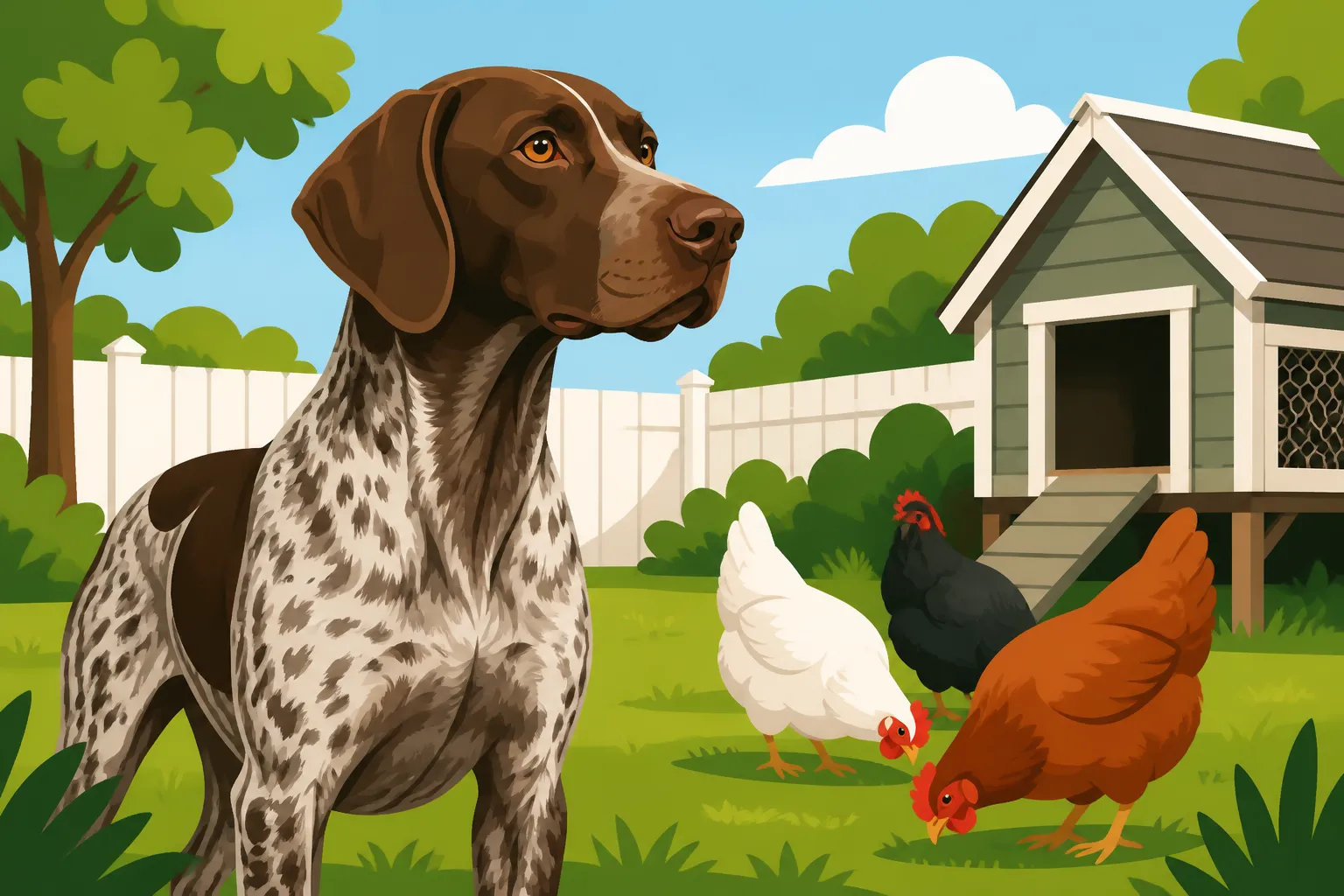
Imagine your GSP out in the yard. A chicken scratches, moves, perhaps flutters its wings slightly. For your GSP, this isn't just a bird; it's a target. They might go into a classic point, rigid and intense, tail stiff. Then, the chicken moves faster, perhaps tries to run, triggering the "flush" instinct. The dog gives chase, and if they catch it, the natural inclination is to "retrieve" – which, for a chicken, can be fatal. This sequence is automatic, fast, and driven by immense instinct. It's not malice; it's pure, unadulterated breed purpose. Trying to interrupt this instinctual chain requires constant, unwavering intervention and management from you.
High Prey Drive Versus Small Prey
German Shorthaired Pointers have a high prey drive, period. This means any small, fast-moving creature can capture their attention and ignite that chase instinct. Squirrels, rabbits, cats, and yes, chickens, are all seen as potential prey items. The difference with chickens is their sheer vulnerability and how perfectly they fit the "bird" profile that the GSP was bred for.
It’s crucial to understand that even the most well-behaved, obedience-trained GSP can have its instincts override its training in a high-excitement moment, especially when something as compelling as a bird is involved. A young, inexperienced GSP will find chickens almost impossible to resist, and even an older dog, if not meticulously trained and managed, can revert to instinct. The challenge isn't just teaching them "not to chase," but literally reprogramming centuries of selective breeding. This is why management and prevention often become more important than direct training when it comes to the safety of your flock.
Training and Management Strategies for Coexistence
Successfully integrating a German Shorthaired Pointer with backyard chickens is an advanced undertaking that demands an incredible amount of time, consistency, and realistic expectations. It’s not just about stopping the chase; it’s about creating an environment where the GSP understands that chickens are absolutely off-limits, always.
Early Introduction and Desensitization
If you're starting with a puppy, early, controlled introductions are paramount, but they must be done with extreme caution. The goal isn't immediate interaction, but slow, gradual desensitization under strict supervision. This means starting with visual exposure from a distance.
Bring your GSP puppy on a leash to an area where they can see the chickens, but are far enough away that they can't reach them, and the chickens aren't stressed. Keep these sessions very short and positive. Use high-value treats to reward calm behavior, eye contact with you, and any instance where the puppy ignores the chickens. As your puppy matures and develops better impulse control, you can slowly decrease the distance, always ensuring the chickens remain safe and the puppy is on a secure leash and harness. Never allow the puppy to chase, lunge, or even get too excited. Any escalation in excitement means you've moved too close, too fast. For detailed guidance on foundational puppy training, resources like BAXTER & Bella can be incredibly helpful with their online programs, offering structured steps for socialization and impulse control that are essential before even thinking about chicken introductions. You really need that solid obedience foundation first. The Month a Shorthair Puppy Stops Nipping can provide a good benchmark for when some of that early puppy energy starts to settle into a more trainable phase.
Establishing Clear Boundaries and No-Go Zones
One of the most effective strategies is to create physical barriers and "no-go zones" that your German Shorthaired Pointer simply cannot access when the chickens are out. This means robust fencing around your chicken coop and run. Don't underestimate a GSP's determination or athletic ability; they can jump surprising heights and dig with impressive speed. Your fence needs to be tall, and ideally, have an apron or be buried to prevent digging under.
Consider creating a secondary secure enclosure for your GSP within your yard when unsupervised, or ensuring your chickens have an entirely separate, fully predator-proof area. Your dog should understand that the chicken coop area is never a place for them to roam freely. Consistent enforcement of these boundaries is key. If your GSP so much as sniffs the fence line with too much interest, redirect them immediately. This isn't just about protecting the chickens; it's about setting your dog up for success by removing the temptation.
Reliable Recall and "Leave It" Command
These two commands are non-negotiable lifelines for a GSP living near chickens. Your "leave it" command needs to be absolute, instantaneous, and reliable, even in the face of a flapping chicken. This command should be practiced relentlessly in increasingly distracting environments, long before you ever try it near chickens. Start in a quiet room with low-value items, then move to higher-value items, then to distracting environments with other dogs or toys.
Your recall must also be flawless. If your GSP breaks its focus on the chickens, even for a split second, you need to be able to call them back immediately, every single time. This means constant practice, high-value rewards for coming when called, and never punishing your dog for coming to you, even if it took a moment. Loose Leash Walking a German Shorthaired Pointer is a good starting point for building a strong communication foundation, and the "come" command is just as vital.
Without a rock-solid recall and "leave it," allowing your GSP and chickens in the same open space is an irresponsible gamble.
The Importance of High-Level Management
Even with the best training, management often remains the primary tool for keeping chickens safe from a German Shorthaired Pointer. Their drive is so strong that complete trust may never be possible, especially if you're not always present to supervise.
Physical Barriers and Secure Enclosures
Let's talk about those barriers again, because they are that important. You need a chicken run that can withstand a determined GSP. We're talking sturdy wire, buried hardware cloth, and a roof to deter jumpers and keep aerial predators out. For your GSP, a secure kennel run or a truly escape-proof yard is essential. Many GSP owners find a robust dog kennel, purchased from places like Amazon or a specialty pet supply store, to be invaluable for times when they cannot provide direct supervision. It ensures the dog is safe, and so are the chickens.
Think about double fencing if your property allows it – a fence around the chicken area, and another fence around your main yard. This creates a buffer zone that adds an extra layer of security. This also helps with the issue of dogs getting bored and destructive; What an Under Exercised Shorthair Does to a House certainly extends to the yard as well, potentially leading to fence damage if they're trying to reach interesting things.
Leash and Long Line Management
Initially, and often indefinitely, your German Shorthaired Pointer should never be loose in the same area as the chickens without a leash or a long line. A long line allows you to practice recall and "leave it" commands with a safety net, giving you the ability to physically interrupt a chase if training fails. This requires your full attention and active participation during every single session.
Think of the long line as an extension of your arm. It's there to prevent mistakes, not just correct them after the fact. If your dog consistently ignores commands even on a long line, it's a sign that they are not ready for that level of proximity, and you need to go back to more basic desensitization from a greater distance.
Constant Supervision and Environmental Control
You simply cannot leave your German Shorthaired Pointer unsupervised with chickens. This isn't a "set it and forget it" situation. Even if your dog seems completely calm, a sudden movement or sound from a chicken can trigger an instinctual reaction. This means if you're out in the yard, your dog is with you, on a leash, or safely confined. When you go inside, your dog is either with you, crated, or in their own secure outdoor run. Crating a Shorthair That Has Energy to Burn is a skill that can truly save your sanity and your flock.
Consider rotating access to the yard. Perhaps the chickens get free-range time when your GSP is on a walk or inside. And your GSP gets yard time when the chickens are safely tucked away in their coop. This is about managing the environment to minimize risk, recognizing that these two species have fundamentally conflicting natural behaviors.
When to Reconsider the Chicken Dream
Sometimes, despite your best efforts, the risk is simply too high, or the stress on either your dog or your chickens is too great. Recognizing when to give up on the "peaceful coexistence" idea is a responsible and humane choice.
Assessing Your Dog's Individual Temperament
Every German Shorthaired Pointer is an individual, even with strong breed characteristics. Some might have a slightly lower prey drive than others, while some are utterly relentless. Honestly assess your dog's temperament:
- How strong is their prey drive in general? Do they obsess over squirrels, birds, or rabbits on walks?
- How quickly do they respond to "leave it" and recall in highly distracting environments?
- Do they show any signs of aggression or intense fixation towards the chickens, beyond just curiosity?
- Are they showing signs of stress or anxiety due to the constant temptation and your constant corrections?
If your GSP shows extreme, unshakeable fixation, a history of catching small animals, or significant difficulty with impulse control even after dedicated training, it might be an uphill battle that's not worth the risk. It's not fair to the chickens, and it can be incredibly frustrating and stressful for your dog to be constantly denied its most fundamental instincts.
Prioritizing Safety and Well-being
Ultimately, the safety and well-being of both your dog and your chickens must be your top priority. If there's ever a moment where you feel you can't guarantee the chickens' safety, or if your GSP is constantly stressed from being corrected around them, then you need to rethink the setup.
A chicken attack can be devastating, not just for the chickens but also for your dog if they ingest feathers or parts, or if you have to intervene forcefully. The emotional toll on you, the owner, is also immense. Sometimes, the most humane solution is to create entirely separate living spaces for your GSP and your flock, where they never have direct, unsupervised access to each other. This might mean reconfiguring your yard, building more secure enclosures, or even rehoming the chickens if the situation becomes unmanageable. It's a tough decision, but one that ensures everyone can live safely and without undue stress. The Two Hours a Day a German Shorthaired Pointer Needs reminds us that these dogs have significant needs, and if the chicken situation is preventing them from getting appropriate exercise and mental stimulation, that's another factor to weigh.
The Realistic Time Commitment Involved
Making this work requires a monumental time commitment. This isn't a weekend project; it's potentially years of consistent, vigilant training and management. You'll need to dedicate time daily to controlled exposures, reinforcement of commands, and ensuring all barriers are secure. This includes:
- Daily supervised training sessions: Short, focused times where your dog is exposed to chickens under strict control.
- Regular checks of enclosures: Fences need to be constantly inspected for weaknesses, holes, or damage.
- Constant vigilance: Every moment your dog is near the chickens requires your undivided attention.
If your lifestyle, work schedule, or other commitments prevent you from dedicating this level of consistent time and attention, then it's simply not fair to either your GSP or your chickens to put them in this situation. It's a long-term project that really demands your absolute dedication. The Structure a German Shorthaired Pointer Needs Daily highlights how important consistency is for these intelligent and active dogs in all aspects of their lives.
Long-Term Success and Safety
Even after years of diligent training and management, maintaining a safe environment for your German Shorthaired Pointer and backyard chickens requires ongoing effort and adaptation. This isn't a goal you reach and then stop working towards; it's a dynamic balance.
Continuous Reinforcement and Vigilance
Never assume your GSP is "cured" of its prey drive towards chickens. Instincts are incredibly powerful and can re-emerge, especially if training lapses or if a novel situation (like a chicken flying over a fence) occurs. You'll need to continue reinforcing "leave it" and recall, even if your dog seems to ignore the chickens. Periodically conducting supervised sessions where you test their obedience near the flock can help keep skills sharp. Always reward calm, indifferent behavior.
Keep an eye on any changes in your dog's behavior or the chickens' behavior. A new chicken, a different dynamic in the flock, or a change in your dog's energy levels could all potentially disrupt the delicate balance you've established.
Adapting as Your Dog Ages
Just like people, dogs change as they age. A young, boisterous GSP puppy might be a chaotic force, but a senior German Shorthaired Pointer might slow down significantly. However, even an older dog can have a moment where instinct takes over, especially if they are experiencing cognitive decline or pain that affects their impulse control.
An older GSP might be less inclined to chase, but still capable of a quick, decisive strike if a chicken gets too close or flusters them. Continue to assess their physical and mental state. If an older dog starts showing renewed interest or a decline in obedience, it's time to tighten up management again. What worked for a five-year-old dog might not work for a ten-year-old dog. The Age a German Shorthaired Pointer Is Called Senior and What a Ten Year Old German Shorthaired Pointer Can Still Do can offer insights into the typical progression of a GSP's lifespan and capabilities.
Learning from Setbacks and Adjusting
There will likely be setbacks. Maybe your GSP lunges at the fence once, or perhaps a chicken makes a dash too close to your dog. These are not necessarily failures, but learning opportunities. Analyze what happened: Was your supervision lacking? Was the barrier compromised? Did you push too far too fast?
Don't get discouraged. Use these moments to adjust your strategy. If a physical barrier failed, strengthen it. If your dog ignored a command, go back to basic training steps in a less distracting environment. The key is to be proactive and make adjustments before a serious incident occurs. Remember, managing a GSP with a high prey drive near vulnerable livestock is a marathon, not a sprint, and it requires constant flexibility and a willingness to adapt your approach to the ever-changing reality of living with both.
| Aspect | German Shorthaired Pointer Considerations | Chicken Safety Strategy | Owner Commitment Required |
|---|---|---|---|
| Innate Drive | High prey drive, bred for bird hunting (point, flush, retrieve) | Absolute physical barriers, constant vigilance | Extremely High |
| Training Focus | Impeccable "Leave It" and Recall, strong impulse control | Strict separation, never unsupervised contact | Extremely High |
| Enclosures | GSP: Secure yard/kennel; Chickens: Fortified, predator-proof coop/run | Tall, buried, roofed fencing; double barriers if possible | High |
| Supervision | Never unsupervised together, even for a moment | Direct observation during any proximity | Absolute |
| Potential Risks | Injury/death to chickens, stress to dog, owner frustration | Constant stress, potential loss of flock | High |
| Long-Term Outlook | Ongoing management and reinforcement, not a "one-and-done" task | Consistent protection and careful exposure | Lifelong |
Disclaimer
This article is for general informational purposes only and does not constitute professional advice. Laws, prices and regulations vary by location and change over time. Consult a qualified professional for guidance on your specific situation.