Conditioning a Shorthair to the E-Collar Properly
It’s a familiar scenario for many German Shorthaired Pointer owners: you're out in the field, your magnificent dog is doing what it loves, ranging far, but suddenly, it's locked on a scent and your voice simply disappears into the wind. Communication breaks down when it's needed most. This guide is all about responsibly and effectively conditioning your high-drive GSP to an e-collar, turning it into a reliable communication tool that enhances your bond and their safety, rather than causing fear.
Understanding the E-Collar and Your GSP's Unique Drive
Before you even consider placing an e-collar on your German Shorthaired Pointer, it’s vital to really wrap your head around what this tool is – and isn’t. There's a lot of misunderstanding out there, and for a breed as sensitive and intelligent as the GSP, getting it wrong can set back your training significantly.
Dispelling Common Misconceptions About E-Collars
Let's cut through the noise: an e-collar is not a "shock collar" in the way many people still perceive it. Modern e-collars, sometimes available on platforms like Amazon, are sophisticated training tools that deliver a very mild, adjustable stimulation, often referred to as a "tap" or "tens." Think of it less as a punishment and more like a gentle poke or a vibrating phone on your wrist – just enough to get your dog's attention, even at a distance, without causing pain. The goal is to interrupt, redirect, or reinforce, not to inflict discomfort.
Many people still hold onto the outdated image of harsh, high-level shocks. However, contemporary e-collars offer a wide spectrum of intensity, often with 100 or more levels, plus vibration and tone options. This allows you to find an almost imperceptible "working level" that simply reminds your GSP of your presence and command without startling them. We’re aiming for a subtle cue, not a jolt, to communicate.
Ultimately, the e-collar is an aid, not a crutch or a shortcut. It doesn't replace foundational obedience training, positive reinforcement, or your relationship with your dog. Instead, it serves as an extension of your voice and leash, providing clear, consistent communication when conventional methods are impossible, especially in an expansive field where your GSP is doing what it was bred to do.
Reading Your Shorthair's Individual Sensitivity
German Shorthaired Pointers are often described as "soft" dogs, meaning they can be quite sensitive to pressure and correction. What might be an appropriate level of stimulation for a more thick-headed breed could be entirely too much for your GSP. Their keen intelligence means they often pick up on cues quickly, but their sensitivity also means they can shut down or become anxious if handled too roughly.
Finding your GSP's "working level" is perhaps the most critical step. This is the lowest level of stimulation your dog perceives. To find it, you start at the absolute lowest setting on your e-collar and gradually increase it, one tiny increment at a time, while observing your dog closely in a calm, distraction-free environment. You’re looking for the slightest indication that they feel it: a twitch of an ear, a head turn, a flicker of an eye, or a shift in weight. You do not want a yelp, a flinch, or a dramatic reaction. If you see more than a subtle acknowledgment, you’ve gone too high. It's truly about finding that quiet "hey, I'm here" signal. Pay close attention to Reading a German Shorthaired Pointer's Stress Signals to ensure you're not overdoing it.
It's tempting to think that because your GSP has such immense drive and energy in the field, they must be "tough." While they are incredibly resilient and determined hunters, their emotional makeup is often finely tuned. If the e-collar is introduced incorrectly or used at too high a level, it can easily create fear or confusion, which can damage their confidence and dampen their natural enthusiasm for work. Always strive for a positive, clear, and reassuring approach, even when introducing new tools.
Laying the Groundwork: Foundational Obedience and Collar Acclimation
Before any e-collar is introduced, your GSP needs to understand basic commands unequivocally. The e-collar isn't a magic button that teaches commands; it's a remote cue that reinforces commands your dog already knows. Think of it as an invisible, silent leash that allows you to communicate over greater distances.
Ensuring Basic Obedience is Rock Solid First
I cannot stress this enough: your German Shorthaired Pointer must have a solid grasp of basic obedience commands like "sit," "stay," "here" (or "come"), and "heel" while on a traditional leash in a variety of environments. If your dog doesn't reliably respond to "come" when on a 15-foot long line, it certainly won't respond to a low-level e-collar stimulation from 50 yards away. The e-collar simply extends your existing communication, it doesn't create it.
A GSP's innate drive to hunt and range means they often "turn off" their ears when their nose is engaged. This is precisely why a reliable foundation is paramount. When you say "come" and apply a low-level stimulation, the dog needs to associate that feeling with the known command, not with a confusing new sensation. Working diligently on commands like "whoa" with a check cord or long line, for example, is essential groundwork. We have a great article on Building Whoa on a Shorthair With a Check Cord that can help solidify this crucial command before moving to remote tools.
Consider enrolling in a quality obedience program or utilizing structured online training resources. Programs like BAXTER & Bella offer comprehensive, step-by-step guidance that can help you build this essential foundation. Consistency in your voice commands, hand signals, and leash work before introducing the e-collar will make the transition much smoother and prevent your GSP from becoming confused or resistant.
Proper Collar Fit and Initial Acclimation
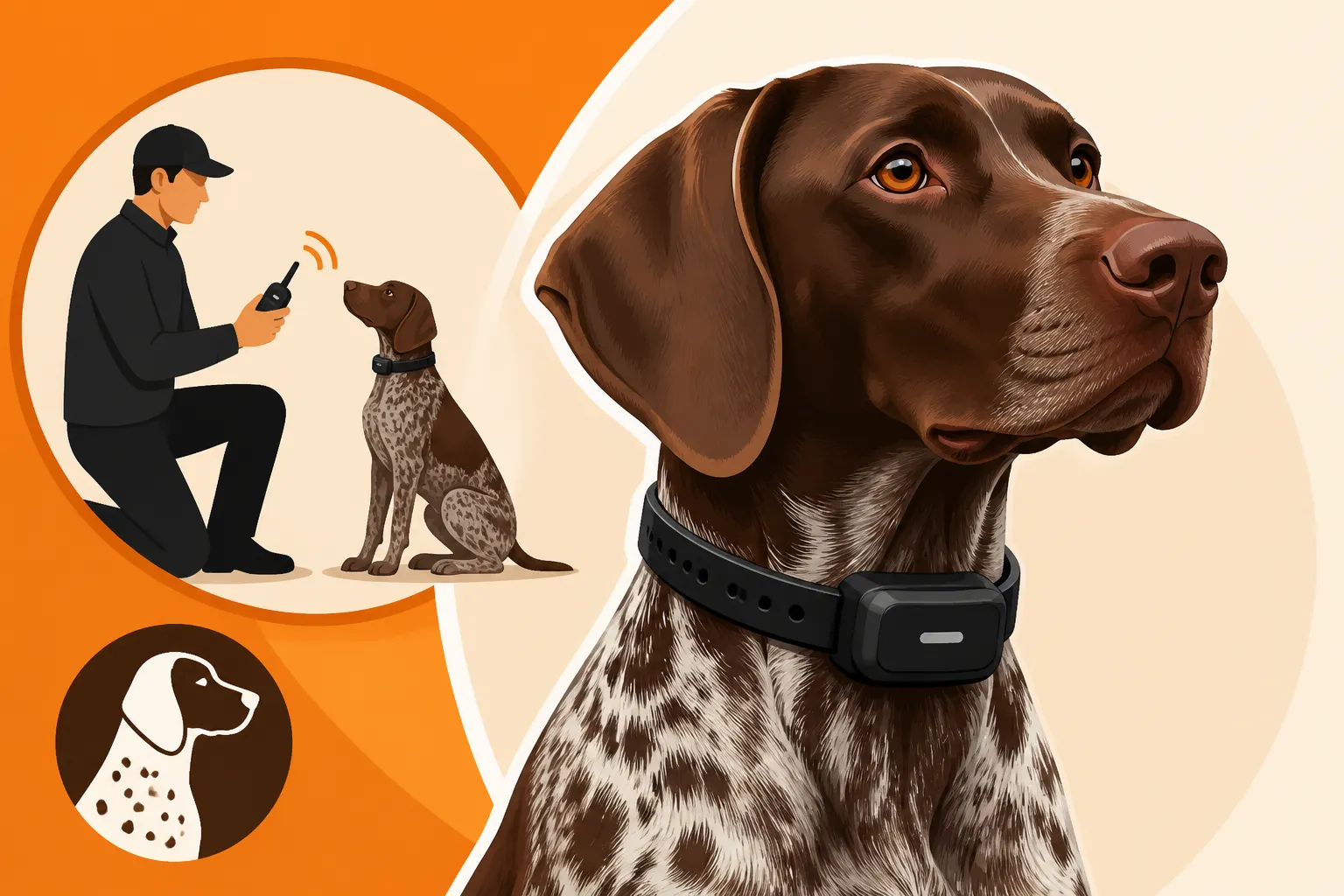
Once your GSP has a stellar foundation in obedience, and you've found their working level, the next step is getting them comfortable with the e-collar itself. Proper fit is non-negotiable. The collar should be placed high on your dog’s neck, just behind the ears, and it needs to be snug – snug enough so that the contact points make continuous contact with the skin, but not so tight that it's uncomfortable or restricts breathing. You should barely be able to get two fingers under the strap. A loose collar will provide inconsistent stimulation, which is confusing and unfair to your dog.
Before you ever turn on the remote, allow your German Shorthaired Pointer to wear the e-collar for short periods, without any stimulation. Treat it like any other piece of gear, like their regular collar or a new vest. Put it on them before mealtime, for a short walk, or during a play session. The goal is for them to associate the collar with positive experiences and to simply get used to the feel of it.
Gradually increase the time your GSP wears the collar over several days or even a week or two. You want them to be completely indifferent to it – no pawing at it, no trying to scratch it off. It should be just another part of their routine. Never put the collar on and immediately start training with stimulation. This creates an immediate negative association. Patience here pays off immensely in building a positive relationship with the tool.
The Conditioning Phase: Linking Commands to E-Collar Cues
This is where the real work begins – teaching your GSP what the e-collar's sensation means in the context of your commands. This phase requires immense patience, consistency, and a sharp eye for your dog's reactions.
Pairing Known Commands with Low-Level Stimulation
Start this phase in a quiet, distraction-free environment, like your living room or a fenced backyard. The process is simple: give a known verbal command (like "come" or "sit"), and immediately follow it with a brief, low-level stimulation at your GSP's working level. The timing here is absolutely critical. You want the dog to associate the sensation with the command, not as a separate, random event.
The moment your GSP responds to the command, even if it's a hesitant or partial response, immediately release the stimulation and offer enthusiastic praise and a reward. It's like saying, "Yes! That's it! Good job!" Repeat this sequence many, many times. The verbal command always comes first, then the e-collar sensation as a backup if they hesitate or ignore the verbal cue. The goal is for the e-collar to be an additional layer of communication that reinforces what they already know.
This isn't about forcing compliance; it's about building understanding. Your GSP learns that "come" (verbal) + sensation = performing the "come" behavior, which then earns praise and relief from the sensation. The dog makes the connection: "When I feel that, it means Mom/Dad is serious about that command, and if I do it, the feeling stops, and I get rewarded." Consistency is paramount, every single time you use the collar.
Gradually Introducing Distractions and Increasing Range
Once your GSP is reliably responding to paired commands in a low-distraction setting, it’s time to gradually introduce more environmental challenges. Start in a mildly distracting outdoor area, perhaps your backyard with some ambient noise, or a local park during a quiet time, always keeping your dog on a long line initially. You'll continue the same verbal command + stimulation sequence. If your GSP struggles, go back to a less distracting environment until they are successful, then slowly reintroduce the challenge.
Next, you’ll begin to increase the distance between you and your dog. German Shorthaired Pointers are bred to cover ground, and the e-collar really shines in extending your communication range when they're out exploring. Start with your GSP just a few feet away, then gradually extend the range in small increments. This is where you'll see the power of the e-collar for a wide-ranging GSP, helping you to Shortening a Shorthair That Ranges Too Far if needed, or keeping them within a safe distance.
Practicing recall with the e-collar at increasing distances and with growing distractions is one of the most important applications for a GSP owner. A solid Recall on a German Shorthaired Pointer That Is Locked On is not just convenient; it can be a lifesaver, keeping your dog safe from traffic, dangerous wildlife, or getting lost in thick cover. Always remember to make the experience positive when they return, even if you had to use stimulation to get their attention.
Moving Towards Advanced E-Collar Use and Field Application
With a strong foundation established, the e-collar can become an incredibly valuable tool for refining your GSP's field performance and ensuring safety in more dynamic environments.
Reinforcing Advanced Commands and Steadying
For hunting GSPs, the e-collar truly comes into its own for reinforcing advanced field commands. Once your dog understands the basic communication of the collar, you can use it to maintain steadiness around birds, a crucial skill for a finished gun dog. When your GSP is on point and a bird flushes, the collar can be used at a low level to reinforce "whoa" or "stay" from a distance, preventing them from breaking point or chasing the flush. This allows for a clean shot and teaches control. We discuss this in more detail in Steadying a Shorthair to Wing and Shot.
The consistency of the e-collar communication is what makes it so powerful for these nuanced behaviors. Your GSP learns that the expectation to hold steady is consistent, regardless of your physical proximity. This builds confidence in the dog because the rules are always clear. It’s not about correcting a mistake harshly, but about providing a clear, timely reminder of the desired behavior even when their natural instinct is to give chase.
Remember, even in advanced application, the e-collar is one part of a holistic training program. It works best when combined with verbal commands, hand signals, and plenty of positive reinforcement. Never expect the e-collar alone to teach complex behaviors. It's there to add precision and reliability to what your German Shorthaired Pointer already understands through your diligent training efforts.
Ethical Use and Knowing When to Seek Professional Guidance
Ethical e-collar use is paramount. Always remember that the goal is clear, silent communication, not punishment. If you find yourself consistently needing to use higher levels of stimulation, or if your GSP is showing signs of anxiety, fear, or shutting down (such as in A Shorthair That Shuts Down Under Pressure), it's a strong indicator that something in your training approach or the collar's application needs adjustment. Revisit the basics, lower the stimulation level, or re-evaluate the context of your training.
There is absolutely no shame in seeking help from a professional. A qualified dog trainer with experience in e-collar conditioning and German Shorthaired Pointers can provide invaluable guidance, assess your dog's individual temperament, and help you refine your technique. Sometimes, an experienced eye can spot subtle issues or suggest alternative approaches that you might not consider on your own. Looking up reviews for trainers or specialized e-collar training aids can be done on sites like Amazon, but always prioritize trainers with specific GSP and e-collar experience. Information on Pro Trainer Rates by the Month for a Shorthair can help you budget for this essential investment.
Finally, regular checks of your e-collar's fit, battery life, and contact points are part of responsible ownership. Treat it as a critical piece of gear, just like you would a GPS Collar Subscription Fees for a Shorthair Owner or a first-aid kit for the field. Proper care ensures its reliability and your GSP's comfort and safety. The e-collar, when conditioned properly, should be a tool that strengthens your bond and allows your German Shorthaired Pointer to safely and joyfully express their incredible potential in the field and at home.
E-Collar Conditioning Phases for Your German Shorthaired Pointer
To help summarize the conditioning process, here's a table outlining the key phases:
| Phase | Goal | Key Actions | Duration |
|---|---|---|---|
| Acclimation | Neutrality to the collar | Wear collar without stimulation, positive associations | 1-2 weeks |
| Foundation | Link known commands to low-level stim | Verbal command + low stim; release on response, praise | 2-4 weeks |
| Generalization | Apply in varied, mildly distracting settings | Introduce short leash, then long line, new environments | 3-6 weeks |
| Proofing & Range | Reliable response in high-distraction, distance | Increase distractions, distance; reinforce recall, whoa | Ongoing |
Disclaimer
This article is for general informational purposes only and does not constitute professional advice. Laws, prices and regulations vary by location and change over time. Consult a qualified professional for guidance on your specific situation.