Shortening a Shorthair That Ranges Too Far
It's incredibly frustrating, isn't it? You've got a German Shorthaired Pointer, a dog bred for boundless energy and a desire to cover ground, and suddenly that incredible drive becomes a challenge when they range too far. Whether you're trying to keep them safely within sight on a hike, or attempting to pattern them in the field without losing them over the next ridge, controlling a GSP's natural inclination to explore can feel like an uphill battle. This guide will walk you through practical strategies, training techniques, and helpful tools to bring that impressive range back into a manageable and enjoyable distance for both of you.
Understanding the German Shorthaired Pointer's Natural Drive
Let's be real: German Shorthaired Pointers weren't bred to stroll politely on a leash beside you for miles. They were purpose-built to be supreme hunting companions, designed with an engine that just doesn't quit and a nose that pulls them forward. Understanding this inherent nature is the first step in learning how to work with it, rather than constantly fighting against it.
The Instinct to Cover Ground
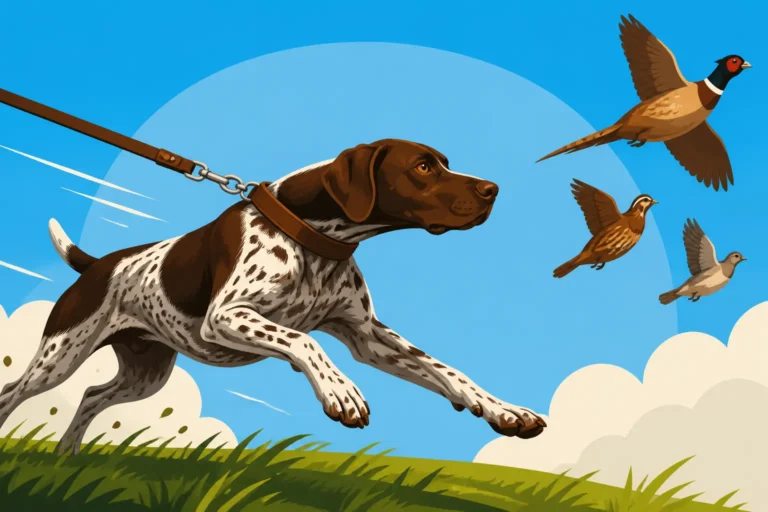
The very essence of a German Shorthaired Pointer's purpose lies in its ability to range widely and efficiently. They are a versatile hunting breed, meaning they're expected to point upland birds, retrieve downed game, and even track. To do this effectively, they need to cover a lot of ground in search of scent. This isn't disobedience; it's instinct. Picture a vast open field, teeming with pheasants or quail. A GSP's brain is wired to systematically sweep that area, covering ground in an almost hypnotic rhythm, always searching for that tell-tale whiff of game. This genetic programming is incredibly powerful, and it means your Shorthair naturally wants to be out there, exploring and hunting, often much further than you might prefer for safety or control. This drive is what makes them magnificent, but also what demands diligent training.
Why Range Can Become Excessive
Sometimes, however, that impressive range veers into the territory of "excessive." This often happens when the dog's natural drive isn't properly channeled or when foundational training hasn't been solidified. An under-exercised GSP, for instance, has a reservoir of pent-up energy that will manifest as an overwhelming desire to run, run, run. If they aren't getting The Two Hours a Day a German Shorthaired Pointer Needs, that extra energy often translates into pushing boundaries and extending their range whenever given the chance. Beyond sheer energy, a lack of clear communication, inconsistent expectations, or insufficient early training can all contribute to a GSP deciding that their hunting agenda takes precedence over your commands. They might test boundaries, especially as adolescents, and if those boundaries aren't firm and consistent, their range will expand.
Assessing Your Dog's Individual Temperament
Just like people, every German Shorthaired Pointer has its own unique personality, even within the breed's general characteristics. Some Shorthairs are naturally closer working, always checking in and staying within a reasonable radius, while others are born with an insatiable desire to push further and further out. Observing your dog's natural tendencies is crucial. Does your Shorthair naturally keep an eye on you while exploring, or do they disappear into cover, only to reappear minutes later from an unexpected direction? Do they seem to get "locked on" scent and become deaf to the world, or can they break away fairly easily? Understanding these individual traits will help you tailor your training approach. A truly bold, independent ranger will require more intensive, consistent, and perhaps different training methods than a slightly more biddable, naturally closer-working dog. This isn't about blaming your dog; it's about understanding their wiring to help them succeed.
Building a Foundation of Control: Beyond the Backyard
You can't expect a German Shorthaired Pointer to magically stay close in the excitement of a new field if they haven't learned basic control in less stimulating environments. Think of it like building a house: you need a rock-solid foundation before you start adding the fancy features. For a GSP, that means mastering the essentials, not just in your living room, but out in the real world.
Mastering the Reliable Recall
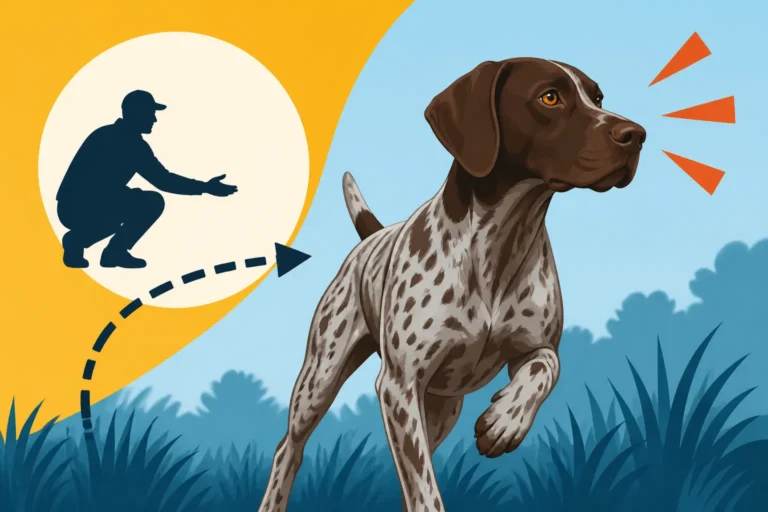
If your Shorthair ranges too far, the single most critical command you need to perfect is the recall. Without a bulletproof "Come!" or "Here!" command, you're essentially handing your dog a blank check to explore as far as their nose takes them. This isn't just about calling them back when you're ready to leave; it's about recalling them mid-stride when they're hot on a scent, or preventing them from crossing a dangerous road. Start small, in a low-distraction environment like your fenced yard. Make coming to you the most rewarding thing ever – a party with high-value treats and enthusiastic praise. Gradually introduce distractions. Practice in different locations, with varying levels of noise and interesting smells. Don't just call them when it's time to go home; call them, reward them lavishly, and then immediately release them to continue playing. This teaches them that coming to you doesn't always mean the fun ends, which is key for a truly reliable recall. If you struggle, consider structured online courses like those offered by BAXTER & Bella, which emphasize positive reinforcement and build skills systematically from puppyhood. They often break down complex behaviors like recall into manageable steps, helping you become a more effective trainer. Recall on a German Shorthaired Pointer That Is Locked On is a critical skill for their safety and your peace of mind.
Introducing and Proofing the "Whoa" or "Stop"
Beyond coming back, a strong "whoa" or "stop" command is incredibly valuable for managing a GSP's range. This command means "stop exactly where you are and stand still, no matter what." It's not just for pointing birds; it's a vital safety command that can halt your dog before they run into traffic, approach an unknown animal, or disappear over a hill. Like recall, start in a quiet area. Use a long lead or check cord initially. When your dog is moving, say "Whoa!" and gently stop their forward motion with the lead. As they stop, praise and reward. The goal is for them to freeze in place, even if they're excited. Gradually increase the duration they hold the "whoa" and introduce distractions. Practice with them facing away from you, facing towards tempting objects, and eventually, with birds or other game-like stimuli present. This takes patience and repetition, but the ability to stop your dog in their tracks, even at a distance, gives you immense control over their range. Building Whoa on a Shorthair With a Check Cord will be a game-changer for many Shorthair owners.
The Importance of Consistent Practice in Varied Environments
It's one thing for your GSP to have perfect recall in your living room; it's quite another for them to respond when a rabbit bolts across their path in a new field. This is where "proofing" comes in. You need to practice these foundational commands in every conceivable environment, under every kind of distraction. Start in quiet parks, then move to busier trails, then to fields where you know there might be wildlife. The key is to set your dog up for success. Don't plunge them into the most distracting environment possible and expect perfection. Gradually increase the difficulty, always ensuring you can enforce the command if needed (which is where a long check cord becomes indispensable). Consistency is paramount. Every time you give a command, you must be prepared to follow through. If you let them ignore "Come!" once, they learn that it's optional. Regular, short training sessions in diverse locations will build the muscle memory and understanding that these commands are non-negotiable, regardless of how exciting the environment might be.
Essential Tools for Managing Range in the Field
While training is the cornerstone, sometimes you need a little help from modern ingenuity to keep that high-octane German Shorthaired Pointer within a reasonable radius. These tools aren't substitutes for training, but rather extensions of your control and safety measures.
Leveraging the Check Cord Effectively
The check cord is perhaps the most undervalued tool for managing a ranging GSP. It's essentially a very long leash, usually 20 to 50 feet, that allows your dog freedom to explore while you maintain a physical connection. This is invaluable for teaching recall and whoa in distracting environments. Instead of letting your dog blow past you, you can gently but firmly step on the cord or give a quick pop to reinforce the command. It provides a crucial safety net while your dog is learning that you mean business, even when they're some distance away.
| Tool | Primary Purpose | Best Use Case | Considerations |
|---|---|---|---|
| Check Cord | Physical control, proofing commands | Early training, high-distraction environments | Can snag on brush, requires active handler attention |
| E-Collar | Remote communication, enforcement | Advanced recall, range limits, breaking bad habits | Requires proper conditioning, can be misused, Whether an E-Collar Damages a Soft Shorthair if not used correctly |
| GPS Tracker | Location monitoring, recovery | Large, open areas; dense cover; safety | Not a training tool, battery life, subscription fees (often) |
When using a check cord, let your dog drag it initially in a safe area. Only pick it up when you need to reinforce a command. If they ignore your "Come!" command, reel them in with the cord, making sure to praise and reward when they reach you, even if you had to physically guide them. This teaches them the consequence of not listening, without resorting to punishment. You can find excellent quality check cords on Amazon, often in bright colors for visibility. Remember, the check cord is a teaching tool, not a permanent solution for range control. Its purpose is to bridge the gap until your verbal commands are reliable.
The Strategic Use of E-Collars
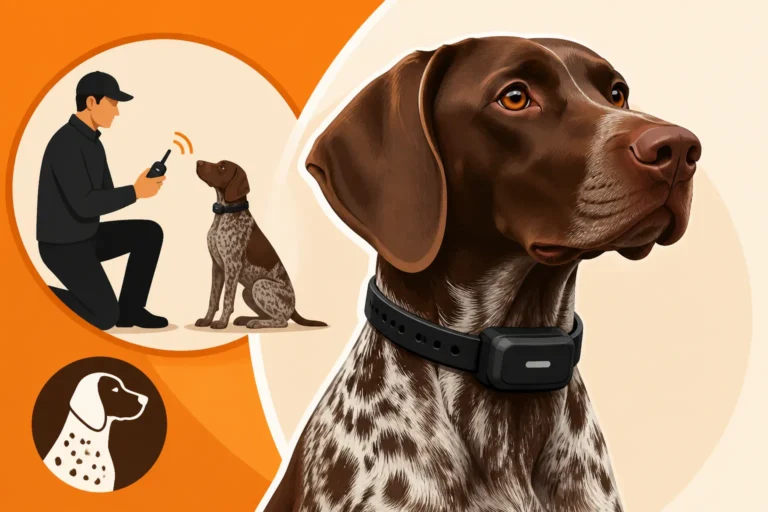
E-collars, or electronic collars, are a more advanced tool that can be incredibly effective for managing a GSP's range, especially in a hunting context where distances are greater and distractions are intense. However, they are not a quick fix and require careful, ethical, and knowledgeable use. The goal of an e-collar is not punishment, but rather to provide a clear, consistent, and instant form of communication at a distance. It's an extension of your voice and leash, not a replacement for training.
Before even thinking about using an e-collar for range control, your dog must understand the commands (recall, whoa, turn) without it. The e-collar is then introduced as a reinforcement tool, starting with very low stimulation levels that mimic a tap or vibration. Your dog learns that the sensation precedes the known command, and by complying, they can avoid the sensation. This method is called "conditioning." Once conditioned, the e-collar can be used to remind a GSP to check in, to reinforce a turn command, or to interrupt an undesirable behavior like extending their range too far. When an E-Collar Belongs on a German Shorthaired Pointer is a serious consideration, as improper use can cause more harm than good. Always seek guidance from a professional trainer experienced in e-collar conditioning for hunting dogs to ensure humane and effective use.
GPS Tracking Devices for Peace of Mind
Let's face it: even the best-trained German Shorthaired Pointer can get caught up in the moment, or disappear into dense cover in pursuit of a bird. The worry of losing your dog in the vastness of the field or woods is a heavy one. This is where GPS tracking devices come in. While they aren't a training tool to control range, they are an invaluable safety tool to monitor it and find your dog if they do go out of sight.
Modern GPS trackers are lightweight, attach easily to your dog's collar, and typically link to an app on your smartphone or a handheld device. They can show you your dog's real-time location, often with accuracy down to a few feet. Some even offer geofencing features, alerting you if your dog crosses a pre-set boundary. For a German Shorthaired Pointer owner, especially one who hunts in large, unfamiliar territories, a GPS tracker offers immense peace of mind. You can let your dog work a little wider, confident that you can locate them if they get carried away or find themselves disoriented. Brands like Garmin and Fi offer popular and reliable options that you can find readily on Amazon or specialty pet retailers. They are an investment in your dog's safety and your own emotional well-being.
Advanced Training Techniques for Refined Range
Once your German Shorthaired Pointer has a solid grasp of basic commands and you're comfortable with your control tools, you can move on to more sophisticated techniques designed to specifically shape their hunting range and pattern. This is where you really start to hone them into a finely tuned field partner.
Teaching Directional Whistle Commands
In the chaos of a busy field, your verbal commands can easily get lost in the wind or the excitement. This is where whistle commands become invaluable. A whistle carries further, cuts through noise, and offers a distinct signal that isn't confused with human chatter. For range control, teaching directional whistle commands is particularly powerful. A single blast for "whoa" or "stop," a series of short blasts for "come," and specific patterns for "go left" or "go right" can guide your dog from a distance.
Start introducing whistle commands by pairing them with your verbal commands and hand signals at close range. For example, give your hand signal for "go right," say "Right!" and then blow the "right" whistle command. When your dog responds, reward generously. Gradually phase out the verbal command and rely solely on the whistle and hand signal. Practice in increasing distances and varied terrain. Many hunting dog enthusiasts create their own unique whistle patterns, ensuring clarity and consistency. The key is that your dog learns to associate specific whistle sounds with specific actions, allowing you to effectively Turning a German Shorthaired Pointer With One Blast and guide them through cover, keeping their range appropriate for the terrain and your hunting strategy.
Developing a Consistent Quartering Pattern
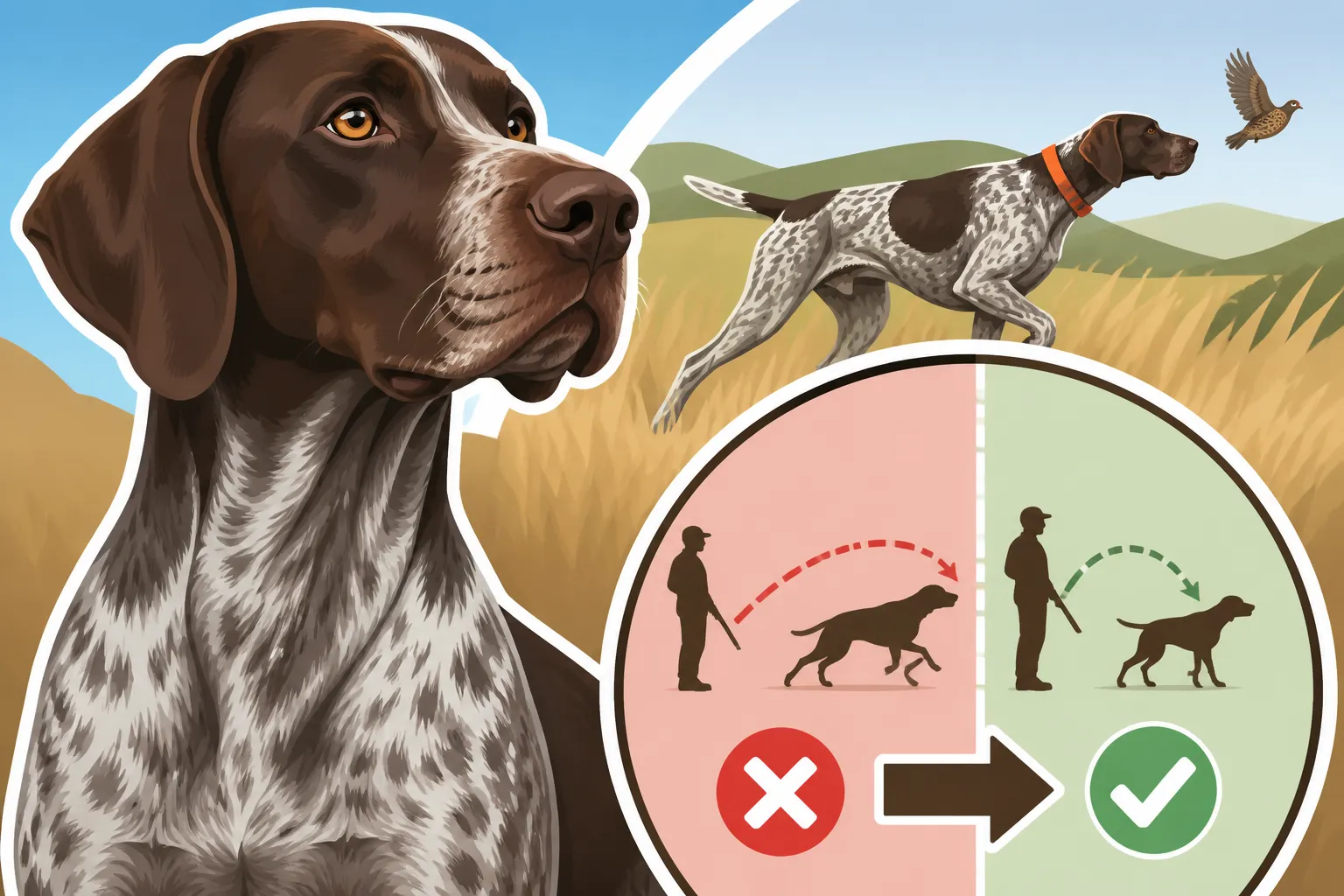
A German Shorthaired Pointer that ranges too far often does so because they haven't learned to work a systematic pattern. Instead, they might zig-zag wildly or make long, sweeping runs that miss chunks of cover. Teaching a consistent quartering pattern helps your dog work efficiently, maximizing their chances of finding birds while staying within your desired range. Quartering involves the dog working back and forth in front of you, perpendicular to your line of travel, effectively sweeping the area.
To teach this, start with your dog on a check cord in an open field. Walk in a straight line, and every time your dog starts to go too far to one side, use your directional whistle or hand signal (and a gentle tug on the cord if needed) to turn them back across your path. As they turn and head the other way, praise and encourage them. Repeat this pattern, always maintaining a straight line for yourself. The dog learns that their job is to go out to a certain distance, turn, sweep back, and then turn again. Over time, they'll develop a rhythm, checking in with you visually or by listening for your whistle signals. This method allows your dog to use their natural hunting instincts within a structured framework, making them a much more effective and manageable hunting partner. Keeping a Shorthair in Front on Big Country becomes much easier when they understand the concept of a systematic search.
Working with Cover and Terrain
The type of cover and terrain significantly impacts a German Shorthaired Pointer's natural range. In dense woods or heavy brush, a GSP's range will naturally shorten because visibility is limited and scent is often concentrated. In open fields, however, their range will naturally expand. It's vital to teach your dog to adapt their range to these different environments. You don't want them busting through heavy cover 100 yards out, nor do you want them clinging to your heels in a wide-open stubble field.
Practice in varied environments. In thick cover, encourage closer work with more frequent check-ins, perhaps by occasionally tossing a retrieve a shorter distance. Use your voice and whistle to keep them tighter. In open areas, you can allow them to stretch out a bit more, but still enforce your chosen range boundaries with your recall, whoa, and directional commands. The goal is for your dog to learn to read the cover themselves and adjust their search pattern accordingly, always remaining responsive to your guidance. This adaptability is what makes a truly versatile German Shorthaired Pointer. They learn that different scenarios demand different levels of independence and range.
Troubleshooting Common Range-Related Challenges
Even with solid training, German Shorthaired Pointers can present unique challenges when it comes to range control. Their intelligence, drive, and independent spirit mean you'll sometimes hit a snag. But don't despair; many of these issues are common and have solutions.
When Excitement Overrides Training
You've done all the work, your GSP knows their commands, but then a fresh scent hits, and suddenly, they're deaf. The excitement of the hunt, or even just a strong, novel smell, can sometimes override even the best-ingrained training. This is often less about disobedience and more about an instinctual "tunnel vision" that kicks in. Your dog isn't being malicious; they're just doing what they were bred to do, with an intensity that can be hard to break.
To address this, you need to proof your training under excitement. This means practicing with increasingly high-value distractions. Start with a distant bird launcher or a hidden dummy, and gradually move closer, always demanding a response to your commands before they get the reward of the retrieve or the flush. Use a long check cord or an e-collar (if properly conditioned) to gently enforce the command when they start to ignore you. The key is to teach your dog that listening to you is the fastest way to get to the "good stuff," like finding the bird. Make yourself part of the hunting equation, not a distraction from it. This is where patience and persistence truly pay off.
Addressing Persistent "Self-Hunting" Behaviors
A "self-hunting" German Shorthaired Pointer is a dog that decides they know best. They run their own pattern, ignore your calls and whistles, and essentially hunt for themselves, with you merely being a passenger. This can be incredibly frustrating and dangerous, as it puts your dog at risk and undermines your partnership. This behavior often stems from either a lack of foundational control, or the dog learning that they can get away with it.
To tackle self-hunting, you must re-establish yourself as the leader and the source of the hunt. Go back to basics, reinforcing recall and whoa in a very controlled environment. Use a long check cord constantly in the field. Every time your dog starts to self-hunt, immediately stop them with the cord and redirect them to your desired pattern. If they continue to ignore you, you might need to end the hunt. If the fun stops every time they self-hunt, they will quickly learn that cooperation is the only way to keep playing. This might mean short, frustrating sessions initially, but consistency is vital. A German Shorthaired Pointer That Self Hunts needs clear boundaries and consistent consequences. Remember, you are the conductor of the orchestra, not merely a spectator.
Navigating Distractions and Temptations
German Shorthaired Pointers are driven by their incredible noses and prey drive. Rabbits, deer, squirrels, even interesting smells in the grass – all are massive temptations that can pull a dog off course and extend their range far beyond what's acceptable. It's not enough to train in a sterile environment; you need to train through these distractions.
This means gradually exposing your dog to controlled distractions. For instance, practice recall in a park where you know there are squirrels, but keep your dog on a long line. When a squirrel appears, give your recall command and be ready to reinforce it. Reward heavily for success. You can also work on a "leave it" command, teaching your dog to ignore tempting stimuli. This takes time, but it's crucial for real-world reliability. It's about teaching your dog to make the right choice despite the temptation, because listening to you is more rewarding. Gradually increase the intensity and proximity of the distractions. This will help your Shorthair develop the mental discipline to stay on task and within your desired range, even when their instincts are screaming otherwise.
Maintaining and Adapting Range Control Over Time
Training a German Shorthaired Pointer is rarely a "one and done" deal. Their high intelligence and drive mean that range control is something you'll constantly reinforce and adapt throughout their life. It's an ongoing conversation, not a finished project.
Regular Reinforcement and Proofing
Think of range control training as a muscle: if you don't use it, it atrophies. Even the most well-trained German Shorthaired Pointer benefits from regular reinforcement sessions. This doesn't mean formal, hour-long training every day, but rather incorporating short, sharp command sessions into your regular walks and hunts. Call them back for no reason, reward, and release. Give a "whoa" command mid-play. Practice directional whistles when they're working cover.
Continue to "proof" your training in new and different environments. Every new field, every different type of cover, every new group of birds presents a fresh challenge that tests your dog's understanding and your control. Consistent, varied practice ensures that your dog's responses remain crisp and reliable, even as distractions change and their excitement levels fluctuate. Don't assume that because they knew it last year, they'll know it just as well this year without practice. Always keep those skills sharp.
Adjusting for Age and Experience Levels
A German Shorthaired Pointer puppy's range is naturally shorter than a mature, experienced hunting dog. You wouldn't expect a youngster to work a quarter-mile pattern. As your GSP matures, gains experience, and builds confidence, their physical capabilities and mental focus will increase, and with it, their potential range. You might choose to allow a more experienced dog to work a bit wider in certain situations, especially in expansive, open terrain where game might be spread out.
Conversely, as your Shorthair enters their senior years, their energy levels will naturally decline. You might find their range shortens on its own, or you might need to actively encourage them to work closer to conserve their energy. Pay attention to your dog's physical condition and mental state. An older dog with joint issues, for example, might struggle with the strenuous quartering they once did effortlessly. Adjust your expectations and training accordingly, always prioritizing your dog's well-being and continued enjoyment of the hunt.
Integrating Range Work into Every Hunt
The most effective way to manage a German Shorthaired Pointer's range is to make it an intrinsic part of every single hunt, or even every intense outdoor activity. It shouldn't be a separate training exercise; it should be integrated into the flow of working with your dog. Every time you step into the field, whether for training or a real hunt, you are actively teaching and reinforcing range control.
This means being mindful of your commands, your whistle signals, and your dog's response from the moment you release them. Are they checking in? Are they holding their whoa? Are they turning on command? Continuously guide and correct as needed. Don't let small infractions slide, as they can quickly snowball into larger range issues. The goal is to build a seamless partnership where you and your GSP are working as a cohesive unit, covering ground efficiently, finding game, and always maintaining that critical line of communication and control. A German Shorthaired Pointer that understands and respects its working range is not only safer but also a far more effective and enjoyable hunting companion. The Structure a German Shorthaired Pointer Needs Daily extends into their field work and is key to a happy, well-adjusted gun dog.
Disclaimer
This article is for general informational purposes only and does not constitute professional advice. Laws, prices and regulations vary by location and change over time. Consult a qualified professional for guidance on your specific situation.