Teaching a Shorthair to Quarter in Front of You
It's incredibly frustrating when you're out in the field, ready to enjoy a day of hunting with your German Shorthaired Pointer, and they're either right underfoot or so far out you can barely see them. That systematic, back-and-forth pattern known as quartering, where your dog efficiently covers the ground in front of you, is the hallmark of an effective bird dog. This guide is here to help you understand and teach your enthusiastic GSP how to quarter like a pro, transforming them into a true partner in the field.
Understanding the Natural Quartering Instinct in Your German Shorthaired Pointer
Before we dive into the nuts and bolts of teaching, it's crucial to acknowledge what makes German Shorthaired Pointers so special. These dogs were bred for versatility, designed to be all-around hunting companions. This means they come pre-wired with certain instincts that we, as trainers, need to recognize and channel, rather than try to suppress. Quartering, at its heart, is about maximizing efficiency in scent detection, a skill deeply embedded in their DNA.
The GSP's Innate Drive to Search
German Shorthaired Pointers possess an incredible prey drive and an insatiable desire to find birds. This drive is a double-edged sword: it’s what makes them such powerful hunters, but if left unguided, it can lead to erratic, inefficient searching. They inherently want to cover ground, casting back and forth to pick up scent. Think of it like a natural sweeping motion. In a GSP, this isn't just a casual walk; it's a focused, energetic exploration of every possible hiding spot for game. They don't want to miss anything, and that intense focus is something we build upon. The challenge often lies in getting them to cover the ground in front of you and within a reasonable range, rather than letting them follow their nose wherever it might lead, which could be far out of gun range or into dangerous territory.
Reading Your Dog's Natural Pattern
Every German Shorthaired Pointer has a unique "search pattern" even before formal training begins. Some might naturally run wider, while others prefer to stick closer. Some might favor a particular direction or seem to follow scent trails haphazardly. Taking the time to observe your dog in an open field, without any pressure, can tell you a lot. What does their unguided search look like? Do they run in big, looping arcs, or are they more choppy and close-quarters? Do they check back with you frequently, or do they become completely absorbed in their mission?
Understanding this baseline behavior is vital. You're not trying to erase their natural tendencies but rather to refine them. If your dog naturally runs wide, you’ll focus more on bringing them in. If they're too close, you’ll encourage them to push out. Think of yourself as a sculptor, gently shaping their raw talent. This observation phase is also a great opportunity to reinforce basic recall in a low-pressure environment, calling them back periodically and rewarding them, building a positive association with returning to you, even when there's an exciting scent involved. This helps cement the idea that you are the center of their universe, even when birds are on their mind.
Starting Foundation: Basic Obedience and Directional Cues
Before you can ask your German Shorthaired Pointer to execute a precise quartering pattern, they absolutely must have a rock-solid foundation in basic obedience. This isn't just about good manners; it's about establishing a clear communication system between you and your dog, which is paramount in the field where distractions are abundant and stakes can be high. Without these fundamentals, attempting to teach complex patterns will only lead to frustration for both of you.
Mastering "Here" and "Whoa"
Two commands stand head and shoulders above the rest for field work: "Here" (or recall) and "Whoa." "Here" means drop everything and come directly back to me, regardless of what exciting smells or sights are around. For a GSP with a powerful prey drive, this isn't always easy, and it requires consistent, positive reinforcement in all sorts of environments. Start in a low-distraction area and gradually increase the complexity, always making "Here" the most rewarding thing your dog can do. Practicing with a long line, perhaps 30-50 feet long, is invaluable here. If your dog doesn't respond, you can gently but firmly guide them back with the line, ensuring that you control the outcome. The Structure a German Shorthaired Pointer Needs Daily often emphasizes how much practice these core commands need.
"Whoa" is equally critical. This command means "stop, stand still, and don't move a muscle until I release you." It's not just a pause; it's a freeze. This command is essential for safety, control, and allowing you to walk in on a pointed bird. Many trainers start "whoa" on a table or barrel to limit movement and distractions, gradually moving to the ground and then to the presence of birds. A German Shorthaired Pointer's natural instinct might be to creep or break on a bird, so a strong "whoa" overrides that impulse. Remember, the goal isn't to break their spirit, but to instill disciplined control that keeps them safe and makes them a more effective hunter. A strong "Whoa and Why Every Shorthair Starts There" is a topic many GSP owners will find invaluable.
Introducing Directional Hand Signals
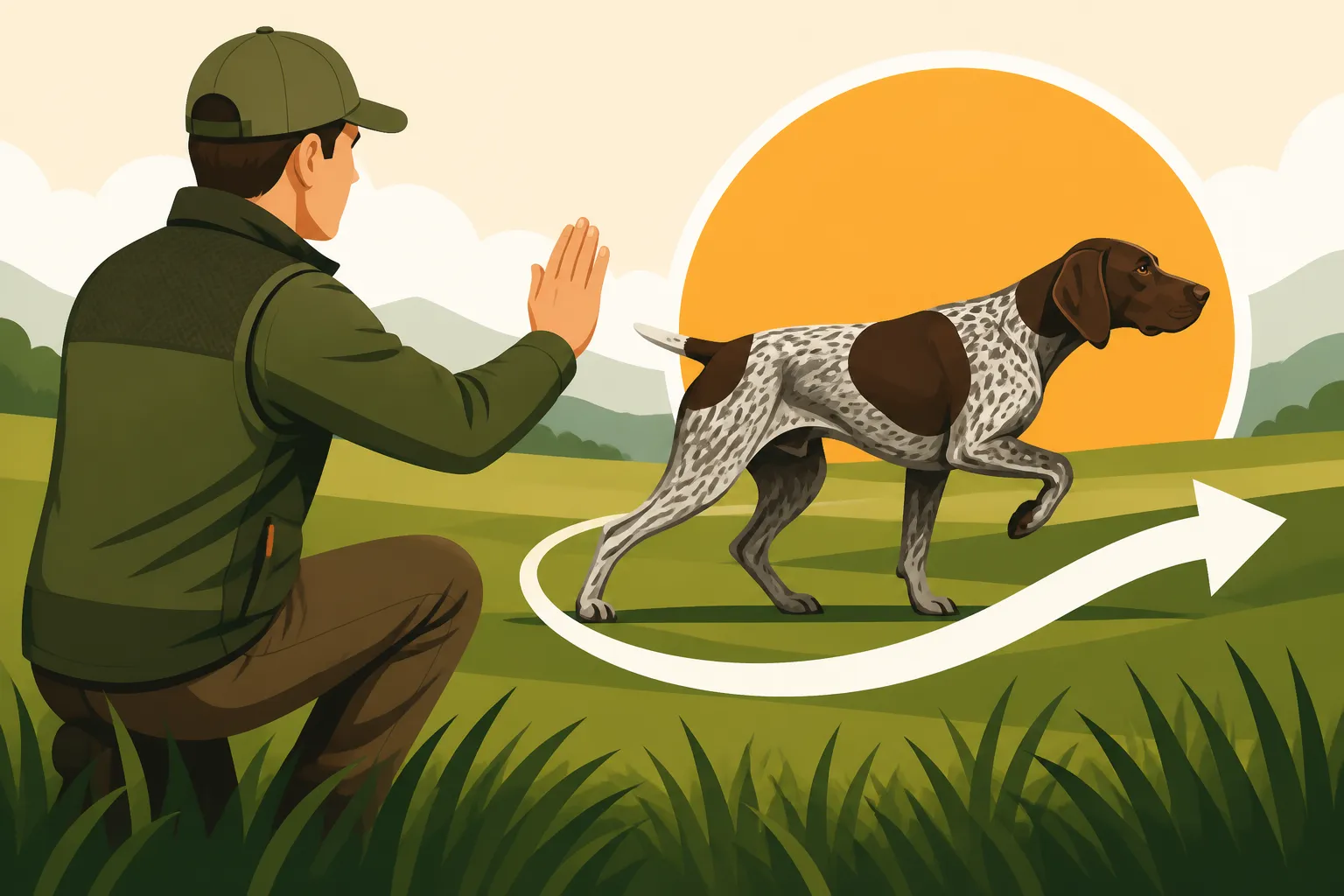
Once "Here" and "Whoa" are reliable, you can begin introducing directional cues. These are often taught with hand signals, as a whistle or voice command can carry less clearly in windy conditions or over long distances, and visual cues are often faster for a dog to process. Common signals include a sweep of your arm to the left or right, indicating the direction you want them to go, and perhaps an arm raised high for "whoa" or to encourage them to hunt further out.
Start in a quiet environment, perhaps in your yard, with your dog on a long line. Walk a short distance and then give your directional signal, gently guiding them with the line if necessary. As they turn in the correct direction, offer praise and a treat. Repeat this many, many times, always associating the hand signal with the desired movement. You might combine it with a verbal cue initially, like "Hunt left!" while sweeping your arm, then slowly phase out the verbal component as your dog understands the visual signal. Consistency is key here. If you use one signal for left, always use that same signal. Over time, your dog will associate the movement of your arm with the command to change direction, laying the groundwork for a beautiful quartering pattern in the field. Some owners find BAXTER & Bella's online puppy school and obedience programs helpful for laying these foundational skills before heading to the field.
Introducing the Quartering Pattern: From Simple to Complex
Once your GSP has a solid grasp on "Here," "Whoa," and basic directional signals, you're ready to start shaping their natural search into a productive quartering pattern. This isn't something that happens overnight; it's a gradual process of building understanding, trust, and consistency.
The Basic Zig-Zag Pattern
The quartering pattern is essentially a zig-zag, with your dog moving back and forth across the wind, covering the ground ahead of you. To introduce this, find a large, open field with minimal distractions and ideally a gentle breeze. Start by walking in a straight line, keeping your dog on a long line, maybe 20-30 feet initially. Let your dog get a little ahead, then give a directional hand signal, say, to the left. As your dog turns, praise them. Walk forward a bit, and once they've gone a reasonable distance to the left, give the signal to turn right.
The idea is to guide them into sweeping arcs that take them across the field in front of you. Don't expect perfection immediately. Your goal is to get them to understand the concept of turning on your command and covering ground. Imagine an invisible line extending from your dog's nose, forming a wide 'V' in front of you. Each sweep should bring them back towards the center before they turn and go the other way. This isn't about rigid military drills; it's about creating a fluid, efficient search. Regularly practice off-leash time to help them develop confidence and range, but always reinforce the expectation of checking in and responding to your signals. Off Leash Time a German Shorthaired Pointer Needs Weekly is critical for this development.
Expanding the Range Gradually
As your German Shorthaired Pointer starts to understand the basic zig-zag, you'll want to gradually expand their range. This means encouraging them to hunt further away from you, pushing out wider and deeper into the cover. Continue to use your directional signals, but now, instead of turning them immediately, let them extend their cast a bit further before calling them back across.
This expansion should be controlled. If your dog starts ranging too far, immediately use your "Here" command and reel them in, perhaps shortening the long line or using a sharper whistle command. The key is to teach them that you dictate the limits of their search. If they consistently come back to you when called, they earn more freedom to range. If they push the boundaries, the boundaries shrink. This is where patience really pays off. You want them to hunt boldly and independently, but always within your control. For dogs that naturally range wide, you might focus more on the "turn" signal to prevent them from disappearing. Shortening a Shorthair That Ranges Too Far is a common challenge that requires this kind of consistent management.
Using Terrain to Your Advantage
The natural landscape can be a powerful ally in teaching quartering. Think about how wind and cover influence scent. German Shorthaired Pointers typically prefer to hunt into the wind, as it carries scent directly to them. Use this to your advantage. Start your quartering training with the wind at your back, so your dog is naturally wanting to run into it as they sweep left and right. This encourages them to push out and keeps their nose to the air.
Moreover, the density and type of cover can help shape the pattern. Open fields are great for starting, but moving into light cover – short grass, stubble fields – can encourage them to work more thoroughly. When you encounter heavier cover, such as tall prairie grass or brush, your dog might naturally shorten their range and work more slowly. This is okay; it's adaptive behavior. Your job is to guide them to sweep through this cover, ensuring they don't miss any pockets where birds might be hiding. Walking the edge of a field or a treeline can also help define the boundaries of their casts, giving them a visual cue for where to turn.
Tools and Techniques for Effective Quartering Training
Teaching a German Shorthaired Pointer to quarter effectively involves more than just commands; it requires the right tools and a systematic approach to training. These aids are extensions of your communication, helping you guide your dog and reinforce desired behaviors, especially over distance.
Long Lines and Check Cords
The long line, often 20 to 50 feet in length, is your best friend when first teaching quartering and recall. It allows you to give your dog the impression of freedom while maintaining control. When you give a directional command, and your dog hesitates or goes the wrong way, a gentle tug on the long line can reinforce the direction. It's not about punishment, but about physically communicating what you want. You can guide them through the arcs of the quartering pattern, gently pulling to ensure they turn when signaled. This is particularly useful for establishing the muscle memory of the pattern and ensuring that your "Here" command is always obeyed.
A check cord, typically 15-30 feet, is similar but often used for more direct, quick corrections or to maintain a closer range if your GSP is still prone to ranging too wide. It allows for a snap correction to reinforce a "whoa" or a directional turn. Both tools provide that essential physical connection before your dog fully understands and reliably responds to verbal or whistle commands at a distance. You can find excellent quality long lines and check cords on Amazon, making it easy to get started with this crucial training aid.
The Role of the Whistle and E-Collar
As your German Shorthaired Pointer becomes more proficient, you'll want to transition from physical control (long line) to remote control (whistle and e-collar). A whistle is invaluable for long-distance communication. Different whistle blasts can signify different commands – a series of short, sharp toots for "here," a single long blast for "whoa," and maybe different patterns for directional changes. Start introducing whistle commands while your dog is still on the long line, pairing them with your existing verbal and hand signals. This way, the dog associates the sound with the action they already know. Whistle Commands a Shorthair Should Know is a foundational topic that needs dedicated practice.
The electronic collar (e-collar) is another powerful tool, but it must be used correctly and responsibly. It is not for punishment; it's for communication and reinforcement. The goal is to use the lowest possible stimulation level that your dog perceives, akin to a tap on the shoulder. It's used to reinforce commands they already understand, especially when distractions are high or they've extended their range. For example, if your dog knows "Here" but is hesitant to come when locked on scent, a low-level stimulation paired with the "Here" command can remind them to respond. Proper conditioning to the e-collar is paramount; never introduce it as a negative. Many resources cover Conditioning a Shorthair to the E-Collar Properly, emphasizing building a positive association before using it in the field. When used correctly, it can be an indispensable tool for maintaining control and ensuring your dog's safety and effectiveness.
Utilizing Training Grounds and Equipment
Choosing the right training environment is just as important as the tools you use. Start in open, low-distraction fields, then gradually move to areas with light cover, and eventually to actual hunting grounds. Varying your training locations helps your dog generalize the quartering pattern and not just associate it with one specific field.
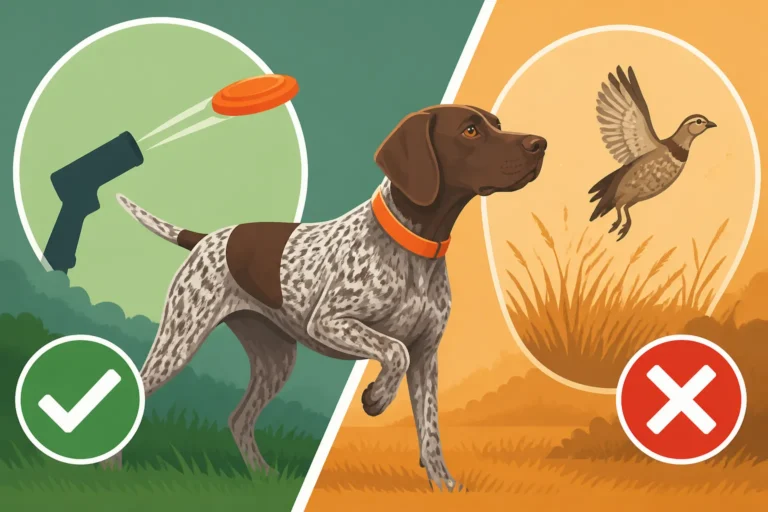
Beyond the physical space, consider training equipment like launcher birds or remote bird release systems. These allow you to control when and where birds appear, creating realistic hunting scenarios where your GSP can practice quartering, pointing, and whoa-ing on actual game. Initially, you might just use a wing on a string or a dead pigeon to build prey drive and pointing instincts, but live birds, even pen-raised, are crucial for refining the quartering process. They provide the ultimate motivation and allow you to see how your dog reacts under real pressure.
Addressing Common Quartering Challenges
Even with the best intentions and consistent training, you're bound to encounter some bumps in the road when teaching your German Shorthaired Pointer to quarter. These challenges are normal, and understanding how to troubleshoot them is key to continuing progress.
When Your Shorthair Ranges Too Far
This is perhaps the most common frustration for GSP owners. Their boundless energy and intense prey drive can lead them to disappear over the horizon, hunting independently and completely ignoring your commands. It's disheartening and dangerous. The root cause often lies in inconsistent recall training, a dog that hasn't learned the boundaries, or insufficient prior exercise. A GSP needs a significant amount of physical and mental stimulation daily; without it, they'll seek to burn that energy in the field, often on their own terms. Exercise a Shorthair Needs Before a Work Day can significantly impact their focus and willingness to listen.
To address this, go back to basics. Reintroduce the long line and enforce strict compliance with your "Here" command, making coming back to you the most rewarding thing. Use a consistent whistle command for recall, ensuring it’s sharp and distinctive. If you're using an e-collar, this is where its precise, low-level stimulation can be invaluable. Pair the recall command with a mild stimulation the instant you give the command. Release the stimulation the moment they turn towards you. This teaches them that ignoring your command results in a mild discomfort that immediately stops when they comply. Never chase your dog; if they range too far, turn around and walk in the opposite direction, forcing them to come find you. A GPS tracking collar is also a smart investment for safety, especially if your dog has a tendency to roam; many options are available on Amazon that can connect to handheld devices or smartphone apps.
When Your Shorthair Hunts Too Close
On the flip side, some German Shorthaired Pointers can be "foot hunters," sticking too close to their handler and not pushing out to cover ground effectively. This might stem from a lack of confidence, over-correction in early training, or simply not understanding that their job is to search. They might be afraid to make a mistake or were inadvertently punished for ranging out.
To fix this, you need to encourage boldness and independence. Stop calling them back so frequently. Instead, use your directional hand signals and verbal cues (e.g., "Hunt 'em up!" or "Go on!") to actively push them away from you, into the cover. Walk slowly, allowing them time to explore. When they do push out and make a nice cast, praise them enthusiastically. Don't worry if they aren't finding birds yet; focus on rewarding the behavior of casting out. You might even plant a few birds in strategic spots slightly ahead and to the sides of your walking path, so they "discover" birds when they push out. This builds their confidence that good things happen when they hunt away from you. This is also where a good BAXTER & Bella foundational program might help build confidence in puppies.
Dealing with Self-Hunting Tendencies
A "self-hunting" German Shorthaired Pointer is one that hunts for itself, ignoring the handler's directions, often breaking point or chasing birds without regard for the gun. This is different from merely ranging too far; it's about a dog that believes they are in charge of the hunt. This behavior can be incredibly frustrating and dangerous, as it often results in missed birds or dogs running into unsafe situations.
This issue typically arises from a lack of established leadership and consistent enforcement of commands like "Whoa" and "Here." The dog hasn't learned that the hunt is a partnership. The solution requires a firm return to control and discipline. Re-establish your authority through obedience drills, ensuring every command is followed. Utilize a long line or check cord to physically prevent self-hunting. If they creep on a point, a firm "Whoa!" and a gentle check with the line corrects the behavior. If they break, the same. When working with birds, steady them to wing and shot, ensuring they hold their point until released. This might mean starting with only one bird, or even just a pigeon in a remote launcher, so you can precisely control the interaction and correct any self-hunting tendencies immediately. Consistency and unwavering expectations are the only way to overcome this challenge. The Age a Shorthair Puppy Starts Whoa is never too young to begin instilling this critical control.
Advancing Your Shorthair's Quartering Skills
Once your German Shorthaired Pointer has a solid foundation in quartering, it's time to refine and advance their skills, preparing them for real-world hunting scenarios that are rarely as perfectly controlled as training grounds.
Working in Different Cover Types
The type of cover directly impacts how your GSP will quarter. Short stubble fields allow for wider, faster casts. Tall, dense cover like switchgrass or heavy cattails will naturally cause your dog to shorten their range, slow down, and work more thoroughly, nose to the ground. Your training should reflect this variety. Start with lighter cover, then gradually introduce denser, more challenging environments.
The key is to teach your dog to adapt their pattern to the cover while still staying within your control. In light cover, encourage those big, sweeping casts. In dense cover, teach them to "grind it out," systematically exploring every foot of ground with shorter, tighter turns, but still moving in that general zig-zag. Your directional signals become even more important here, guiding them through thick patches where you suspect birds are holding. This also means you need to adjust your walking speed. You'll move faster in open areas and slow down considerably in heavy cover to allow your dog to work it properly.
Quartering with Other Dogs
Hunting with multiple dogs can be incredibly rewarding, but it also adds a layer of complexity to quartering. Ideally, both dogs should be well-schooled in quartering individually before you attempt to hunt them together. When you first introduce them, keep it in a low-pressure environment. The biggest challenge is often "stealing point" or dogs getting tangled up. Each dog needs to learn to respect the other's work.
Start with one dog working, and the other on a long line or even at heel for a short period, then switch. Gradually introduce them working together, focusing on teaching them to "back" or honor another dog's point. This means if one dog points, the other should stop and honor that point from a respectful distance, not rush in. Teaching a Shorthair to Back Another Dog's Point is a specific skill that takes time and patience, often using "whoa" in conjunction with another dog pointing. Your directional cues will become even more important to keep both dogs quartering on their respective sides, preventing them from crossing paths unnecessarily or piling up on one scent. It’s a delicate dance, but a well-drilled brace of GSPs quartering in unison is a beautiful sight.
Maintaining the Skill Off-Season
Quartering isn't a skill you train once and then forget until hunting season. Like any complex behavior, it requires regular maintenance. The off-season is the perfect time to reinforce and refine these skills without the pressure of a live hunt.
Dedicate time each week to field work, even if it's just in a local park or an open field. Practice your directional cues, your recall, and your "whoa" in varied environments. Run your dog through their quartering pattern, even if there are no birds present, just to keep the patterns sharp and the communication lines open. This could involve simply walking your dog in a zig-zag pattern and using your signals to guide them, treating it like an advanced obedience exercise. Using training birds or even just training dummies can keep their retrieve skills honed and their bird drive active. The more consistently you work on quartering, the more automatic it becomes for your German Shorthaired Pointer, ensuring they're ready to perform at their best when opening day arrives. Consider joining local NAVHDA (North American Versatile Hunting Dog Association) groups, as they often have opportunities for year-round training and testing, ensuring your GSP remains a top-tier field partner.
Disclaimer
This article is for general informational purposes only and does not constitute professional advice. Laws, prices and regulations vary by location and change over time. Consult a qualified professional for guidance on your specific situation.