Teaching a Shorthair Puppy Not to Jump on People
It's incredibly frustrating when your spirited German Shorthaired Pointer puppy, brimming with joyful enthusiasm, decides that the best way to say hello is to launch themselves directly at your face, or worse, at an unsuspecting guest. This guide is here to walk you through understanding why your high-energy companion engages in this boisterous behavior and, more importantly, to equip you with realistic, step-by-step strategies to teach them polite, four-paws-on-the-floor greetings.
The Energetic Reality: Why Your GSP Puppy Jumps
German Shorthaired Pointers are a breed renowned for their boundless energy, intelligence, and intense desire to be near their people. When a GSP puppy jumps, it's rarely out of malice or defiance. Instead, it's usually a cocktail of natural instincts and learned behaviors that, while well-intentioned on their part, can be quite overwhelming and even painful for us.
It's Often About Connection, Not Disobedience
Think about how your GSP puppy interacts with other dogs. They often greet each other face-to-face, sometimes even playfully jumping and pawing to initiate interaction. When they see you, their favorite human, their immediate impulse is to bridge that height gap to get closer to your face, your hands, or whatever part of you smells most interesting! This is especially true for such an affectionate breed; they simply want to be as close to you as possible, and for a small puppy looking up at a tall human, jumping feels like the most direct route. It's a natural expression of their exuberant, loving nature.
Learned Behaviors: How We Accidentally Encourage Jumping
The truth is, often we, as well-meaning owners, inadvertently teach our puppies that jumping gets results. Imagine this common scenario: you walk in the door, your GSP puppy bounds up, jumps, and you instinctively reach down to pet them, or even just say "No!" and push them away. To your puppy, any attention, positive or negative, is a reward. That little push, that eye contact, that verbal reprimand – it all tells them, "Ah, this is how I get Mom or Dad to notice me!"
Even the smallest gestures can reinforce the behavior. A quick glance down, a sigh, or stepping over them can be interpreted as engagement. Over time, your smart GSP figures out that jumping is a pretty reliable way to get what they want: your valuable attention. This is why consistency is paramount; without it, they'll keep trying what works, even if it's not what you intended.
The Height Advantage: Getting Face-to-Face
For a GSP puppy, the world of humans is a tall one. Everything exciting – your smile, your encouraging words, that delicious treat you're holding – is happening way up high. They haven't yet learned that there are polite ways to get your attention at ground level. Their instinct is to elevate themselves to meet you. It’s a simple mechanical solution to a height difference. As they grow bigger, this problem only intensifies, as a 60-pound GSP puppy launching themselves can be quite a force! Understanding this inherent drive helps us approach the training with more empathy and strategic thinking, focusing on teaching them alternative ways to bridge that gap.
Building a "Four Paws on the Floor" Foundation
Stopping jumping isn't just about telling your GSP "no"; it's about teaching them what to do instead. Just like with house training or learning their name, patience and a clear, consistent message will be your best tools.
Starting Early with Management and Socialization
Prevention truly is the best medicine when it comes to jumping. From the moment your German Shorthaired Pointer puppy comes home, manage situations where jumping is likely to occur. This means making a conscious effort to prevent them from practicing the behavior. When you come home, keep greetings calm and low-key. If your puppy is overly excited, consider keeping them on a leash initially or using a baby gate to separate them until they can calm down.
Early socialization is also key. Expose your puppy to different people in a controlled manner, teaching them that calm greetings are always rewarded. Many owners find value in structured environments like puppy classes. In these settings, trainers can guide you through appropriate social interactions and help your pup learn manners from both people and other dogs. This kind of foundational work is often discussed in resources like Puppy Classes Before a Shorthair Starts Field Work, even if your GSP won't be a hunting dog.
Online resources, like those offered by BAXTER & Bella, often provide structured curricula that emphasize polite greetings and impulse control from a young age. These programs can be incredibly helpful for new puppy owners, providing step-by-step guidance on how to introduce your GSP puppy to new people and situations calmly, preventing jumping habits before they even take root.
Teaching Alternative Behaviors: The Power of "Sit"
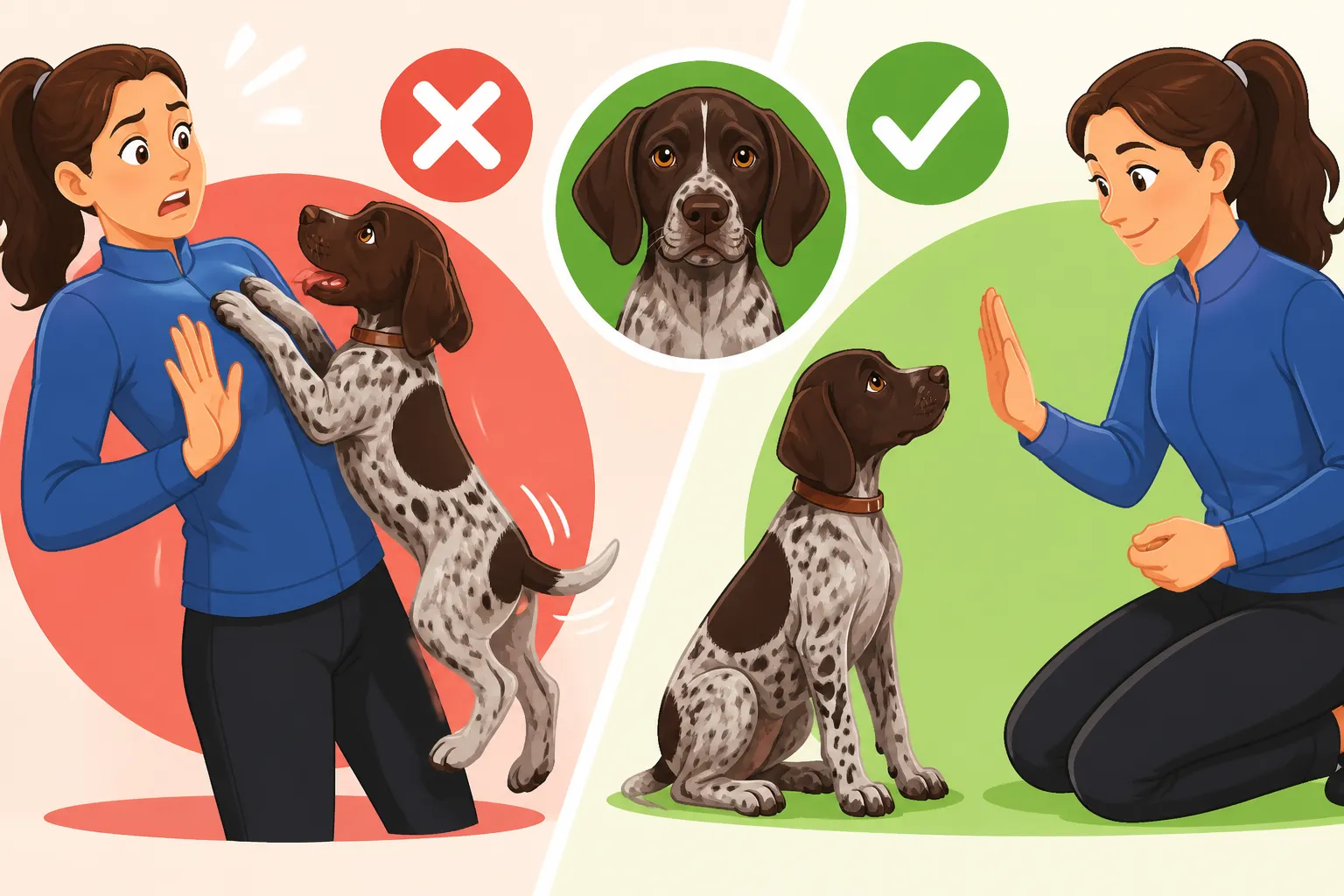
Instead of focusing on "don't jump," teach your GSP puppy what you do want them to do: "sit." This is a fundamental command that can be used in almost every polite greeting scenario. When someone approaches, or when you come home, ask your puppy to sit. Reward them immediately and enthusiastically with a high-value treat as soon as their rear touches the ground. The goal is to make "sitting" the default greeting behavior.
Practice this command in various situations: when people approach their crate, when you prepare their food, before opening the door to go outside. The more your puppy associates "sit" with getting what they want, the more readily they'll offer that behavior instead of jumping. This kind of consistent, positive reinforcement is vital for a breed as smart and eager to please as a GSP. It’s all part of providing The Structure a German Shorthaired Pointer Needs Daily to help them thrive.
The Golden Rule: Consistency from Everyone
This cannot be stressed enough: everyone who interacts with your German Shorthaired Pointer puppy must be on the same page. If you spend weeks diligently teaching "four paws on the floor" greetings, but a friend or family member comes over and makes a huge fuss when your puppy jumps, all that hard work can be undermined in minutes. Your GSP is an opportunist; if jumping works even once, they'll remember it.
Communicate your training plan to everyone. Explain to guests that you are working on polite greetings and ask them to help by only engaging with your puppy when all four paws are on the ground. You might even have treats ready for them to use. This collective effort is crucial for fast and lasting results. Your GSP will learn much quicker if they receive the same message from every person they encounter.
Practical Strategies for Curbing the Jump
Once you have a solid foundation, it's time to put practical techniques into action. These methods focus on removing the reward for jumping and heavily reinforcing calm, desired behavior.
The "No Attention" Protocol: Turning Away and Ignoring
This is arguably one of the most effective strategies, though it requires patience and commitment. The moment your GSP puppy jumps on you:
- Turn your back: Immediately pivot your body away from your puppy.
- Cross your arms: This removes any temptation to accidentally engage with their paws or face.
- No eye contact, no speaking: Pretend they are invisible. Any sound or glance, even a "No!", is attention.
- Wait for all four paws on the floor: Be patient. It might take a few seconds, or even a minute, especially at first.
- Reward calm: The instant all four paws are on the ground (even if it's just for a split second), turn back, praise them softly, and give them a small, high-value treat.
- Repeat: If they jump again, repeat the entire process immediately.
The key is that the moment they jump, all interaction ceases. The moment they are calm, attention, praise, and rewards flow. Your GSP will quickly learn that jumping makes you disappear, while keeping their paws on the floor brings good things. This technique is similar to how you might address other unwanted puppy behaviors, such as The Month a Shorthair Puppy Stops Nipping, by redirecting attention from the unwanted action.
Redirection and Reward for Calm Greetings
While ignoring is powerful, combining it with redirection can be even more effective. When you anticipate your GSP puppy might jump (e.g., when you're about to open the door for a guest), have a plan.
- Offer a designated toy: As a guest enters, immediately give your puppy a favorite chew toy. This gives them something appropriate to put their mouth on and focus on instead of jumping.
- Ask for a "Sit": As soon as your puppy's attention is on you, ask for a "sit" command. Reward that sit with a treat before the greeting begins.
- Calm praise: When the guest approaches, if your puppy stays sitting or at least keeps all four paws on the floor, the guest can then offer calm praise and a gentle pet.
Keep a handful of high-value treats or a favorite toy readily accessible. Many owners find it useful to have a treat pouch handy. Amazon offers a wide variety of practical and durable treat pouches that make positive reinforcement easy and efficient. The idea is to make polite greetings far more rewarding than jumping.
Managing High-Excitement Situations
German Shorthaired Pointers are naturally excitable, and certain situations just dial up that energy. Coming home after a long day, or a doorbell ringing, can trigger an uncontrollable urge to jump.
- Pre-exercise: If you know guests are coming, take your GSP puppy for a good, solid exercise session beforehand. A tired GSP is a good GSP! This might involve a brisk walk, a run, or some vigorous playtime in the yard. Remember, a GSP needs a lot of activity; topics like The Two Hours a Day a German Shorthaired Pointer Needs highlight their significant exercise requirements.
- Leash management: When expecting company, keep your puppy on a leash. This gives you immediate control. As soon as they start to launch, you can gently guide them back down, ask for a sit, and then release the tension on the leash when they comply.
- Use barriers: Baby gates or crates are fantastic management tools. If your puppy struggles to contain their excitement, have them behind a gate or in their crate when guests first arrive. Once they've settled, you can slowly reintroduce them, working on polite greetings.
- Doorbell training: Practice the doorbell. Have someone ring it while you're ready to ask your GSP to sit and stay. Reward calmness at the sound, teaching them not every ring means a frantic greeting.
Troubleshooting and Long-Term Success
Even with the best intentions and consistent effort, there might be times when you feel like you're not making progress. This is normal, especially with a high-drive breed like a German Shorthaired Pointer.
When the Jumping Persists: Addressing Stubborn Habits
If your GSP puppy continues to jump despite your best efforts, it's time to re-evaluate your approach.
- Increase consistency: Is everyone truly following the rules every single time? Even one slip-up can reinforce the unwanted behavior. You may need a "family meeting" to realign.
- Lower your expectations (temporarily): If your puppy is failing, the situation might be too stimulating. Can you simplify the environment? Maybe practice greetings in a quieter room, or with just one person at a time, before moving to more challenging scenarios like a busy entryway.
- High-value rewards: Are your rewards exciting enough? For a GSP, a tiny piece of dry kibble might not cut it when their adrenaline is pumping. Experiment with small pieces of cheese, cooked chicken, or hot dogs.
- Short, frequent sessions: Instead of long, drawn-out training sessions, break it down into many short (1-2 minute) sessions throughout the day. This keeps your GSP engaged and prevents them from getting bored or frustrated.
- Review basics: Sometimes, going back to fundamental commands like "sit" and "stay" in a distraction-free environment can strengthen their understanding and build their impulse control. This is often the case when you encounter issues like The Adolescent Shorthair That Stops Listening, where a solid foundation is crucial.
Preparing for Guests and Public Outings
Teaching polite greetings at home is one thing, but a brand new person or a busy park is a whole different level of excitement for a GSP.
- Role-play with friends: Ask patient friends or family members to act as "guests" who follow your training protocol. Practice greetings many times until your puppy is consistently performing a "four paws on the floor" hello.
- Leash up for success: When going to public places, always have your GSP on a leash. This allows you to control their movements and prevent jumping before it happens. You can then use the "ignore and turn away" method or redirection as needed.
- Communicate with strangers: Don't be shy about politely asking strangers not to encourage jumping. A simple, "Please wait until he sits before you pet him; we're working on his manners," is usually well-received. This is particularly important when considering how a powerful A Sixty Pound Shorthair Around a Toddler interacts with children; polite greetings are essential for safety.
- Practice in varying environments: Start with low-distraction areas and gradually increase the challenge. A quiet park bench first, then a slightly busier walking path.
Knowing When to Call in a Professional Trainer
Sometimes, despite your best efforts, a persistent jumping problem can feel overwhelming. This is absolutely not a sign of failure on your part, but rather an indication that an outside perspective can be incredibly valuable.
A certified professional dog trainer, especially one experienced with energetic working breeds like German Shorthaired Pointers, can observe your interactions and your dog's behavior with fresh eyes. They might identify subtle cues you're missing, suggest new techniques tailored to your GSP's specific personality, or help you understand why certain methods aren't working. They can also provide hands-on guidance, demonstrating techniques and troubleshooting in real-time. Don't hesitate to seek help if you feel stuck; a professional can accelerate your progress and strengthen the bond with your well-mannered companion.
Conclusion
Teaching your German Shorthaired Pointer puppy not to jump is a marathon, not a sprint. It requires immense patience, unwavering consistency, and a deep understanding of your GSP's spirited nature. By focusing on management, rewarding desired behaviors, and eliminating reinforcement for jumping, you'll gradually shape your enthusiastic companion into a dog who greets everyone with polite, four-paws-on-the-floor manners. Remember, every calm greeting is a win, and with dedication, you'll transform that bouncy enthusiasm into a well-behaved greeting that everyone can enjoy.
Do's and Don'ts for Stopping Puppy Jumping
Here's a quick summary of key actions to take and avoid when your GSP puppy tries to jump.
| Action Category | DO | DON'T |
|---|---|---|
| Greeting Behavior | Ask for a "sit" and reward immediately. | Pet, talk to, or make eye contact with a jumping puppy. |
| Attention | Give lavish praise and treats when all four paws are on the floor. | Give any attention (positive or negative) when they are jumping. |
| Physical Contact | Gently guide them into a sit if on leash, then reward. | Push them away with your hands or knees; this can be seen as play or attention. |
| Management | Use leashes, gates, or crates to prevent jumping in high-excitement situations. | Allow your puppy to greet guests without a plan or supervision. |
| Consistency | Ensure everyone in the household and all guests follow the same rules. | Let one person allow jumping, as this undermines all other training efforts. |
| Energy Levels | Exercise your GSP thoroughly before anticipated greetings or training sessions. | Expect a highly energetic GSP to be calm without prior mental or physical exertion. |
| Troubleshooting | Seek professional help if you're struggling or the behavior escalates. | Get frustrated or give up; consistency and patience are your best allies. |
Disclaimer
This article is for general informational purposes only and does not constitute professional advice. Laws, prices and regulations vary by location and change over time. Consult a qualified professional for guidance on your specific situation.