A Shorthair That Shuts Down Under Pressure
There's nothing quite as disheartening as watching your usually enthusiastic German Shorthaired Pointer, a breed known for its boundless energy and unwavering drive, suddenly hit a wall. One moment they're soaring across the field, a picture of grace and power, and the next they're hesitant, withdrawn, or even completely shutting down, refusing to engage. This guide aims to help you understand why your Shorthair might be experiencing this "shutdown" under pressure, what it looks like, and how you can gently guide them back to their confident, joyful selves.
Understanding What "Shutting Down" Looks Like
When we talk about a German Shorthaired Pointer "shutting down," it's more than just a momentary hesitation or a tired dog. It's a behavioral response to overwhelming pressure, stress, or fear that manifests as a complete cessation of their usual activities or a profound withdrawal. It can be subtle at first, often missed by owners who are focused on the task at hand, but it can quickly escalate if the pressure isn't alleviated.
Subtle Signs of Stress and Discomfort
Before a full shutdown, your GSP will likely give you plenty of signals that they're uncomfortable. These are often easy to dismiss if you're not keenly tuned into canine body language, especially in a breed as stoic and driven as the Shorthair. They might start by turning their head away, blinking rapidly, or licking their lips excessively, almost as if trying to taste the air. You might notice a slight stiffening of their body, a lowering of their tail, or ears that are pinned back more than usual.
A GSP might also yawn when not tired, or pant even if it's not hot. Some will start to shed more than usual, leaving a trail of short, stiff hairs, or shake off as if wet, even when perfectly dry. These are all early indicators that your dog is trying to cope with an escalating situation. If you're working on a new command, for instance, and your Shorthair suddenly starts performing these displacement behaviors, it's a clear sign that they're feeling the weight of the expectation or are confused by the task. Catching these early signs is crucial to preventing a full shutdown. Think of it as their polite way of saying, "I'm not okay right now." For more on interpreting these subtle cues, check out Reading a German Shorthaired Pointer's Stress Signals.
Overt Withdrawal and Complete Cessation of Activity
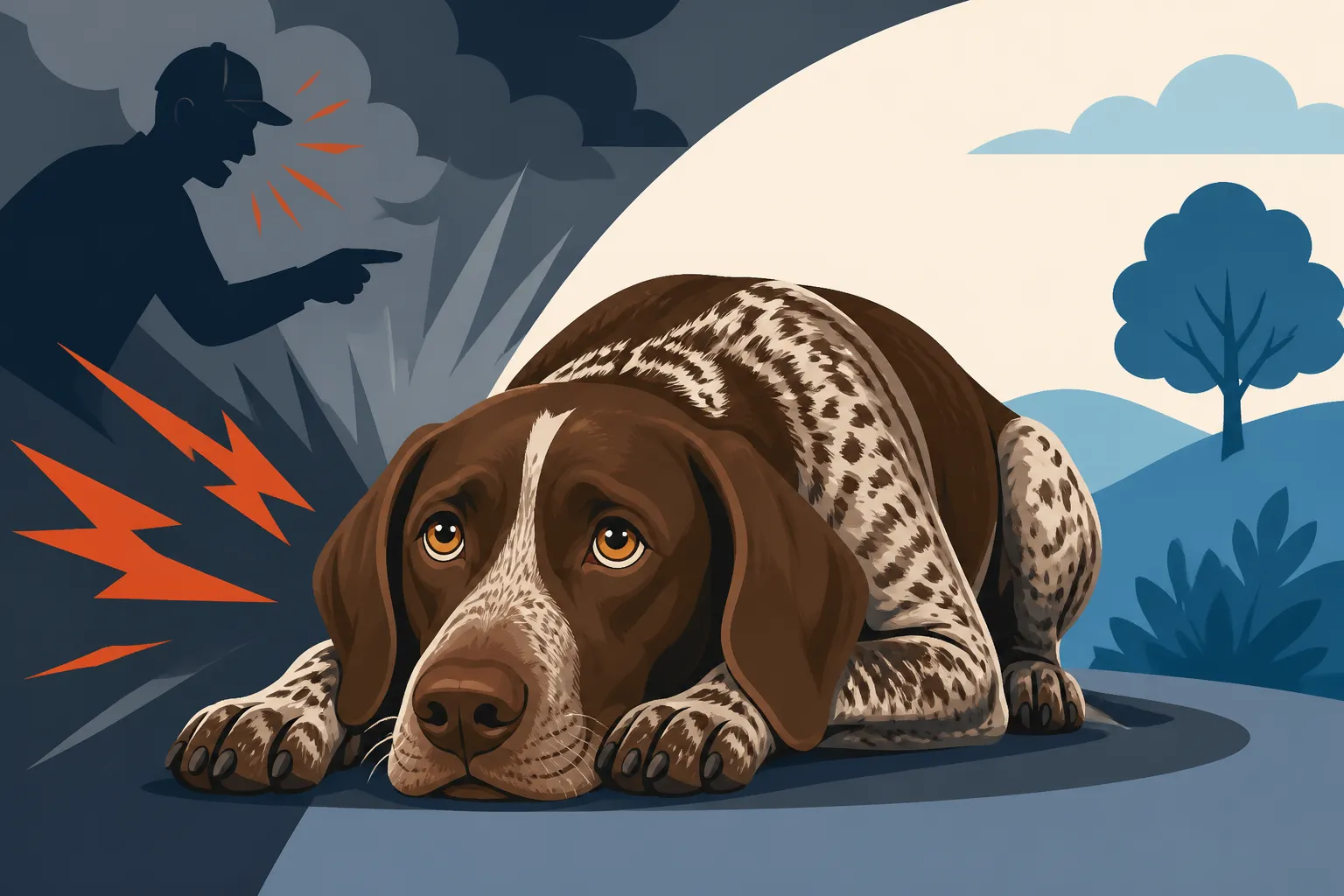
When a GSP truly shuts down, the signs become undeniable. They might stop moving altogether, freezing in place or even lying down, refusing to get up or continue the activity. This isn't stubbornness; it's often a dog overwhelmed to the point of immobility. Their eyes might dart around, avoiding direct contact, or become wide with a "whale eye" where the whites of their eyes are visible. They may tuck their tail tightly between their legs, flatten their ears against their head, and adopt a hunched posture.
In a training scenario, a shut-down GSP will ignore commands they usually know, not because they're being disobedient, but because their brain has effectively "switched off" from processing information and is solely focused on survival or escape. Imagine you're in the middle of teaching your Shorthair to retrieve a challenging bird, and suddenly, instead of racing for it, they just stand there, head lowered, trembling slightly. This is their system going into overload. They've ceased to be an active participant and have retreated internally. This can happen in a crowded field trial, a loud training session, or even just during a particularly frustrating moment for them.
| Behavior Trait | Subtle Stress Sign | Overt Shutdown Sign |
|---|---|---|
| Eyes | Blinking, darting, direct stare | Whale eye, avoiding eye contact, glazed over |
| Mouth | Lip licking, yawning, tight mouth | Excessive panting (no heat), drooling, closed mouth |
| Ears | Slightly lowered, swiveling rapidly | Pinned flat against head, rigid |
| Tail | Lowered, slow wag, stiff carriage | Tucked tightly between legs, rigid, still |
| Body Posture | Stiff, tense muscles, slight hunch | Hunched, low to the ground, frozen, cowering, trembling |
| Movement | Hesitation, slower responses, pacing | Freezing, immobility, refusal to move, attempts to hide |
| Vocalization | Whining, low growl, excessive barking | Silence, no response to cues, or sharp, desperate yips |
| Engagement | Distracted, less focused, easily startled | Complete disengagement, ignores commands/environment |
| Grooming/Shedding | Excessive shaking off (when dry), increased shedding | Obsessive licking, pulling out hair, skin picking |
Why German Shorthaired Pointers Shut Down
German Shorthaired Pointers are incredible athletes and intelligent partners, but they are also incredibly sensitive. Their eagerness to please, combined with their high drive, can sometimes be a recipe for disaster when not handled with finesse. Understanding the root causes of shutdown is the first step toward preventing it.
Overwhelm and Excessive Pressure
One of the most common reasons a GSP might shut down is simply too much, too soon, or too intense pressure. This breed is renowned for its motor and desire to work, which sometimes leads owners to push them harder or faster than they're ready for. Pressure can come in many forms: constant corrections, an e-collar setting that's too high or used incorrectly, repetitive tasks without success, or even just the handler's frustration.
Imagine a young GSP puppy learning "whoa" for the first time. If the handler is too insistent, or uses a training collar with too much force, the puppy might not understand what's being asked and instead of learning, they become overwhelmed. They might associate the training tool or the handler's tone with discomfort rather than instruction. A hunting scenario where a dog is pushed relentlessly through dense cover, or asked to retrieve a difficult bird after many failed attempts, can also lead to overwhelm. The dog wants to succeed, but feels incapable, leading to a mental block. When this happens, their natural instinct might be to withdraw from the situation entirely. This kind of pressure, especially on a "soft" Shorthair, can be very damaging, as discussed in Whether an E-Collar Damages a Soft Shorthair. It's a fine line between challenge and stress.
Confusion and Lack of Clear Communication
German Shorthaired Pointers thrive on clarity and consistency. They are problem-solvers by nature, but if they cannot figure out what you want, or if your signals are inconsistent, it can lead to immense frustration and ultimately, shutdown. This is especially true for complex tasks or when transitioning from one stage of training to another.
Consider a GSP that's been taught a command using one cue, and then the owner suddenly switches to another, or uses inconsistent body language. The dog, eager to please, tries to interpret the new signals but fails repeatedly. Each failure builds confusion, and eventually, the dog may simply give up trying. They might decide that any attempt on their part will be met with more confusion or even correction, so the safest option is to do nothing at all. This often happens with adolescent Shorthairs who are testing boundaries and might momentarily "forget" commands. If met with harsh corrections rather than patient retraining, they can quickly become withdrawn. This can be a challenge during stages like The Adolescent Shorthair That Stops Listening. Clear, consistent, and positive communication is key to building confidence and preventing this kind of behavioral retreat.
Previous Negative Experiences or Fear
Like humans, dogs remember past experiences, especially negative ones. A single traumatic event, or a series of unpleasant encounters, can leave a lasting impact and make a GSP prone to shutting down when faced with similar circumstances. This could be anything from a bad experience with loud noises (leading to gun shyness, for example), an injury during training, or even an overly harsh correction from a previous owner or trainer.
For instance, a GSP that was once scolded harshly for bumping a bird might become hesitant to point again, fearing a repeat of the negative experience. A dog that suffered an injury in dense cover might become reluctant to enter similar terrain. This fear can manifest as a shutdown, where the dog simply refuses to engage with the trigger for their past trauma. It's a protective mechanism. It's important to recognize that this isn't defiance, but a genuine fear response. Rebuilding trust and positive associations in these cases requires immense patience and a gentle approach, which is often needed for Fixing a Gun Shy German Shorthaired Pointer. These deep-seated fears require careful handling to help your dog move past them.
Strategies for Rebuilding Confidence and Preventing Shutdown
Reversing a shutdown and preventing future occurrences requires a thoughtful, empathetic approach. It's about rebuilding trust, clarifying communication, and creating an environment where your GSP feels safe to learn and explore again.
Slowing Down and Breaking Down Tasks
The first and most critical step is to drastically reduce pressure and slow everything down. If your GSP has shut down, pushing them harder will only exacerbate the issue. Break down any challenging tasks into incredibly small, achievable steps. For example, if they're struggling with a retrieve, start by just asking them to mouth the bumper while sitting, then take one step, then two, before gradually increasing distance and complexity. Each successful, tiny step should be met with effusive praise and a reward.
Think of it as setting them up for success repeatedly. This allows your dog to experience competence and rebuild their confidence brick by brick. For example, if a "whoa" command is causing stress, go back to basics. Instead of a field scenario, practice in a quiet area, starting with just a leash and collar, making the expectation incredibly clear and rewarding every tiny moment of stillness. Common Mistakes That Ruin Whoa on a Shorthair emphasizes the importance of a solid foundation. You might find resources on Amazon like clickers or special training treats can help mark these successes clearly. The goal is to make learning feel easy, fun, and entirely positive again.
Positive Reinforcement and High-Value Rewards
Positive reinforcement is paramount when dealing with a GSP who has shut down. Focus entirely on rewarding desired behaviors and ignore or redirect undesired ones (unless safety is a concern). This means using their favorite treats, enthusiastic verbal praise, exciting play, or anything else they find highly motivating. The rewards should be so valuable that they are eager to try, even if they're a little unsure.
When your GSP offers even a tiny step in the right direction – perhaps just a glance at a bird they previously ignored, or a slight shift in weight towards a retrieve item – mark that moment with a "yes!" or a click, followed immediately by a jackpot of treats or a quick game of tug. This creates a strong positive association and tells them they're on the right track. Over time, these positive experiences will replace the negative ones, fostering a more resilient and confident dog. Consider exploring online training platforms like BAXTER & Bella that focus heavily on positive reinforcement techniques, offering structured lessons that you can follow at your own pace.
Environmental Management and Gradual Exposure
Managing the environment is crucial for a GSP prone to shutdown. Identify what triggers the shutdown (e.g., loud noises, crowds, specific locations, certain equipment) and avoid those triggers initially. Work in quiet, familiar environments where your dog feels secure. Once they've regained some confidence, you can begin a very gradual process of desensitization and counter-conditioning.
This means slowly introducing the trigger at a very low intensity, far enough away that your dog notices it but doesn't react with fear or shutdown. Pair this low-level exposure with high-value rewards. For example, if loud noises are an issue, start playing very quiet recordings of those noises while your GSP is eating their favorite meal. Slowly, over weeks or months, increase the volume or bring the physical trigger closer, always ensuring your dog remains relaxed and happy. The moment you see any signs of stress, back off immediately. This might also involve adjusting how you introduce equipment like an e-collar, using it minimally and always pairing it with positive experiences, as covered in When an E-Collar Belongs on a German Shorthaired Pointer. This controlled exposure is not about pushing them through fear but about building positive associations step-by-step.
When to Seek Professional Help
While many cases of GSP shutdown can be managed with patience and the strategies above, there are times when professional intervention is necessary. Recognizing when you're out of your depth is a sign of responsible ownership, not failure.
Persistent or Worsening Behavior
If your GSP's shutdown behavior is persistent, meaning it doesn't improve despite your best efforts, or if it actually worsens over time, it's definitely time to call in a professional. This includes situations where the dog becomes completely unresponsive, shows signs of aggression when pressured, or starts exhibiting shutdown in increasingly benign situations. You might find that the dog who once only shut down at a field trial now struggles in a busy park, or even at home when asked to do something simple.
These deeper behavioral issues often have complex underlying causes that an experienced professional can help diagnose. They might be able to spot subtle body language cues you're missing, or identify triggers you hadn't considered. Don't let the problem fester; early intervention can prevent it from becoming more ingrained and harder to resolve.
Aggression or Severe Anxiety
Any instance of aggression – growling, snapping, or biting – in conjunction with shutdown behavior is a red flag that requires immediate professional help. This could indicate extreme fear, a broken trust bond, or an underlying medical issue that needs to be addressed. Similarly, if your GSP is showing signs of severe anxiety, such as destructive chewing when left alone, extreme clinginess, or incessant pacing and panting, a professional can provide guidance. This is particularly relevant if the dog is showing signs similar to A Shorthair That Panics Alone in the House but in different contexts.
A certified professional dog trainer, behaviorist, or even a veterinary behaviorist can assess your dog's individual situation, develop a tailored modification plan, and provide you with the tools and techniques to implement it safely and effectively. They can help you understand the nuances of your Shorthair's temperament and guide you in building a stronger, more confident relationship. Many experienced trainers offer virtual consultations, making access to expert advice easier than ever. Look for someone with experience specifically with working breeds and sensitive dogs.
Disclaimer
This article is for general informational purposes only and does not constitute professional advice. Laws, prices and regulations vary by location and change over time. Consult a qualified professional for guidance on your specific situation.