Whether a Shorthair Is Mistaken for a Pointer Mix
A lean, liver-and-white dog with a long nose and an athletic stance can easily be called a Pointer mix, especially when its pedigree is unknown. That guess may be understandable, but appearance alone cannot confirm a German Shorthaired Pointer’s ancestry. This guide explains which traits offer clues, what they cannot prove, and how to investigate a dog’s background sensibly.
Why a German Shorthaired Pointer Can Look Like a Mix
The classic pointer outline invites assumptions
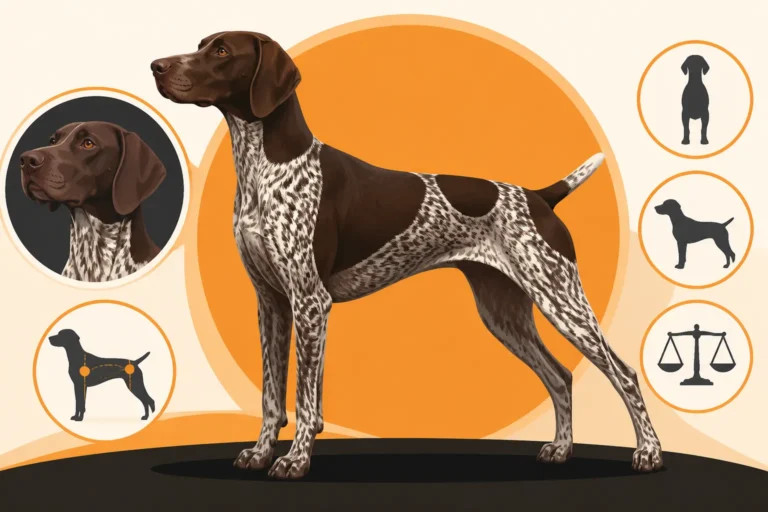
German Shorthaired Pointers are built to move: they tend to have a lean, athletic frame, a deep chest, a tucked-up waist, and a long muzzle. Their short coat also makes their shape easy to see. When one stands alert with its nose forward, many people naturally think “Pointer,” even if they are looking at a purebred Shorthair.
That reaction is partly about shared appearance. Several pointing breeds have a similar working-dog silhouette, and people who are unfamiliar with the distinctions may use “Pointer” as a broad description rather than the name of a particular breed. A Shorthair may also be mistaken for a mix if it is unusually tall, narrow, lightly built, or less heavily marked than someone expects.
Coat color contributes to the confusion. German Shorthaired Pointers can be liver and white, with patterns that include ticking, roaning, or larger patches. A person who expects a different pattern—or assumes every Shorthair has the same look—might interpret an unfamiliar coat as evidence of mixed ancestry. In reality, coat pattern alone does not establish whether a dog is purebred or mixed.
The breed has variation within its own type
Not every German Shorthaired Pointer looks like a picture-book example. Individual dogs vary in height, substance, head shape, coat markings, and overall proportions. Age and condition matter, too: a growing adolescent may look leggier than an adult, while weight loss or limited muscle can make a dog appear unusually narrow.
Breeding purpose can influence appearance as well. A dog from field-focused lines may look more lightly built than one whose relatives were selected with the show ring in mind. That does not make either dog a mix. It means that a breed can contain visible variation while still retaining recognizable shared traits. For more context, see The Split Between Field and Show Shorthairs.
The practical takeaway is simple: a dog can look atypical and still be purebred, and a dog can look strongly like a Shorthair without being one. Appearance gives you clues to consider, not a final answer.
How to Compare a Shorthair With Similar Looking Dogs
Look at the whole dog, not one striking feature
A long muzzle, short coat, or liver-and-white pattern can make a dog look Shorthair-like, but none of those features is conclusive on its own. Instead, consider the dog’s overall proportions and how its features fit together. Look at the head, ear shape and placement, chest, topline, legs, tail, coat, and movement as a whole.
Even then, a visual comparison has limits. Photographs can distort proportions, and posture changes how a dog appears. A dog photographed mid-run may look longer and leaner than the same dog standing calmly. A winter coat, poor lighting, or a clipped image can hide useful details. If the dog is a puppy or adolescent, its proportions may still be changing.
People also tend to compare dogs with familiar breeds based on whichever trait catches their eye first. A dog with a broad head may prompt one guess; a dog with a fine muzzle may prompt another. Instead of asking, “Does this one feature match a Shorthair?” ask, “Do the dog’s overall build and features fit the breed, and what reliable records support that impression?” The differences between related pointing breeds are explored in The German Shorthaired Pointer Against the English Pointer and The German Shorthaired Pointer Against the Brittany.
Compare likely possibilities without treating the table as a test
The table below is a starting point for observation, not a breed-identification chart. Individual dogs can fall outside common expectations, especially when their ancestry is unknown.
| What you notice | What it may suggest | Why it does not prove ancestry |
|---|---|---|
| Lean, athletic frame and short coat | A Shorthair or another sporting breed | Many active breeds share these traits |
| Liver-and-white coat with ticking or roaning | A pattern commonly seen in German Shorthaired Pointers | Coat patterns can appear in mixes and other breeds |
| Long muzzle and hanging ears | A pointing or gundog background may be possible | These features are not unique to one breed |
| Strong pointing or scent interest | A dog may show pointing-dog behavior | Instinct and learned behavior do not verify pedigree |
| A look that differs from familiar Shorthairs | A mix, an individual variation, or an inaccurate expectation | One unusual feature is not enough to decide |
If you are comparing a Shorthair with a Weimaraner, pay attention to more than coat color: their typical coat appearance and overall look differ, but mixed ancestry and individual variation can blur those contrasts. The German Shorthaired Pointer Against the Weimaraner offers another useful point of comparison.
What Can Actually Confirm a German Shorthaired Pointer’s Breed
Pedigree records provide the clearest documentation
If someone says a dog is a purebred German Shorthaired Pointer, ask what supports that claim. Registration documents and a pedigree can show recorded parentage, while breeder records may help connect the dog to its litter and family. These records are most useful when they can be matched to the individual dog rather than simply described verbally.
For a dog from a responsible breeder, ask for the registered names of the parents, the dog’s registration information if applicable, and any available documentation. If you are checking a pedigree, remember that titles and health testing tell you different things from proof of parentage. Titles may describe achievements in competition or work; health results may tell you about screening. Neither should be confused with a visual guess. The overview How to Read a Shorthair Pedigree for Hunting Ability explains what pedigree information can—and cannot—tell you about a dog’s background.
A missing paper trail does not automatically mean a dog is mixed. Rescue dogs, strays, and dogs surrendered after a change in household may arrive without records. In that situation, describe the dog honestly as a Shorthair-looking dog or a possible German Shorthaired Pointer rather than treating an unverified label as fact.
DNA results are clues, not a substitute for a documented pedigree
A canine DNA test may offer an estimate of breed ancestry, but it should be interpreted as one piece of information. Results can depend on the company’s reference database and how it analyzes genetic similarities. A result that identifies a likely breed contribution can be interesting, especially for a dog with an unknown past, but it does not create a formal pedigree or prove that the dog meets a breed standard.
It also helps to separate two questions: “What ancestry might this dog have?” and “Is this dog a registered purebred?” A DNA estimate may help investigate the first. It cannot by itself provide the family records needed to answer the second in the formal sense. If a result seems surprising, review the company’s explanation of its methodology and consider whether the dog’s known history supports the interpretation.
For owners weighing a test, it may help to first write down what you hope to learn. Are you curious about likely ancestry, trying to understand a dog’s appearance, or seeking information relevant to health? Those goals are not interchangeable. Breed ancestry does not replace veterinary evaluation, and a breed estimate is not a guarantee of a dog’s behavior or future needs.
What to Do When Your Dog Is Called a Pointer Mix
Respond with what you know, not what you have to guess
If your dog has verified registration or reliable pedigree documentation, you can explain that it is a German Shorthaired Pointer. If you do not have that evidence, it is perfectly reasonable to say, “She looks like a Shorthair, but we don’t know her full background.” That answer is both clear and honest—and usually ends the conversation without turning a stranger’s guess into a debate.
This can matter when adopting or rehoming. A shelter or rescue may use a breed label as a practical description, not a confirmed statement of ancestry. That label can help people picture the dog, but it should not be treated as a guarantee of pedigree, size, temperament, or exercise needs. If you are considering a dog based on a listing, ask about its observed personality, medical history, activity level, and behavior in the home. Those details are more useful for deciding whether the dog fits your life than a label based only on appearance.
It is also worth remembering that “mix” does not mean “less of a dog.” A mixed-ancestry Shorthair lookalike can be a wonderful companion, and a purebred dog may not match a person’s assumptions about the breed. Focus on the individual in front of you. If you are still deciding whether this breed’s needs fit your routine, Whether a First Time Owner Can Handle a Shorthair and Whether a German Shorthaired Pointer Needs to Hunt to Be Happy can help you think beyond appearance.
Choose supplies by measurements and needs, not by the label
A mistaken breed label can lead to practical frustrations, too. Owners sometimes buy a collar, harness, bed, or crate based on what they think a dog’s breed “should” need, only to find the fit is wrong. Measure the dog’s neck and chest, check its weight, and follow the sizing guidance for the specific item. For a harness, make sure it does not rub behind the front legs or restrict shoulder movement.
That advice applies whether you are shopping at a local pet store or browsing Chewy: use your dog’s actual measurements rather than relying on a breed name to choose a size. If a harness is uncomfortable, reassess the fit before deciding the dog is simply difficult to handle. Likewise, when comparing crate options on Chewy, check the product’s dimensions against the dog’s length and height, then consider how the crate will be used at home or while traveling.
A third useful moment to keep the label in perspective is when choosing walking gear from Chewy or another retailer. A dog described as a “Pointer mix” may have the same need for a secure, comfortable fit as a documented Shorthair, but individual body shape matters more than the label. The aim is not to prove what the dog is through its accessories; it is to choose equipment that works safely for the dog you actually have.
Keep the identity question separate from care decisions
Whether a dog is a purebred Shorthair, a mix, or simply unknown, its needs should be based on health, behavior, age, and activity. A high-energy dog may need structured exercise and training, but a breed guess alone cannot tell you how much activity is appropriate for that individual. Similarly, a dog’s interest in birds or tendency to point can be fascinating without serving as proof of ancestry. Whether a German Shorthaired Pointer Mix Still Points explores why behavior may show up in a mix without settling the pedigree question.
If you are concerned about a dog’s development, gait, breathing, vision, skin, or other health issue, ask a veterinarian rather than relying on an online breed comparison. The veterinarian can assess the dog in front of you and help decide whether testing or follow-up makes sense. Breed identity may add useful context, but it should not delay care when something seems wrong.
Disclaimer
This article is for general informational purposes only and does not constitute professional advice. Laws, prices and regulations vary by location and change over time. Consult a qualified professional for guidance on your specific situation.