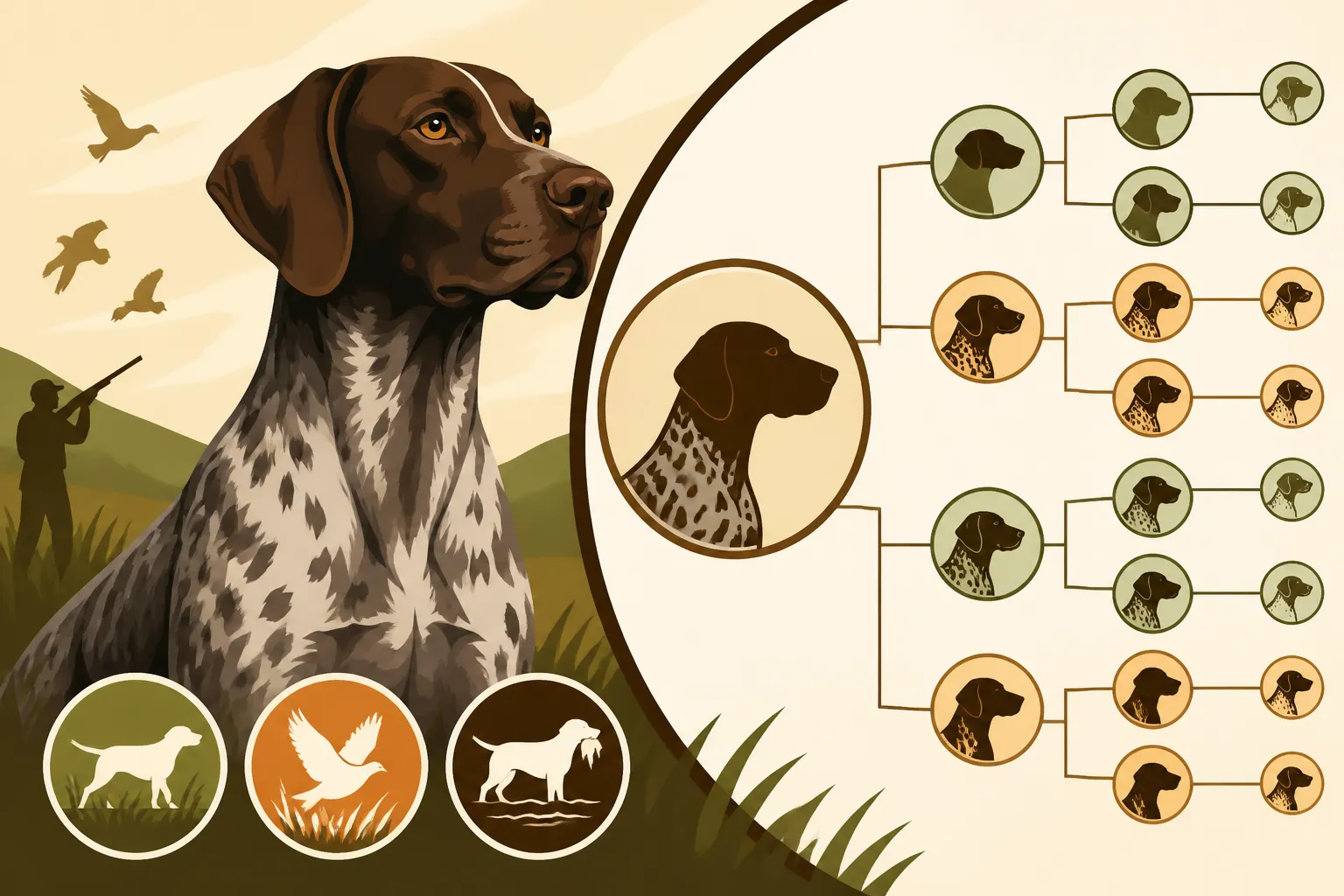
How to Read a Shorthair Pedigree for Hunting Ability
A German Shorthaired Pointer pedigree can look like a wall of names and abbreviations, but it can offer useful clues about hunting style, training history, and the kind of work a dog may enjoy. The challenge is knowing which details carry real weight—and which are only hints. This guide explains how to read those clues without treating a pedigree as a guarantee of performance.
Start with the kind of hunting ability you want
“Hunting ability” is not one single trait. A family that produces dogs with strong bird-finding instincts may not reliably produce the close-working, steady, water-loving companion you have in mind. Before you study titles, decide what you want the dog to do: hunt upland birds, retrieve waterfowl, track wounded game, work at a particular range, or combine several jobs.
Separate field and show clues from your actual goals
A pedigree may lean toward field-bred or show-bred dogs, but those labels are broad descriptions, not a complete forecast of an individual dog. Field-oriented lines are often selected with hunting performance in mind, while show lines may emphasize conformation and movement. There are capable hunters in both, and individual breeders make different choices within each tradition. For a fuller explanation of the differences, see The Split Between Field and Show Shorthairs.
Consider two hypothetical puppies. One comes from several generations of field-titled dogs that range widely and hunt hard. The other comes from show-bred parents whose relatives hunt regularly and work close to their handlers. If you hunt tight cover with a small group, the second puppy might suit your style better, even if the first pedigree looks more impressive on paper. Your preferred terrain, quarry, and handling style matter.
The label alone cannot tell you how much exercise, training, or control a dog will need in daily life. A high-drive hunting dog can be a poor match for an owner who cannot give it regular outlets, even if its pedigree looks ideal. If you are weighing that practical side, Whether a Field Line Shorthair Is Harder to Live With and Whether a Show Bred Shorthair Can Still Hunt can help put the labels in perspective.
Describe the hunting job before reading the names
Think through what a good day afield looks like for you. Do you want a dog that searches close enough to handle in thick grouse cover, or one that covers more ground across open country? Do you expect reliable retrieves from water? Is tracking a wounded bird important? The answers help you assess whether a pedigree’s recorded work matches your needs.
Then ask the breeder how the parents and close relatives actually hunt. “Great hunting dogs” is too vague to tell you much. Ask what they hunt, how often they work, how far they range, how they respond to handling, and whether they retrieve to hand. A specific story—such as a dog that regularly retrieves ducks from cold water or hunts close through brush—is more useful than a string of broad compliments.
Read titles as evidence, not as promises
Titles and test results can make a pedigree easier to interpret because they show that a dog completed a structured evaluation. But each title measures particular skills under particular conditions. A title does not mean that a dog has every quality you want, and a dog without a title may still have meaningful hunting experience.
Understand the test behind the letters
When you see abbreviations such as NA, UPT, or UT, find out what they stand for and what the test evaluates. A title is only informative if you know whether it reflects natural ability, trained performance, or a broader set of work. What NA, UPT and UT Mean on a Shorthair Pedigree is a useful place to start, and What the Natural Ability Test Scores on a Shorthair can help clarify what a particular evaluation is intended to show.
Different testing systems may emphasize different parts of a versatile dog’s work. A dog can do well in one kind of test and still need development in another area, such as steadiness, water work, or retrieving. Likewise, an impressive result tells you about the tested dog’s performance; it does not prove every puppy in that dog’s litter will have the same temperament or ability.
Ask what the dog had to do to earn a title. Was the performance mainly natural, or did it reflect extensive training? How old was the dog? Was the test aligned with the kind of hunting you plan to do? Understanding the context helps you use the title as one piece of evidence rather than a shortcut to a conclusion.
Look for relevant, repeated evidence
A single titled ancestor can be encouraging, but repeated evidence across close relatives is more useful. Several relatives with documented hunting or test results may suggest that a breeder has consistently selected for working ability. Pay particular attention to the parents, grandparents, and siblings of the parents; their records are generally more relevant to your puppy than a famous dog far back in the pedigree.
Look at the kind of evidence, not just the number of titles. A pedigree full of field credentials may not answer whether relatives retrieve waterfowl well or work the range you prefer. An untitled relative may have hunted regularly without being entered in a formal test. Ask the breeder to distinguish between verified results, personal hunting experience, and family reputation.
A useful comparison is:
| Pedigree clue | What it may tell you | What to ask next |
|---|---|---|
| Several close relatives with relevant titles | A pattern of tested ability may be present | What skills did the tests evaluate? |
| Parents hunted regularly but have no titles | Practical field experience may exist without formal records | What game and conditions did they work in? |
| One titled dog several generations back | There is a notable ancestor, but limited evidence about consistency | What do closer relatives do? |
| Strong records in one type of work | The line may have demonstrated particular skills | Does that work match your hunting plans? |
| Few details beyond names and registration | The pedigree offers limited performance evidence on its own | Can the breeder share firsthand examples? |
You can also compare the systems behind the credentials. AKC Hunt Tests Versus NAVHDA for a Shorthair can help explain why two dogs’ accomplishments may not be directly comparable. A title is most meaningful when you understand the task, conditions, training, and scoring behind it.
Trace the pedigree through several generations
A pedigree is a family map, not a simple ranking. Read it from the puppy’s parents outward, and note where hunting records or particular traits appear. The goal is not to find the most decorated ancestor. It is to see whether the breeder can describe a credible, consistent picture of dogs that suit your intended work.
Begin with the parents and their close relatives
Ask about the sire and dam separately. What work have they done? What are they like to handle? Do they hunt with a style that fits your plans? Then ask about their siblings and offspring from earlier litters, if any. Firsthand reports about close relatives can help you see whether a quality appears repeatedly or belongs mainly to one exceptional dog.
A sire with strong titles may attract attention, but the dam’s history matters just as much. Ask how she hunts, what she is like at home, and how she responds to training. Also ask whether either parent has produced previous litters and what those dogs are doing. A breeder who can discuss both strengths and limitations is often giving you more useful information than one who only lists accomplishments.
Write down the answers instead of trying to remember them during a conversation. For example, note that the dam hunts close in cover, retrieves from water, and has a calm temperament indoors, while the sire ranges farther and has formal test results. That does not tell you exactly what your puppy will be like, but it gives you a practical basis for discussing the match.
Notice consistency, gaps, and family stories
As you scan names and records, look for patterns across more than one branch of the pedigree. Are there hunting dogs on both sides? Do relatives show a variety of work, or does the family have documented experience mainly in one area? Are there repeated results that align with your goals? These patterns can help you ask better questions, but they still do not replace meeting the breeder and learning about the individual dogs.
Gaps are not automatically bad signs. Many serious hunting dogs never earn a title, and a pedigree may not capture every weekend spent in the field. The important question is whether the breeder can explain what those dogs actually did. “No title, but hunted grouse and woodcock for years” gives you a different kind of information than “I don’t know much about that dog.”
Be cautious when the story rests on one impressive ancestor while close relatives are unknown or untested. A famous name can add context, but it cannot fill in missing information about the parents’ temperament, trainability, health, or hunting style. Ask for examples from nearby generations before placing much weight on distant ancestors.
Use the pedigree to guide breeder questions
A pedigree is most useful when it starts a conversation. It can help you focus on the traits that matter, but it cannot predict exactly how an individual puppy will mature. Hunting ability is shaped by inherited tendencies, early development, training, opportunity, health, and the fit between dog and handler.
Ask for specific examples rather than broad claims
Bring a short list of questions to the breeder. Ask what birds the parents hunt, how they search, how they handle a flush, whether they retrieve, and what kind of water work they have done. If you want a close-working dog, ask how close relatives respond to handling in cover. If you hunt waterfowl, ask for examples of real retrieves rather than relying on a general claim that the line is versatile.
Ask about the dogs’ behavior away from hunting, too. A pedigree may contain strong working credentials, but you still need a dog whose drive, confidence, and sensitivity are manageable for your household and training experience. Ask how the parents behave around people, other dogs, new environments, and everyday routines. These details do not measure hunting ability directly, but they matter to the experience of owning and developing the dog.
Finally, ask what the breeder is trying to improve with the pairing. Thoughtful breeding involves decisions about strengths and trade-offs, not simply combining two titled dogs. A candid explanation of why the sire and dam suit each other can tell you a lot about how carefully the breeder understands the dogs behind the pedigree.
Treat your conclusions as a shortlist, not a verdict
After you review the pedigree and speak with the breeder, summarize what you know: which close relatives have relevant work, what kind of testing or hunting experience is documented, and how well the family’s style matches your plans. Then note what remains uncertain. You might have strong evidence of upland ability but little information about water retrieves, or a promising family history without much experience from previous litters.
Use that picture alongside what you learn by meeting the breeder and, where possible, the parents or close relatives. Ask how the breeder evaluates puppies and matches them with homes. A puppy’s behavior at one visit is not a reliable prediction of its adult hunting style, but the breeder’s observations over time may help identify differences in confidence, energy, and responsiveness.
The best pedigree is not necessarily the one with the most titles or the most recognizable names. It is the one whose documented history and firsthand descriptions give you sensible reasons to believe the dogs may fit your kind of hunting—and whose breeder is open about both the strengths and the unknowns. That is a much sturdier foundation than choosing a puppy on pedigree prestige alone.
Disclaimer
This article is for general informational purposes only and does not constitute professional advice. Laws, prices and regulations vary by location and change over time. Consult a qualified professional for guidance on your specific situation.