Whether Dual Champion Shorthairs Still Exist
A German Shorthaired Pointer can look polished in the show ring and still work birds, but that does not automatically make the dog a dual champion. The term has a specific meaning in American Kennel Club competition, and it is easy to confuse it with hunt-test or versatile-dog titles. This guide explains what counts, how a Shorthair earns the distinction, and what it tells you as a buyer or owner.
What a dual champion means for a German Shorthaired Pointer
The formal AKC meaning
In American Kennel Club terms, a Dual Champion has earned both an AKC conformation championship and an AKC field championship. The dog’s registered name may carry the prefix DC, short for Dual Champion. The two titles come from different kinds of competition: one evaluates how closely the dog conforms to the breed standard, while the other recognizes success in field trials.
That distinction matters because people sometimes use “dual champion” casually to describe a dog that hunts and looks like a show dog. A German Shorthaired Pointer may be a capable hunting companion, a show champion, or a titled hunt-test dog without holding the specific combination of AKC titles. If you are checking a pedigree or breeder’s claim, ask which organizations awarded the titles and what the dog’s registered name is.
A DC title is not a general certificate saying that a dog is equally accomplished at every task the breed can do. It confirms achievement in two defined AKC venues. It does not, by itself, tell you how the dog behaves around children, whether it retrieves reliably in cold water, or how it performs on a particular kind of wild bird. Those details require a closer look at the dog’s record, training, and daily life.
How conformation and field titles differ
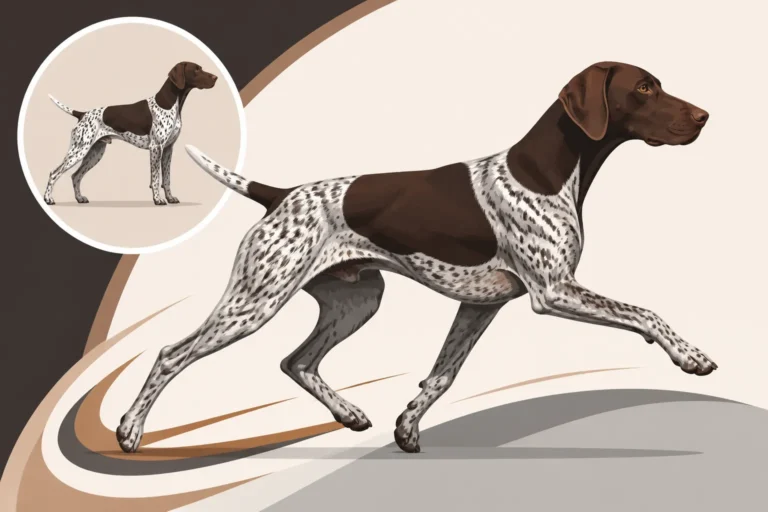
A conformation championship is earned in shows where judges assess dogs against the breed standard. They consider qualities such as structure, movement, coat, and overall breed type. A show title is evidence that the dog was judged to meet the standard well enough to earn the required recognition in that competition system. It is not a field-performance title.
An AKC field championship comes through field-trial competition. Field trials are designed to assess a pointing dog’s performance in the field under the rules of the event. A dog must compete and earn the results required by the applicable rules. That takes more than natural enthusiasm: a dog and handler typically need sustained training, conditioning, travel, and experience competing against other teams.
The labels can be confusing because other programs test different skills. A NAVHDA Utility Test, for example, evaluates a versatile hunting dog through its own testing system, while an AKC hunt test awards titles under a separate structure. These achievements can be valuable, but they are not interchangeable with an AKC field championship. For a closer look at the distinction, see AKC Hunt Tests Versus NAVHDA for a Shorthair and What NA, UPT and UT Mean on a Shorthair Pedigree.
| Term or achievement | What it generally represents | Does it alone make a dog an AKC Dual Champion |
|---|---|---|
| AKC conformation championship | Success in conformation shows against the breed standard | No |
| AKC field championship | Success in AKC field-trial competition | No |
| AKC Dual Champion | Both an AKC conformation championship and an AKC field championship | Yes |
| NAVHDA or AKC hunt-test title | Achievement in that program’s testing or hunt-test system | No |
| A dog that hunts and has show-ring qualities | A description of ability or type, not necessarily a formal title | No |
Do dual champion Shorthairs still exist
Yes, though the combination is demanding
Dual Champion German Shorthaired Pointers still exist. The accomplishment is uncommon because each title requires preparation for a different kind of competition, and doing well in both takes time, money, skill, and a dog suited to the work. A handler may need to balance show entries and grooming with field conditioning, bird work, trial travel, and the dog’s recovery.
The challenge is not simply that the dog must be “good at everything.” Show and field competitors may prioritize different traits, and individual dogs can vary widely even within the same breed. A dog’s structure, movement, temperament, athletic ability, instincts, and training all influence what it can accomplish. The dual title reflects a notable combination of success, but it is not a guarantee that every individual will be equally strong in every hunting situation.
It also helps to remember that field competition and hunting are related but not identical. Field-trial experience can demonstrate highly developed field skills under trial conditions. A hunting home may still need to assess practical qualities such as cooperation, steadiness, retrieving, range, and the kind of cover or birds the dog will encounter. Ask about actual experience rather than assuming the title answers every question.
Why the label can be confused with field and show lines
German Shorthaired Pointers are often discussed as though they fall into two fixed camps: field lines and show lines. That oversimplifies a breed with variation in individual dogs, breeding goals, and family histories. Still, the emphasis a breeder places on certain traits can influence a dog’s appearance, drive, working style, and suitability for a particular home or sport.
A show title does not mean a Shorthair cannot hunt. Nor does a field pedigree mean the dog is automatically a good match for every hunting family. The useful question is what the dog and its relatives have actually done, and whether those qualities align with your plans. You can explore this further in How Shorthair Field Lines and Show Lines Diverged, Whether a Show Bred German Shorthaired Pointer Can Still Hunt, and Whether a Field Line Shorthair Is Harder to Live With.
A dual champion is a striking example of achievement across two arenas, but it should not be treated as proof that one style of breeding is universally superior. If you are considering a puppy, talk with the breeder about temperament, health screening, working ability, and the kinds of homes their dogs thrive in. The distinction between field and show priorities is explored in The Split Between Field and Show Shorthairs.
How a Shorthair earns the dual title
The dog must meet the requirements in both venues
A dog cannot earn the formal dual title just by attending shows and going hunting. It must earn the required AKC conformation championship and AKC field championship under the rules for those competitions. Each title has its own pathway, and the requirements and procedures are governed by the relevant AKC rules.
The sequence can vary. A dog might earn a conformation championship before it develops the field record needed for a field championship, or the order might be reversed. Some owners and handlers pursue both tracks in parallel, while others focus on one before adding the second. In either case, the dog needs a team that can prepare it appropriately without letting competition goals eclipse its welfare.
Training for field work may involve exposure to birds, steady handling, conditioning, and practice in the environments where the dog will compete. Show preparation involves becoming comfortable with handling and presentation, along with maintaining sound condition and coat. A dog that is anxious in a show setting or physically underprepared for field work may struggle, even if it has natural potential.
What the title can and cannot tell you
A DC designation can be meaningful evidence of achievement: the dog succeeded in both the show ring and AKC field trials. For a prospective owner, it can be an interesting clue about the dog’s background and the breeder’s goals. But it is only one part of the picture. Ask for the dog’s full registered name, documented title record, and information about close relatives rather than relying on a shorthand description in an advertisement.
If hunting is your priority, ask what kind of field work the dog has done and how it behaves outside competition. Has it hunted wild birds, planted birds, or both? How does it respond to handling? Does it retrieve? What is its range like? If you want a family companion as well, ask about its ability to settle indoors, its exercise needs, and how it has been raised around people and other animals.
A pedigree can help you follow titles and related dogs, but it needs context. A string of initials is not a substitute for observing the dog or asking direct questions. For help interpreting the information, read How to Read a Shorthair Pedigree for Hunting Ability. The breed club’s health and breeding resources can also help you understand what health clearances to ask about; start with The Parent Club That Sets Shorthair Health Rules.
What to consider if you want a dual-purpose Shorthair
Match the dog to your real plans
It is easy to be drawn to a dual champion’s résumé and imagine that the title guarantees an ideal hunting partner and an effortless house dog. In practice, the right match depends on your experience, schedule, training plans, and home. A high-energy dog from accomplished lines may need structured exercise and ongoing training, not simply a fenced yard and occasional weekend outing.
Be candid about what you want to do. If your main goal is hunting, prioritize a dog with suitable working traits and a breeder who can discuss those traits concretely. If you want to compete in conformation too, ask what that involves and whether the dog’s structure and temperament appear appropriate for that path. If your household mostly wants an active companion, consider whether you have the time to meet the dog’s daily needs even when there is no trial or hunting season on the calendar.
It can be useful to talk with people who participate in both field and show events. Ask what a typical training week looks like, how they manage travel, and what they would do differently with a first dog. Practical logistics matter: keeping basic care supplies organized for training days and trips can make routines easier, and some owners use retailers such as Chewy for ordinary pet-supply replenishment. That convenience does not replace choosing the right dog or planning for its exercise and training.
Verify claims and keep everyday care in view
When you see “dual champion” in a listing, ask whether it refers to the formal AKC title or is being used informally. Request the exact registered name and verify the titles through the appropriate records. If a seller describes a dog as “dual titled,” ask which two titles are meant. That wording may refer to different programs and does not necessarily mean the dog is an AKC Dual Champion.
Also discuss health screening and the individual dog’s needs. A title cannot tell you whether the breeder has completed appropriate health testing or whether the puppy’s parents have the temperament and structure you are seeking. Ask to see relevant documentation, understand the family history, and take time to compare what the breeder says with the dog’s actual record. Routine supplies for grooming, travel, and field clean-up are part of ownership too; Chewy may be one place an owner chooses to restock everyday items, but the important thing is having a practical care routine ready.
Finally, remember that a dual champion is an achievement, not a promise of a particular outcome for every puppy in the pedigree. Even littermates can differ in drive, confidence, trainability, and maturity. A thoughtful breeder will be willing to discuss those differences and help match a puppy to your home, rather than suggesting that a title alone makes the decision. If show and field plans are part of your future, you will still need to build skills gradually, protect the dog’s physical condition, and keep its everyday welfare ahead of the ribbons.
If you are planning for a Shorthair that may hunt, travel, and live closely with your family, good preparation includes both training and ordinary care. Owners often keep routine supplies on hand for muddy paws, coat care, and weekend trips; Chewy is one possible source for that kind of replenishment. The best choice, though, is the dog whose needs and temperament fit your life, whether or not it eventually earns a championship.
Disclaimer
This article is for general informational purposes only and does not constitute professional advice. Laws, prices and regulations vary by location and change over time. Consult a qualified professional for guidance on your specific situation.