The Age a German Shorthaired Pointer Finally Settles
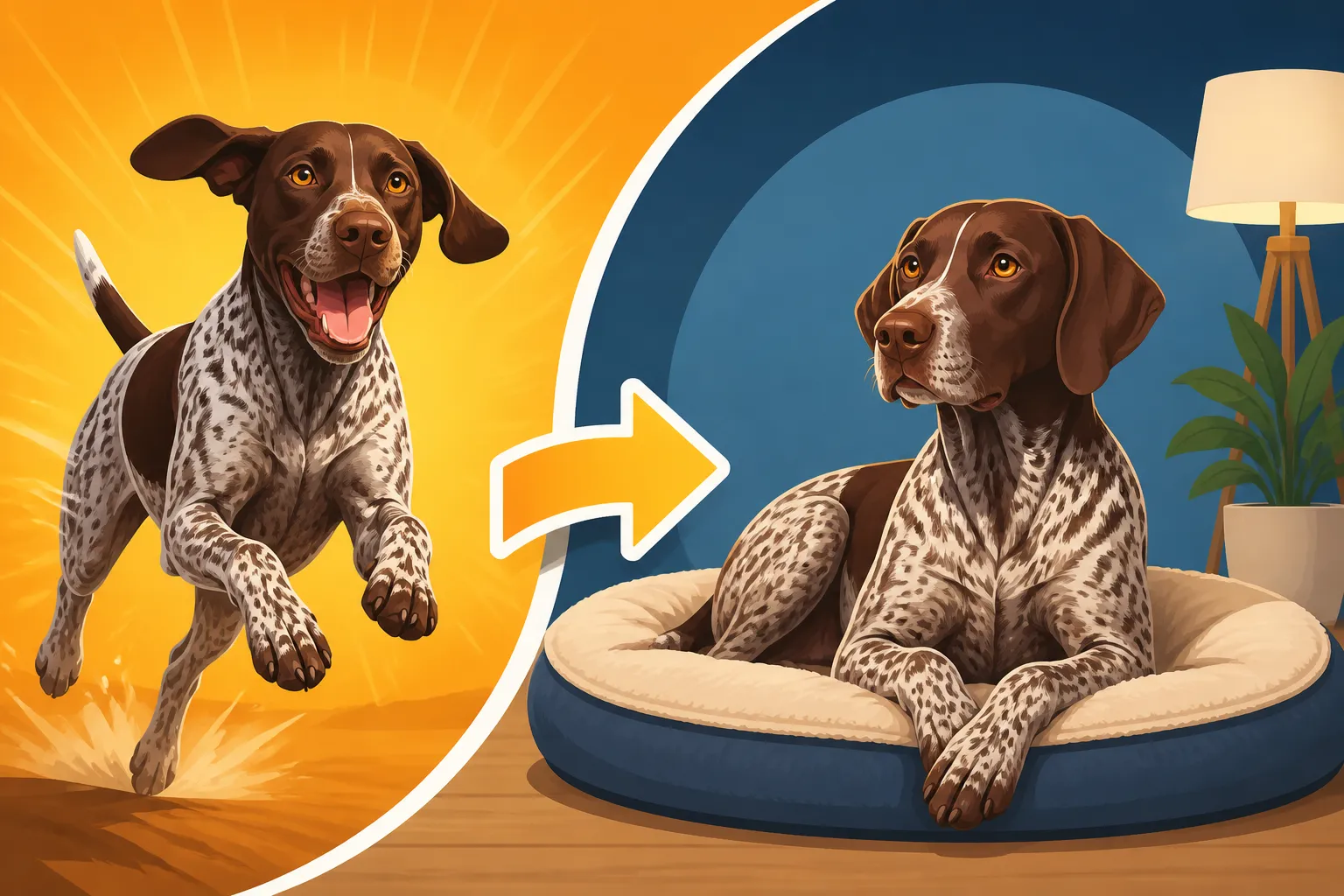
A German Shorthaired Pointer rarely flips from “busy puppy” to “calm adult” on a particular birthday. Many begin to feel more settled as they mature, often between two and three years old, but genetics, daily routine, training, exercise, and the dog’s individual temperament all matter. This guide explains what’s normal, what helps, and when nonstop energy may need a closer look.
When a German Shorthaired Pointer Usually Settles
Puppyhood and adolescence are demanding stages
German Shorthaired Pointer puppies can be energetic from the start, but young puppies also need plenty of sleep. Their enthusiasm may show up as zooming around the kitchen, grabbing sleeves, chewing furniture, or suddenly becoming impossible to redirect when they are overtired. A puppy who seems to have endless energy may actually need a quieter space and a nap, not another round of fetch.
Adolescence often brings a different challenge. From roughly six months through the next year or more, a Shorthair may be physically stronger and more adventurous while still having immature impulse control. A recall that worked in the backyard can disappear when a rabbit bolts across a trail. A dog who once settled beside your desk may start pacing, scavenging, barking at windows, or testing every boundary.
This stage can feel particularly discouraging because the dog looks grown before acting grown. Owners sometimes assume their training has stopped working, when their dog is simply navigating a period of distraction and uneven self-control. The adolescent stage is covered in more detail in The Adolescent Shorthair That Stops Listening.
Two to three years is a common turning point, not a deadline
Many German Shorthaired Pointers become easier to live with somewhere around two to three years old. They may still love a long run, an exciting scent trail, or a day in the field, but they can become more capable of switching off at home. That change tends to be gradual: perhaps the dog rests after dinner more reliably, waits calmly while you prepare a meal, or needs fewer reminders to settle after a walk.
There is no guaranteed age when every Shorthair “finally settles.” Some remain lively and demanding well into adulthood, while others become noticeably more composed sooner. Breeding lines, health, social experiences, household routines, and the amount of useful activity a dog gets can all affect what you see. A dog from a strong working background may have a particularly high need for meaningful activity, but that does not mean every field-bred dog is impossible to live with.
It helps to define what you mean by “settled.” If you expect a German Shorthaired Pointer to become a low-energy couch dog, even a mature, well-exercised one may disappoint you. If you mean a dog who can enjoy activity and then relax in a familiar home routine, that is a more realistic goal. For a broader look at how much daily activity this breed needs, see The Two Hours a Day a German Shorthaired Pointer Needs.
Readiness to rest matters more than a quiet personality
A settled dog is not necessarily a dog who has lost its drive. A healthy adult Shorthair may still become intensely excited when the leash comes out or when it spots a bird. The useful change is that excitement no longer has to spill into every part of the day. The dog can respond to familiar cues, recover after activity, and rest without constant entertainment.
A simple way to track progress is to notice how long it takes your dog to settle after normal events. Does it pace for an hour after a walk, or can it drink, chew quietly, and lie down? Can it stay relaxed while you cook, take a work call, or open the front door? These small everyday measures are often more meaningful than comparing your dog with another Shorthair.
| Life stage | What you may notice | Helpful focus |
|---|---|---|
| Puppyhood | Short bursts of intense play, chewing, and frequent tiredness | Sleep, gentle socialization, basic routines, and safe exploration |
| Adolescence | Bigger body, more distractions, uneven recall, and boundary testing | Consistent cues, management, calm practice, and age-appropriate exercise |
| Young adulthood | Better recovery and more predictable behavior, though still high energy | Regular activity, mental work, and relaxation training |
| Mature adulthood | More reliable ability to rest between activities, with individual variation | Maintain routines and adjust activity to health and lifestyle |
Why Some Shorthairs Stay Restless at Home
Exercise helps, but exhaustion is not the whole answer
A German Shorthaired Pointer needs appropriate physical activity, but simply trying to run the dog until it collapses can create a difficult cycle. A dog conditioned to longer and faster outings may need ever more exercise to reach the same level of physical fatigue. Hard, repetitive exercise can also be unsuitable for a growing puppy or a dog with an injury or joint problem.
Think of a young Shorthair whose owner adds another long run whenever the dog gets restless. The dog may sleep for a while, then wake ready for more. Meanwhile, it has not learned what to do when the household is quiet. Exercise supports wellbeing, but it does not automatically teach a dog to relax.
Build activity around the dog’s age, fitness, health, and experience. A sniffing walk, short training session, controlled retrieve, or safe exploration in a suitable area can be more useful than a frantic game that leaves the dog overstimulated. Before adding distance running to a young dog’s routine, review The Age a Shorthair Puppy Starts Distance Running and ask your veterinarian what is appropriate for your individual dog.
Mental work can channel drive without winding the dog up
German Shorthaired Pointers were bred to use their noses, make decisions, and work with a person. Activities that engage those abilities can be satisfying in ways that a plain walk may not be. Try scattering part of the dog’s meal in a safe patch of grass, hiding a few treats for a supervised search, practicing a short sequence of familiar cues, or using a simple food puzzle.
Keep mental activities appropriately challenging. A puzzle that is too difficult can frustrate a dog; one that is too easy may be over in moments. A food toy can be useful when you need a calm activity, but it should not replace exercise, social contact, or training. If you are comparing puzzle feeders, Chewy is one retailer where owners may browse different formats; choose a design suited to your dog’s chewing style and supervise its first uses.
Scent games are particularly handy on days when weather, illness, or a busy schedule limits outdoor activity. Hide a toy in an easy location and encourage the dog to find it, then gradually make the search more interesting. These short, structured games give the dog a job without requiring a high-speed chase through the house. More ideas are in Mental Work That Tires a Shorthair Out.
Inconsistent routines can keep a dog on alert
Some dogs struggle to rest because the household rhythm is unpredictable. If one day includes a long hunt, the next day has no planned activity, and the following day involves hours alone, the dog may have trouble anticipating what comes next. A predictable pattern does not have to mean a rigid schedule down to the minute. It can simply mean regular opportunities for movement, food, training, quiet time, and toileting.
Restlessness can also be reinforced unintentionally. A dog whines, paws at you, or brings a ball; the owner responds by starting an exciting game. The dog learns that persistent demands are an effective way to make activity happen. Instead, meet the dog’s basic needs on a planned schedule and reward calm behavior when it occurs naturally.
A workable day might include a sniffing walk in the morning, breakfast served in a food toy, a quiet rest period, a short training session later in the day, and a second walk or play session. The specific plan should fit your dog and circumstances. For a fuller routine-building discussion, see The Structure a German Shorthaired Pointer Needs Daily.
How to Teach a German Shorthaired Pointer to Settle
Reward calm behavior before your dog is exhausted
Relaxation is a skill that can be practiced. Begin when your dog is already calm enough to learn, rather than waiting until it is racing through the house. Keep a mat or bed in a low-traffic area. When your dog chooses to lie down, quietly place a treat between its paws. Avoid excited praise that makes it spring up again.
At first, reward very small moments: standing near the mat, sitting on it, or lying down for a few seconds. Gradually reward longer periods of relaxed behavior. If the dog gets up, do not turn it into a confrontation; calmly reset or make the exercise easier. The goal is for the dog to understand that resting on the mat is worthwhile, not to hold the dog there through pressure.
Practice during ordinary moments, such as while you read or prepare a snack, so the dog learns that settling is part of daily life. Chewy may be useful for comparing basic training supplies such as treats or a washable mat, but the important part is how consistently you reward the behavior. A fancy bed will not teach relaxation on its own.
Use management to prevent rehearsal of unwanted habits
Training is much easier when the dog has fewer chances to practice pacing, counter surfing, and launching at every sound. Use baby gates, a leash indoors when appropriate, covered sightlines at a window, or a comfortable resting area to make the environment less exciting. For example, if the dog spends every afternoon barking at delivery trucks, move its resting spot away from the front window and reward quiet behavior before a truck arrives.
Crates can help some dogs rest, but they should be introduced gradually and associated with comfort. A crate is not a way to force a dog to endure long periods of confinement or a substitute for activity and companionship. If your dog becomes distressed when confined, seek individualized guidance rather than simply leaving it to “cry it out.” See Crating a Shorthair That Has Energy to Burn for more on making crate time a positive part of a routine.
When you need an indoor activity, choose one that fits your dog’s habits and supervise anything the dog could chew or swallow. A stuffed food toy, a safe chew selected for the dog’s size and chewing style, or a short scent search can help bridge the gap between exercise and rest. Chewy is one place owners sometimes compare food toys and chews, but check product suitability carefully and ask your veterinarian if your dog has dietary or chewing concerns.
Protect rest as carefully as you plan exercise
Dogs need downtime, and puppies especially need substantial sleep. If a young dog has been active, has eaten, and has had a chance to toilet, a quiet nap may be more helpful than another game. Set up a calm place away from children, visitors, and household traffic. If the dog keeps waking because something exciting is happening nearby, adjust the environment rather than assuming it is being stubborn.
A useful pattern is activity followed by a deliberate wind-down. After a walk, offer water, allow a calm sniff around the yard, and then guide the dog to its resting place. Avoid going straight from intense fetch into another high-energy game. Some dogs need a few minutes to transition from excitement to quiet, and a consistent cue such as “settle” can help once the dog understands the behavior.
Rest should not be confused with boredom or neglect. The aim is to balance the dog’s needs: enough exercise and engagement to feel satisfied, and enough quiet time to recover. Practical examples of an age-appropriate routine are discussed in Exercise a Shorthair Needs Before a Work Day.
When High Energy May Need Extra Help
Look for a pattern, not one difficult evening
A lively dog may have an unusually restless day after a change in routine, a missed walk, guests arriving, or a stimulating outing. That alone does not mean something is wrong. Pay attention to whether the behavior is persistent and whether your dog can settle at any point during the day.
Make notes for a week if you are unsure. Record sleep, activity, meals, alone time, training, and the situations that lead to pacing, barking, or destructive behavior. A pattern may emerge: perhaps the dog gets overtired after late-evening play, becomes unsettled when left alone, or is much calmer after sniffing activity than after ball chasing. This gives you something concrete to discuss with a veterinarian or qualified trainer.
Also consider the environment. A dog living in a busy home with constant movement may need a quieter rest area. A dog who spends long stretches alone may need a different plan for companionship and activity. If you are considering whether this breed’s needs fit your household over the long term, Whether a German Shorthaired Pointer Suits a Non Hunting Home may help frame the decision.
Sudden changes deserve attention
If a previously relaxed dog suddenly becomes restless, cannot sleep, pants at rest, appears uncomfortable, or behaves differently than usual, do not assume it is simply “more energy.” Pain, illness, anxiety, changes in hearing or vision, and other issues can affect behavior. A veterinarian can help determine whether a health concern is contributing.
Seek veterinary advice promptly if restlessness appears with signs such as repeated attempts to vomit, a swollen or painful abdomen, weakness, collapse, difficulty breathing, or marked distress. Those signs can indicate an urgent problem, especially in a deep-chested breed. A dog who seems unable to get comfortable may need medical assessment rather than more exercise.
If health concerns have been ruled out but the dog still cannot relax, a qualified force-free trainer or veterinary behavior professional can help you build a plan. Bring your routine notes and describe what happens before, during, and after the behavior. That information is more useful than saying only that the dog is “hyper.”
Set expectations around the dog you have
A mature German Shorthaired Pointer may become more manageable without becoming low-energy. Many adults still need daily movement, interaction, and chances to use their noses. A good outcome is not a dog who never gets excited; it is a dog who can handle excitement, respond to guidance, and recover afterward.
Progress may be uneven. Your dog may settle beautifully at home after a familiar walk, then struggle after a busy weekend or a new visitor. Keep routines steady, make calm behavior rewarding, and adjust activity as your dog grows and develops. The age of two or three can bring a noticeable shift for many Shorthairs, but the habits you build along the way matter just as much as the calendar.
Disclaimer
This article is for general informational purposes only and does not constitute professional advice. Laws, prices and regulations vary by location and change over time. Consult a qualified professional for guidance on your specific situation.