The Gait That Separates a Shorthair From an English Pointer
A German Shorthaired Pointer and an English Pointer can look strikingly similar when they move, especially across an open field. But their gait is not simply about which dog runs faster or covers more ground. This guide explains the movement people commonly notice, what both breeds share, and how to tell normal variation from a possible comfort or soundness problem.
What gait means in a pointing dog
Gait is more than speed
Gait describes how a dog moves: how the legs swing and land, how the body stays balanced, and how efficiently the dog travels at a walk, trot, or faster pace. For a German Shorthaired Pointer, you may hear movement described as smooth, free, balanced, and ground-covering. Those words describe coordinated motion, not a required running speed.
When a dog trots, its movement is often easiest to assess. The limbs move in a regular rhythm, and the back and body should remain controlled rather than twisting or bobbing excessively. At a faster pace, the stride naturally lengthens and the pattern changes. A dog that looks loose and open at a gallop may appear more compact at a trot, so judging a single snapshot can be misleading.
Gait also depends on the surface and the dog’s state of mind. A Shorthair charging toward a bird, pulling at the end of a lead, or slipping on polished flooring may move differently from one trotting calmly on firm, level ground. Age, fitness, fatigue, body condition, and past injuries can all influence what you see.
The Shorthair’s movement in context
A well-built German Shorthaired Pointer should be able to move with reach in front and drive behind, while keeping its body coordinated. In plain language, the front legs should extend forward without looking cramped, and the rear legs should help propel the dog rather than trail without purpose. The dog should look capable of maintaining an efficient pace, not just taking dramatic steps for show.
That balance matters for a versatile hunting dog. A Shorthair may cover ground over fields, change direction, negotiate uneven terrain, and move between searching and retrieving. Efficient movement helps explain why a dog’s outline and proportions are assessed alongside its gait. For a closer look at those structural expectations, see The Size and Build the Shorthair Standard Asks For and The Movement a German Shorthaired Pointer Should Show.
Still, a breed description is not a promise that every individual Shorthair will move identically. Dogs vary in build, breeding, training, and conditioning. A field-bred dog may have a different overall look from a dog bred primarily for the show ring, and a dog’s working style can affect how its movement appears in the moment.
How the German Shorthaired Pointer’s gait can differ from an English Pointer
Similar purpose, different impression
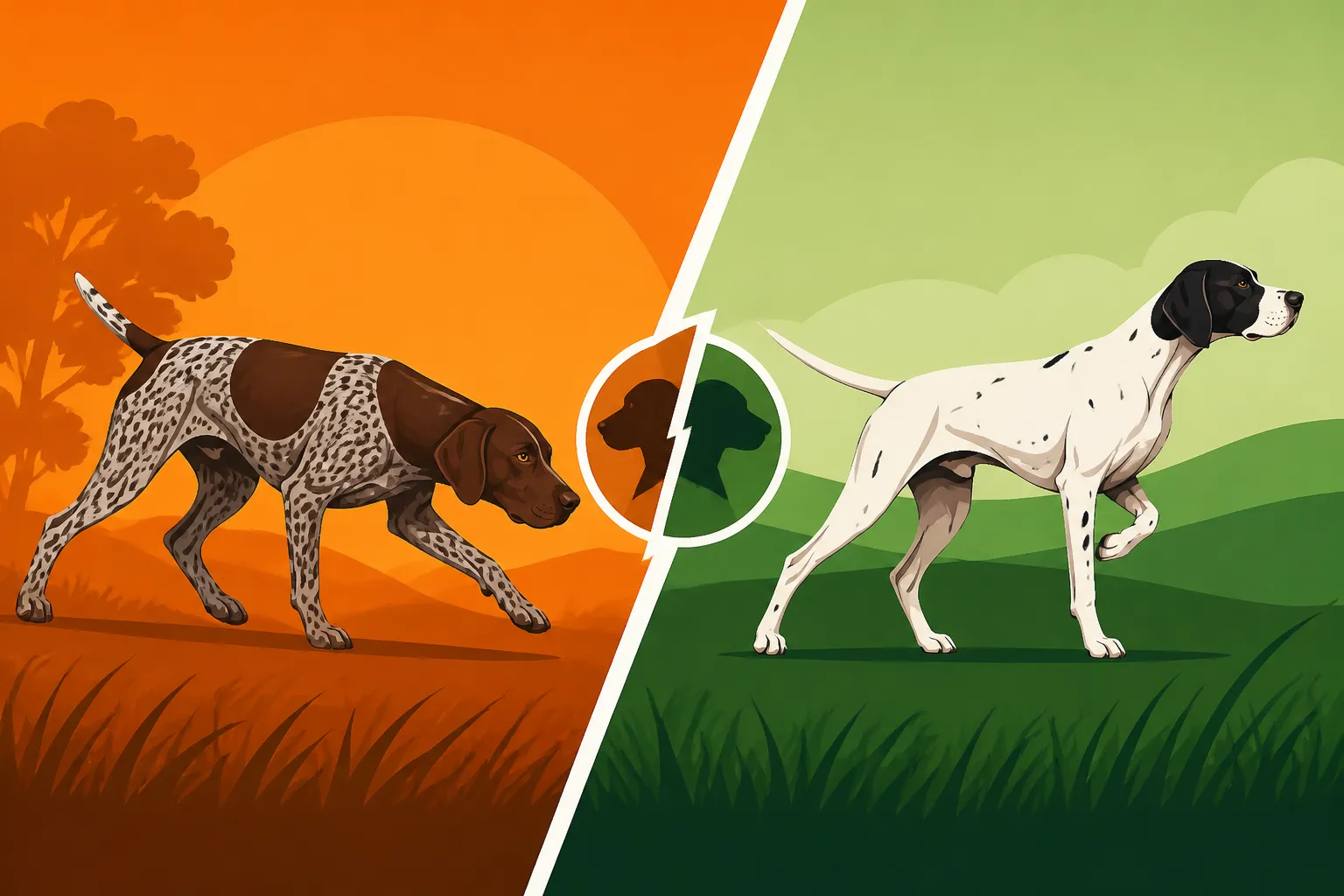
Both breeds are athletic pointing dogs, and both are expected to move efficiently. At a glance, a viewer may notice that an English Pointer seems to have a more sweeping or open stride, while a German Shorthaired Pointer may look more compact and balanced. That can be a useful first impression, but it is not a strict rule separating every dog of one breed from every dog of the other.
An individual English Pointer may have a shorter-looking stride in a slow trot; an individual Shorthair may travel with a very open, flowing action. The dog’s proportions, pace, conditioning, and the ground underfoot can change the impression. A handler who lets one dog trot freely while holding the other tight on a short lead is not making a fair comparison.
The useful distinction is therefore not “one breed moves correctly and the other does not.” It is that each breed has its own overall type and standard, and gait should be considered as part of that picture. For a broader comparison of the breeds’ differences, read The German Shorthaired Pointer Against the English Pointer.
Why “ground-covering” does not mean “always faster”
People sometimes use “ground-covering” as shorthand for a dog that seems to travel a long distance with each stride. It does not mean that the dog must always be moving at top speed, nor does it prove that it is more athletic than another dog. A longer stride can look impressive, but efficiency depends on the whole movement being coordinated and sustainable.
Imagine two dogs trotting beside their handlers on a wide, level path. One takes a slightly longer stride, while the other uses a quicker, shorter rhythm. Either could be moving comfortably and efficiently. If one dog is straining on its lead, overreaching, or losing balance around turns, the long stride alone does not make its gait better.
This is why experienced observers look at more than stride length. They watch whether the feet land consistently, whether the body stays steady, whether the dog appears comfortable, and whether the gait remains coordinated as the pace changes. They also consider the dog’s build and proportions, rather than comparing two dogs as though they had identical bodies. The standard’s size and weight context is discussed in The Inches at the Withers a Shorthair Is Judged On and The Weight Range in the Shorthair Standard.
| What you notice | What it may suggest | What to keep in mind |
|---|---|---|
| Smooth, even trotting | Coordinated movement at that pace | Check more than one pass and use level, nonslip ground |
| A long, sweeping stride | Open reach or a faster pace | Stride length alone does not establish soundness or breed type |
| A more compact-looking action | A different build, pace, or individual style | Compare dogs moving at a similar speed |
| Head bobbing, uneven steps, or repeated shortening of one stride | Possible discomfort or difficulty | Stop the exercise and seek veterinary guidance if it persists |
| A dramatic change after hard exercise | Fatigue, soreness, or an injury may be involved | Allow recovery and pay attention to whether the change continues |
Field lines and show lines can shape what you see
German Shorthaired Pointers are not all bred with precisely the same priorities. Some lines are selected heavily for field work, while others are more commonly seen in conformation settings. That does not mean every field-bred Shorthair moves one way or every show-bred Shorthair another; it does mean that the overall look and style of movement can vary between individuals and breeding programs.
At a field event, a dog may be moving quickly, searching, turning, and responding to scent. In a show ring, the handler may present the dog at a controlled trot so an observer can assess its outline and movement. Those are different tasks, and they can create different impressions. For more background, see The Split Between Field and Show Shorthairs and How Shorthair Field Lines and Show Lines Diverged.
A dog’s purpose is not determined by gait alone. Breeding history, training, temperament, health, and the dog’s actual work all matter. A show-bred Shorthair may still have hunting ability, and a field-bred dog’s movement should still be judged as part of its individual structure and comfort. Whether a Show Bred Shorthair Can Still Hunt offers more context on that distinction.
How to compare the two breeds fairly
Watch both dogs at the same pace
If you are comparing a German Shorthaired Pointer with an English Pointer, begin with a calm walk and then observe each dog at a relaxed trot. Use a broad, level surface with good traction. Watch from the side to see stride and body balance, then from the front and rear to notice whether the legs track consistently.
Try not to compare one dog at a slow pace with another that is excited and running. A dog pulling toward a bird, greeting someone, or reacting to another dog may move with a different posture and rhythm. Give each dog time to settle, and look at several passes rather than making a conclusion from one brief moment.
It also helps to observe the dogs individually, not only side by side. A close comparison can make small differences seem more important than they are. The goal is to notice the overall pattern: whether movement is even, coordinated, and comfortable for that dog—not to declare a winner based on who looks flashier.
Make the viewing surface part of the assessment
Slippery tile, polished concrete, loose gravel, and deep mud can all distort what you see. A dog that is trying not to slip may shorten its stride, spread its feet, or move cautiously. If you are checking movement at home, choose a level outdoor path or a firm floor with secure footing.
For a slick indoor area, a washable nonslip runner can help create safer footing for ordinary movement. A retailer such as Chewy may be one place to look for floor runners or other basic dog-care supplies. The key is not to use equipment to disguise a gait problem; it is to give the dog a stable surface so you can observe natural movement more clearly.
Keep the session brief and low-key. You do not need to make a dog run repeatedly to assess its normal walk and trot. If the dog seems sore, reluctant, or unusually tired, stop rather than trying to coax out a better-looking pass. Conditioning and workload can affect movement too; Conditioning a Shorthair Before Opening Day explores preparation for field activity.
When a gait change deserves attention
Notice changes from the dog’s usual movement
A dog’s normal gait is personal. A sudden change may matter more than whether its stride matches an idealized picture of the breed. Watch for limping, repeatedly favoring one leg, stiffness after rest, reluctance to jump or climb, an unusual head movement while walking, or a change that keeps returning after exercise.
A hard-running Shorthair may come home tired, but persistent unevenness should not be dismissed as simply part of being active. Pay attention to when the change appears, which leg seems affected, what the dog was doing beforehand, and whether the movement improves or worsens with rest. A short video taken from the side and front may help your veterinarian understand what you observed, provided recording it does not delay care.
If a dog suddenly cannot bear weight, appears to be in significant pain, or has a serious injury, contact a veterinarian promptly. For a mild but recurring change, arrange an examination rather than trying to diagnose the cause from gait alone. The hips, elbows, paws, muscles, and other parts of the body can influence how a dog moves.
Check everyday factors without assuming they are the cause
Overgrown nails, sore pads, burrs between the toes, and small cuts can affect how a dog places its feet. After a field outing, check the paws and legs, especially if the ground was rough or the dog ran through cover. A simple post-hunt check can catch visible problems, but it cannot rule out an injury that needs veterinary attention.
If nail length is making you wonder whether the feet are landing normally, a suitable nail trimmer may be available through retailers such as Chewy. Introduce nail care calmly and trim only what you can safely see; ask a veterinary professional or groomer for help if your dog is fearful or the nails are difficult to manage. The point is to support comfortable movement, not to force a dog to tolerate a stressful grooming session.
Comfortable movement also depends on maintaining a suitable body condition and adjusting activity to the dog’s age and fitness. A dog that has spent a quiet winter may need a gradual return to strenuous work rather than a sudden long day in the field. If you are trying to understand how much breed type and build influence motion, The German Shorthaired Pointer Against the Vizsla provides another comparison, while the most important reference for a particular dog remains its own normal movement and veterinary assessment.
Disclaimer
This article is for general informational purposes only and does not constitute professional advice. Laws, prices and regulations vary by location and change over time. Consult a qualified professional for guidance on your specific situation.