Whether an Eighty Pound Shorthair Is Overweight
It’s a common moment for German Shorthaired Pointer owners: you put your big, beautiful dog on the scale at the vet, and the number flashes up. Eighty pounds. Immediately, a little alarm bell might go off in your head, especially if your shorthair is a female or on the smaller side. You look at your powerful, energetic companion and wonder, "Is this too much? Is my eighty-pound shorthair overweight, or is this just a big, healthy GSP?" This guide is here to help you understand what a healthy weight looks like for a German Shorthaired Pointer, how to properly assess your dog's condition, and what steps to take if they truly need to shed some pounds.
Understanding the German Shorthaired Pointer Standard Weight Range
When we talk about weight, it's easy to get fixated on a number. But for a breed like the German Shorthaired Pointer, that number can be highly variable and still be perfectly healthy. These are athletic, muscular dogs, and eighty pounds might mean something entirely different for one GSP versus another.
What the Breed Standard Says About Weight
The American Kennel Club (AKC) breed standard for German Shorthaired Pointers gives us a general guideline, but it’s important to remember these are guidelines, not strict rules. Typically, males are expected to weigh between 55 and 70 pounds, and females between 45 and 60 pounds. You can immediately see that eighty pounds is quite a bit above the average range for a male, and significantly over for a female. However, these standards also account for height, with males usually standing 23-25 inches at the shoulder and females 21-23 inches. A particularly tall, heavily muscled male at the upper end of that height range might naturally carry more weight.
It's less about hitting an exact number on the scale and more about the overall build: a GSP should look lean, powerful, and athletic. They are built for endurance, for covering ground all day, and for that, they need to be efficient machines, not burdened by excess fat. If your dog is a big-boned male who stands tall and wide, eighty pounds might not be as concerning as it would be for a more delicate, smaller female.
Factors Influencing a GSP's Healthy Weight
Many things factor into what "healthy" looks like for your individual German Shorthaired Pointer. It's not just a blanket statement for the breed.
Firstly, sex plays a huge role. An eighty-pound female German Shorthaired Pointer is almost certainly overweight, as this far exceeds the typical healthy range for even the largest females. An eighty-pound male, however, while on the higher end, could potentially be healthy if he's exceptionally tall and muscular.
Secondly, muscle mass is critical. German Shorthaired Pointers are powerful dogs, and a well-conditioned hunting dog will carry a lot of lean muscle. Muscle weighs more than fat, so a fit, muscular GSP will naturally weigh more than one with less muscle tone, even if they have the same amount of body fat. Think about a seasoned athlete versus someone who's rarely active; their weights might differ significantly due to muscle density.
Lastly, activity level is paramount for a GSP. These are not couch potatoes. A German Shorthaired Pointer that is actively hunting several times a week, running miles, or engaged in intense training sessions for field trials or competitive events will naturally have a more developed musculature and a higher metabolism. A GSP that gets less exercise, even if fed the same amount, is far more prone to putting on unhealthy weight. This is why The Two Hours a Day a German Shorthaired Pointer Needs isn't just a suggestion; it's a requirement for their well-being. Regular, intense exercise is key to maintaining a lean, athletic physique, and without it, even a moderately sized GSP can quickly become overweight.
Assessing Your Shorthair's Body Condition Beyond the Scale
The number on the scale is just one piece of the puzzle. The most accurate way to determine if your German Shorthaired Pointer is at a healthy weight is through a Body Condition Score (BCS) assessment. This involves using your eyes and hands to evaluate fat reserves. It’s a method widely used by veterinarians and seasoned dog owners because it accounts for individual variations in bone structure and muscle mass, giving you a more complete picture than just pounds.
The Rib Test and Tuck-Up
The "rib test" is a simple but effective way to gauge your GSP's condition. You should be able to easily feel your dog’s ribs without having to press hard. If you can see their ribs clearly without them being underweight, that's often a good sign of leanness. However, for most German Shorthaired Pointers, the ideal is to feel the ribs distinctly, like feeling the knuckles on your hand, but without them protruding sharply. If you have to dig your fingers in to locate the ribs, your dog is likely carrying too much fat. Conversely, if the ribs are strikingly obvious with no fat padding, your dog might be too thin.
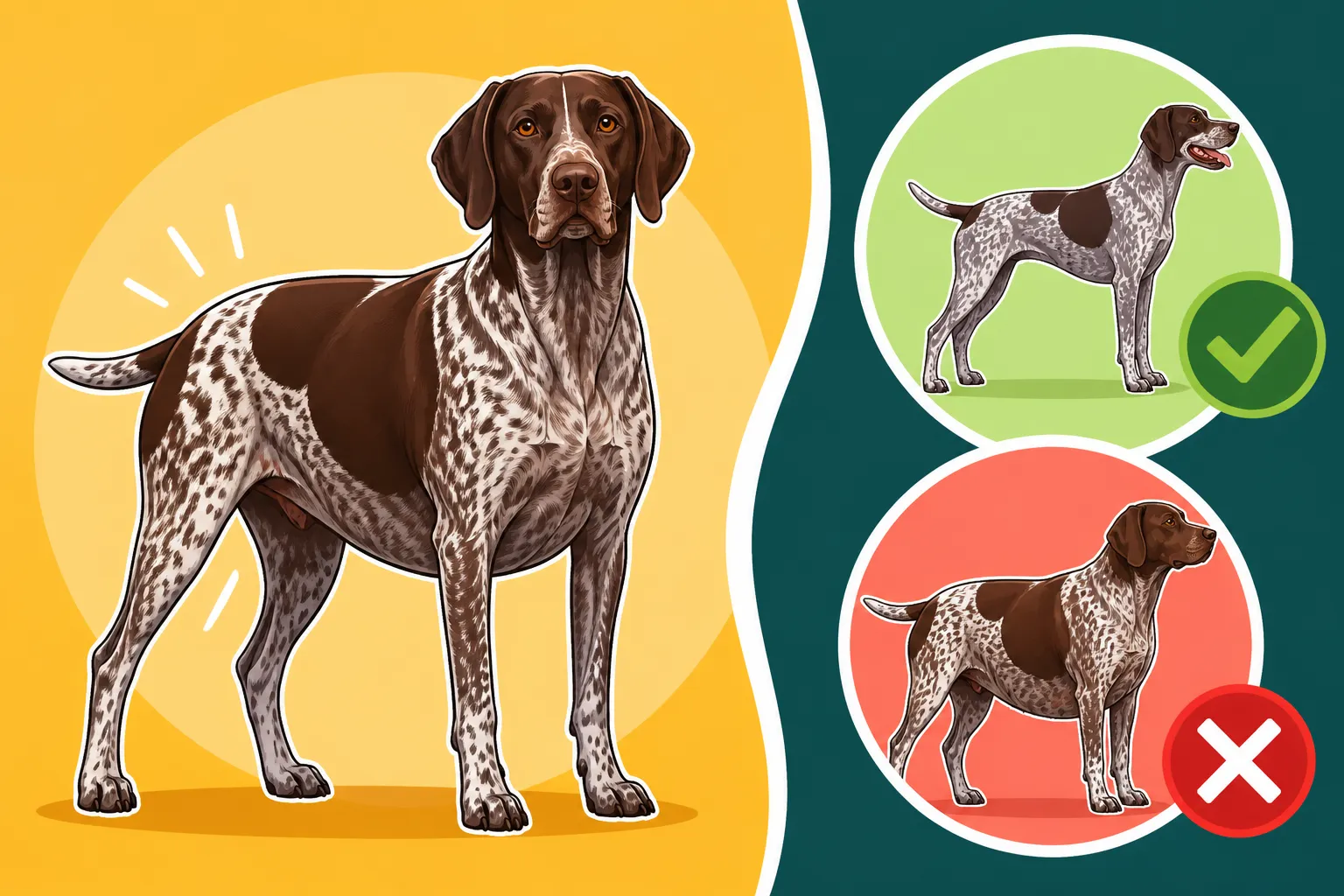
Next, observe the "tuck-up." When looking at your shorthair from the side, their abdomen should visibly tuck up from their chest towards their hind legs. There should be a distinct upward curve. This indicates a lean body mass and minimal abdominal fat. If your GSP has little to no tuck-up, and their belly hangs straight down or even bulges, it’s a strong indicator of excess weight. Even a well-muscled eighty-pound GSP should have a noticeable tuck-up.
The "Hourglass" Figure and Muscle Definition
Another visual cue is the "hourglass" figure. When you look down at your German Shorthaired Pointer from above, you should see a waistline. Their body should narrow slightly behind the ribcage, creating that subtle hourglass shape before widening again at the hips. If your dog has a straight, cylindrical shape from ribs to tail, or if their sides bulge outwards, they are probably overweight.
Beyond shape, pay attention to muscle definition. A healthy, active German Shorthaired Pointer should have visible muscle tone, especially in their hindquarters and shoulders. These are powerful dogs, and their muscles should feel firm and defined when you run your hands over them. If your GSP feels soft or squishy, with an absence of clear muscle contours, it's a sign that fat has replaced muscle or is covering it. The goal is a hard, fit physique, ready for How Long a Working German Shorthaired Pointer Stays Sound.
Here's a simple Body Condition Score (BCS) table to help you assess your GSP:
| Score | Description (Visual & Palpation) | Interpretation |
|---|---|---|
| 1 | Ribs, spine, pelvic bones easily visible from a distance. No fat layer. Severe muscle loss. | Underweight |
| 2 | Ribs easily visible, other bones prominent. Minimal fat. Slight muscle loss. | Underweight |
| 3 | Ribs easily felt, minimal fat cover. Obvious waist, abdominal tuck-up. | Ideal/Lean |
| 4 | Ribs palpable but with slight fat cover. Waist visible but not prominent. | Slightly Overweight |
| 5 | Ribs difficult to feel under moderate fat. No waist, abdomen level with chest. | Overweight |
| 6 | Ribs very difficult to feel. No waist, abdomen rounded and pendulous. | Obese |
For a hunting German Shorthaired Pointer, a score of 3 is often ideal, sometimes a lean 2 during peak season. You should definitely be able to feel those ribs. If you're struggling to feel the ribs, or if there's no visible tuck-up or waist, your eighty-pound GSP is likely carrying too much weight, regardless of their height or perceived bone structure. This often means that even if they are a large dog, they are still considered overweight according to ideal health standards for their breed.
Potential Health Risks of an Eighty-Pound Overweight Shorthair
Carrying extra weight, especially twenty pounds or more over the breed standard for a German Shorthaired Pointer, isn't just about appearance. It significantly impacts their health, quality of life, and longevity. The very traits that make GSPs such incredible athletes – their drive, speed, and endurance – are compromised, and they become more susceptible to a range of serious health issues.
Joint Strain and Orthopedic Issues
Excess weight puts immense pressure on a dog's joints, accelerating wear and tear. For a highly active, athletic breed like the German Shorthaired Pointer, this is particularly concerning. GSPs are already predisposed to orthopedic conditions such as hip and elbow dysplasia. An eighty-pound shorthair carrying excess fat will exacerbate these existing tendencies, leading to earlier onset, more severe pain, and faster progression of arthritis. Imagine running miles on the field with an extra twenty-pound backpack; that's what your GSP's joints are experiencing.
Weight can also contribute to Torn Cruciates in a Field Bred German Shorthaired Pointer. These knee injuries are painful and often require costly surgery and a lengthy recovery. Overweight dogs are far more likely to tear their anterior cruciate ligament, and the recovery process is much harder for them. Beyond these major issues, every joint – from their shoulders to their toes – is under increased strain, leading to chronic pain and reduced mobility, which is heartbreaking for a dog bred to run and explore.
Cardiovascular Health and Heat Tolerance
Being overweight takes a toll on the cardiovascular system. The heart has to work harder to pump blood throughout a larger body mass, which can contribute to high blood pressure and other heart-related problems over time. For a dog known for its boundless energy and endurance, compromised heart health can severely limit their ability to exercise, creating a vicious cycle where less activity leads to more weight gain and further decline.
German Shorthaired Pointers, with their short coats, are often seen as relatively heat tolerant, but excess body fat acts as an insulator, making it much harder for an overweight dog to dissipate heat. This dramatically increases their risk of Heat Exhaustion in an Early Season Shorthair or even heatstroke, especially when working in warm weather. A dog that struggles to cool down can quickly find itself in a life-threatening situation, even on days that wouldn't bother a fit GSP. Their capacity to perform in the field is severely hampered, and even a walk on a sunny day can become dangerous.
Other Metabolic Concerns
The metabolic consequences of obesity extend beyond joints and heart health. Overweight dogs are at a higher risk for developing diseases like diabetes, where their bodies struggle to regulate blood sugar. Their immune systems can also be negatively impacted, making them more susceptible to infections and slower to recover from illnesses or injuries.
Furthermore, an overweight German Shorthaired Pointer will generally have a reduced quality of life. They'll have less energy, be less playful, and may even experience discomfort when simply lying down or getting up. This impacts their mental well-being as much as their physical. Ultimately, being significantly overweight can shorten a GSP's lifespan, denying you and your companion precious years together. It truly impacts The Median Age a German Shorthaired Pointer Reaches.
When an Eighty-Pound Shorthair Might Be Healthy (Exceptions)
While eighty pounds is certainly on the high side for a German Shorthaired Pointer, and often indicates an overweight condition, there are indeed rare instances where a GSP might naturally carry this much weight and still be considered healthy and fit. It really comes down to individual genetics and build, emphasizing why the Body Condition Score (BCS) is so crucial.
Large Bone Structure and Muscle Mass
Some German Shorthaired Pointers are simply built larger than others. This isn't about being fat; it's about having a heavier bone structure and naturally greater muscle mass. A particularly tall male, standing at the very top of the breed standard's height (25 inches at the shoulder) or even slightly above it, might possess a more substantial skeletal frame. If such a dog is also exceptionally well-conditioned, with powerful, dense musculature from consistent, intense work, they could legitimately weigh 80 pounds and still be lean.
Think of a human athlete: a bodybuilder might weigh more than a marathon runner of the same height, but neither is necessarily "overweight" in an unhealthy sense. For GSPs, this usually applies to intact males, as they tend to carry more muscle mass than females. A male GSP who is actively competing in field trials, hunting hard all season, or engaged in other demanding canine sports will develop significant muscle definition. In these rare cases, the eighty pounds is made up of solid muscle and bone, not excess fat. When you look at them, you see power and athleticism, not a round, soft body.
Importance of Individual Assessment
This is where the nuances of individual assessment become critical. You cannot simply look at the number 80 on the scale and automatically declare your GSP overweight. You must apply the principles of the Body Condition Score.
Even a large, heavy-boned, muscular eighty-pound male GSP should still:
- Have easily palpable ribs without pressing hard. You should feel them distinctly, almost like the knuckles on your hand, with just a thin layer of fat.
- Display a clear waistline when viewed from above (the "hourglass" figure).
- Exhibit a noticeable abdominal tuck-up when viewed from the side.
- Have visible muscle definition, especially over the loin and hindquarters.
If your eighty-pound GSP meets these criteria – feeling hard and lean, with clear body contours and muscle definition – then that weight might indeed be healthy for that specific dog. This is particularly true if they are a male in the prime of their working life. However, if any of these BCS markers are absent, or if you struggle to feel their ribs or see their waist, then despite their potential size, that eighty pounds includes unhealthy excess fat. Always prioritize the visual and tactile assessment over a static number on the scale. For a detailed guide on what to feel for, check out Whether You Should See a German Shorthaired Pointer's Ribs.
Steps to Manage Your Shorthair's Weight
If, after careful assessment using the Body Condition Score, you've determined that your eighty-pound German Shorthaired Pointer is indeed carrying too much weight, it's time to take action. Weight management is a marathon, not a sprint, and requires consistency and a multi-pronged approach involving diet, exercise, and regular veterinary oversight.
Nutrition Adjustments
The first place to look is always the food bowl. It’s incredibly easy to overfeed an active breed like a GSP, especially if their activity level has dipped for any reason.
Start by evaluating the quality and quantity of their current food. A high-quality kibble designed for active breeds is essential, but even the best food can cause weight gain if too much is offered. Often, people inadvertently feed more than the recommended guidelines, or the guidelines on the bag are too generous for their particular dog's metabolism or current activity level. Brands like Ollie and other fresh or high-quality performance kibbles often have clearer feeding instructions, but always remember these are starting points. Consider switching to a weight management formula if your GSP needs to lose a significant amount of weight, as these diets are typically lower in calories but still provide essential nutrients.
Portion control is absolutely key. Measure out your dog’s food precisely with a measuring cup. Don't just eyeball it. It might sound trivial, but a little extra kibble each day adds up quickly. Divide their daily allowance into two meals to help with satiety. And let’s be honest: table scraps, treats, and random pieces of cheese or kibble handed out throughout the day can sabotage any diet. These "extra" calories can be surprisingly high. Limit treats, and when you do give them, choose low-calorie options or use small pieces of their regular kibble. For more on what these active dogs need, delve into Feeding a Dog That Burns What a Shorthair Burns and Calorie Needs of a German Shorthaired Pointer in Season. If your shorthair is prone to counter-surfing, ensure food is secured to prevent them from getting extra calories on their own, as discussed in What a German Shorthaired Pointer Steals Off Counters.
Exercise Regimen Enhancements
More calories out means more weight lost. German Shorthaired Pointers thrive on vigorous exercise, and increasing their activity level is a fantastic way to burn calories, build lean muscle, and improve their overall health. This isn't just about longer walks; it's about intensity and variety.
If your GSP is currently getting one sedate walk a day, it’s simply not enough for their breed needs. Aim for Ninety Minutes of Real Exercise for a Shorthair daily, and ideally more. Incorporate activities that get their heart rate up and challenge their muscles. Running, swimming, retrieving games, or even long hikes are excellent options. Swimming is particularly good as it's low-impact on their joints, which is crucial for an overweight dog. Start slowly and gradually increase the duration and intensity of exercise to avoid injury, especially if your dog is significantly overweight. Just like with humans, sudden bursts of extreme exercise can do more harm than good. Consistency is far more important than sporadic, intense sessions. You'll be amazed at how much regular, vigorous activity can transform their physique and their mood.
Regular Vet Check-ups
Before embarking on any significant weight loss journey, a visit to your veterinarian is crucial. They can accurately assess your GSP's Body Condition Score, discuss an appropriate target weight, and help you create a safe and effective weight loss plan. More importantly, they can rule out any underlying medical conditions that might be contributing to weight gain, such as hypothyroidism or other metabolic issues, or that might make certain exercise regimens unsafe. The Vet Schedule a Working Shorthair Should Keep is not just for puppies; it’s vital throughout their lives, especially when health concerns arise.
Your vet can also recommend specific dietary foods, portion sizes, and exercise protocols tailored to your dog's age, current health status, and desired weight. They can monitor your GSP's progress, making adjustments as needed, and provide invaluable support and guidance throughout the process. Tools like a pet food portion calculator or specific dietary plans available through veterinary clinics or reputable online retailers like Chewy or Amazon can also be helpful. Remember, you're not alone in this journey, and professional guidance makes all the difference in achieving a healthy, lasting change for your eighty-pound GSP.
Disclaimer
This article is for general informational purposes only and does not constitute professional advice. Laws, prices and regulations vary by location and change over time. Consult a qualified professional for guidance on your specific situation.