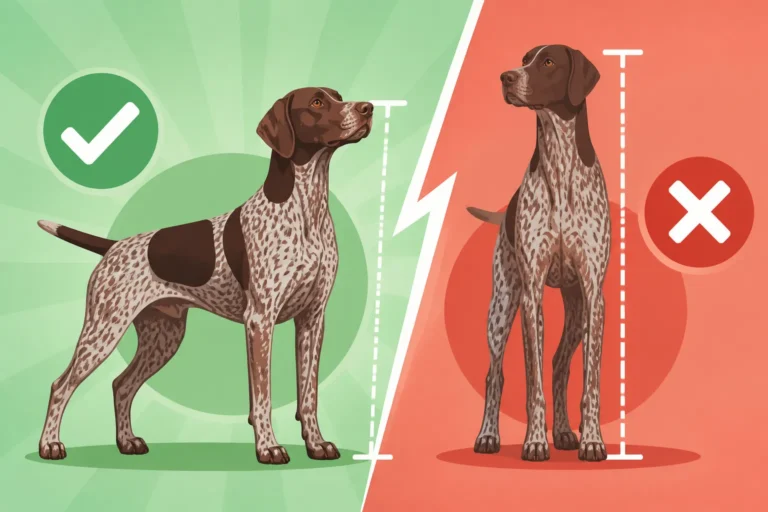
Telling a Shorthair From a Weimaraner at a Distance
At a distance, a gray dog with a sleek coat can look like a German Shorthaired Pointer, especially when you can’t see its markings clearly. The most useful clues are coat color, overall shape, head and ears, and the way the dog carries itself. This guide explains what to look for—and which clues can mislead you.
Start with the coat and color
Look for gray versus patterned markings
The quickest clue is often the coat. A Weimaraner is typically a single shade of gray, ranging from a lighter silver-gray to a darker, mouse-gray tone. From far away, that coat can look almost uniform, which is one reason the breed is sometimes mistaken for a solid-colored German Shorthaired Pointer.
A German Shorthaired Pointer, often called a Shorthair or GSP, can have a more varied pattern. Common coats include liver and white, black and white, roan, or solid liver or black. At a distance, the white areas may blur into the background, and a heavily roaned dog can appear nearly solid. Still, if you can make out patches, ticking, or a speckled look, you may be looking at a Shorthair rather than a Weimaraner.
Lighting and surroundings matter. In low light, a liver GSP can look gray-brown, while a pale Weimaraner may seem almost white. On a muddy trail or in dry grass, a dog’s coat can also be partly hidden. Don’t decide from color alone if you can get a better look at its build or face.
For a closer look at the coat patterns a Shorthair may have, see Liver and White Patterns on a Shorthair and Solid Black and Black Roan German Shorthaired Pointers. Those patterns can make the breed easier to distinguish when the dog is standing in clear light.
Check whether the color looks truly solid
A solid-looking coat does not automatically mean the dog is a Weimaraner. Some German Shorthaired Pointers are solid liver or solid black, and a dark, densely ticked dog may appear more uniform from far away than it does up close. If you see a clear single gray tone without obvious patches or flecks, the Weimaraner becomes more likely, but it is not the only possibility.
Look at more than the back and sides. White markings on a GSP may show up on the chest, toes, or face even when its body appears mostly dark. Conversely, a dog’s coat may be dusty, wet, or shadowed enough to hide details. When the coat offers no obvious answer, move on to the head, ears, and outline.
If you are comparing two dogs you own, visible gear can help you tell them apart without relying on breed features. Owners sometimes choose contrasting collars or reflective accessories from retailers such as Chewy, especially for evening walks or trips to a wooded park. Gear is useful for identifying an individual dog, but it does not tell you what breed the dog is.
Compare the outline, head, and ears
Notice the body shape without relying on size alone
Both breeds are athletic, deep-chested pointing dogs, and their heights can overlap. A tall GSP may look larger than a smaller Weimaraner, while a lean dog in motion may seem taller than it is. Size can be a supporting clue, but it is not dependable enough to make the call on its own.
From the side, a Weimaraner often looks long and elegant, with a smooth, streamlined outline. A German Shorthaired Pointer may look similarly athletic, but its body can appear a little more compact or muscular, particularly in a field-bred dog. Individual variation is real: show and field lines can differ in build, and fitness, age, and posture can change how a dog looks. The article The Size and Build the Shorthair Standard Asks For offers more context on the GSP’s general proportions, while The Split Between Field and Show Shorthairs explains why not every Shorthair has the same silhouette.
At a distance, pay attention to the balance of the whole dog. Does it look tall and smooth, or more compact and strongly built? Treat that impression as one piece of evidence, not a verdict. A dog trotting toward you, standing on uneven ground, or wearing a thick vest can look very different from its usual outline.
Use the head and ears as supporting clues
Both breeds have dropped ears, so “floppy ears” alone won’t settle the question. A Weimaraner’s ears are generally long and broad, hanging close to the head. A GSP’s ears also hang down, but may look shorter or more rounded in proportion to the head. Distance, wind, and movement can make this distinction hard to judge, so use it only when you have a clear view.
The head can offer another clue. A Weimaraner often has a long, refined-looking head and a distinctive, elegant profile. A GSP’s head may appear broader or more robust, with a pronounced muzzle. Yet these are subtle differences, especially when a dog is facing away or looking down to sniff.
If you’re watching from across a field, wait for the dog to turn sideways or lift its head. A still, side-on view may reveal more than a quick glimpse of its face. Don’t approach an unfamiliar dog just to inspect its features; observe from a safe distance and let its handler decide whether contact is appropriate.
Read the movement, tail, and eyes carefully
Watch how the dog moves
Both breeds were developed as versatile hunting dogs, so a purposeful, athletic gait is not unique to either one. A GSP may cover ground quickly, range ahead, and move with an energetic, working-dog style. A Weimaraner can be equally active and athletic. A dog’s behavior in a particular moment—running, sniffing, or standing alert—does not confirm its breed.
Instead, look for the overall impression of movement alongside the coat and outline. Does the dog seem long-legged and fluid? Does its body look more compact and powerful? If it is working in open ground, it may be moving quickly enough that you only catch its general shape. The GSP’s appearance can vary considerably by line and individual, as discussed in The German Shorthaired Pointer Against the Weimaraner.
A quick observation is often inconclusive. For example, a gray dog running through a shaded field may look like a Weimaraner at first, then appear to have a GSP’s ticking when it pauses in sunlight. If the difference matters—because you are trying to identify a lost dog, for instance—take a clear photo from a respectful distance and share it with the dog’s handler or a local animal professional rather than guessing from a fleeting glimpse.
Don’t make the tail or eye color your deciding clue
Tail length is a tempting shortcut, but it can mislead. Some GSPs have docked tails, and many Weimaraners have traditionally been seen with docked tails in parts of the world. Natural tails are also seen, and practices vary by location and individual. A short tail may fit either breed; a longer tail does not rule either one out.
Eyes are also easier to interpret up close than at a distance. Weimaraners are known for light-colored eyes, which may appear amber, gray, or blue-gray depending on the dog and its age. GSP eyes are often darker, but the color may be impossible to judge outdoors, in shadow, or while the dog is moving. A puppy’s eye color can differ from how it looks as an adult, so avoid treating one glance as proof.
If you’re identifying two dogs that regularly walk together, practical visual cues are more dependable than trying to spot tail or eye differences. Distinctive collars, tags, or reflective gear can help handlers keep track of each dog. Chewy is one place owners may browse for dog accessories, but check that any item fits properly and is suitable for the dog’s activity. If the dogs are off leash, equipment should never replace reliable recall, supervision, or compliance with local leash rules.
Make a confident identification without overrelying on one clue
Use a simple comparison checklist
When you have only a few seconds to identify a dog, compare several features at once. A mostly uniform gray coat, a long and elegant outline, and light-looking eyes point toward a Weimaraner. A liver-and-white or black-and-white pattern, visible ticking, or a more compact impression points toward a German Shorthaired Pointer. None of these signs is infallible, but several matching clues make your guess more informed.
| Feature | More typical of a German Shorthaired Pointer | More typical of a Weimaraner |
|---|---|---|
| Coat at a glance | Often liver or black with white, roan, or ticking; some are solid | Usually a uniform shade of gray |
| Body outline | Athletic and sometimes more compact or muscular | Often appears long, sleek, and elegant |
| Ears | Dropped, often appearing shorter in proportion | Dropped and often appearing long and broad |
| Eyes from close range | Commonly darker | Often light in color |
| Tail | May be docked or natural | May be docked or natural |
Use the table as a field guide, not a breed test. Mixed-breed dogs, unusual coat patterns, grooming, lighting, and individual variation can all complicate a visual identification. A German Shorthaired Pointer may not fit the picture you have in mind, and a gray dog that resembles a Weimaraner may be a mix or another breed altogether. For related comparisons, The German Shorthaired Pointer Against the Vizsla and The German Shorthaired Pointer Against the English Pointer explore how other athletic pointing breeds can also be confused at a glance.
If you are comparing breeds because you hope to bring a dog home, spend time with dogs in person and talk with knowledgeable owners or breed clubs. Coat color and appearance are only a small part of the decision. Energy needs, training, health, and the fit with your household matter much more than whether a dog looks sleek from across a park.
Know when appearance cannot give you the answer
Some dogs simply cannot be identified reliably from far away. A solid-colored GSP may have no visible white markings at a distance. A gray Weimaraner in heavy shadow may look nearly black. A young dog may also have proportions and coloring that are still changing, while a senior dog’s coat or posture may look different from the familiar breed image.
If the dog is lost, injured, or behaving unpredictably, prioritize safety over identification. Keep your distance, note the location and direction of travel, and contact the appropriate local animal services or the dog’s handler if you can identify them. A photo may help, but don’t chase or corner an unfamiliar dog. If it is safe to do so, visible details such as collar color, markings, and approximate size can be more useful to responders than a confident but uncertain breed guess.
For a dog you see regularly, observe it in good daylight from more than one angle. A side view may show its proportions; a closer, calm view may reveal ticking, patches, ear shape, and eye color. If you’re identifying your own dogs during hikes or field outings, clearly different collars or other visible accessories can reduce mix-ups. Chewy may be a convenient retailer to check for such gear, though fit and visibility should guide your choice. The most reliable answer still comes from considering the dog as a whole rather than relying on a single feature.
Disclaimer
This article is for general informational purposes only and does not constitute professional advice. Laws, prices and regulations vary by location and change over time. Consult a qualified professional for guidance on your specific situation.