Public Figures Who Have Kept German Shorthaired Pointers
A famous face beside a pointing dog does not automatically make that dog a German Shorthaired Pointer. Breed names are often mixed up in celebrity roundups, and many posts never identify the dog at all. This guide explains how to separate confirmed ownership from guesswork, why public records are thin, and what a public figure’s choice can—and cannot—tell you about living with a Shorthair.
Why a reliable list of famous Shorthair owners is hard to find
There is no central, dependable record of which actors, athletes, politicians, or other public figures have kept German Shorthaired Pointers. Unlike show results or registered litters, private pet ownership is not consistently documented. A public figure may share a photo once, adopt a dog through a rescue without naming its breed, or keep a hunting dog largely out of view.
That makes lists of “celebrity German Shorthaired Pointers” easy to publish but difficult to trust. A confident caption can be repeated from one site to another until it looks established, even if the original post never identified the dog. For readers trying to learn about the breed, that matters: a dog that resembles a Shorthair may actually be a Vizsla, Weimaraner, Pointer, or mixed-breed dog.
A photo is not proof of breed or ownership
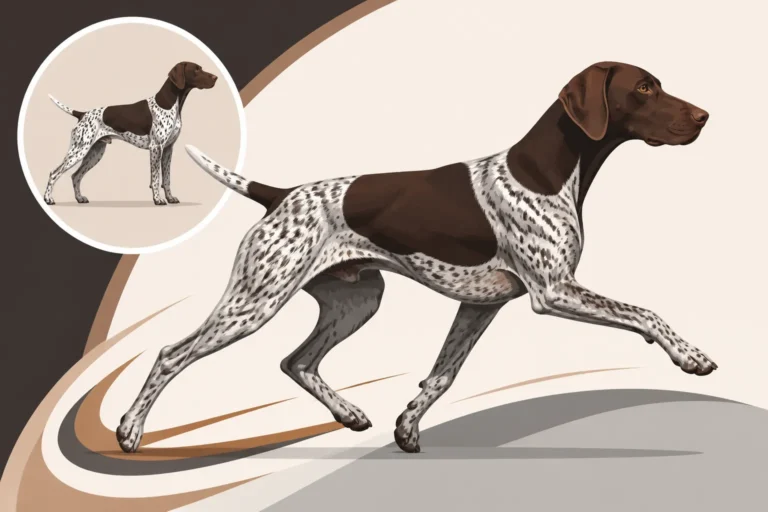
A short coat, long legs, and athletic build are not enough to identify a German Shorthaired Pointer. Several pointing breeds share those features, especially in a quick photograph or a video where the dog is moving. Markings can help, but they are not proof by themselves. Liver-and-white ticking, for example, is familiar on Shorthairs but does not establish a dog’s pedigree.
The relationship can also be misrepresented. A public figure may be walking a friend’s dog, meeting a dog at an event, or posing with an animal used in a film or advertisement. That is different from keeping the dog as a household pet. If a post or interview does not say who the dog belongs to, it is safer not to turn an appearance into an ownership claim.
A useful standard is to look for repeated, direct evidence: the person identifies the dog as theirs, identifies the breed, and refers to the dog as part of their life over time. A single image with a breed-ambiguous dog is a weak basis for a claim. If you are researching the breed’s history and working purpose, What Versatile Actually Means for a Shorthair offers a more dependable starting point than a celebrity photo gallery.
Breed mix-ups are common in public coverage
The German Shorthaired Pointer is frequently confused with other sporting dogs. A Vizsla may look similar at a glance, particularly in a cropped image, though its typical coat color differs. A Weimaraner is also a short-coated, athletic hunting breed and can be mistaken for a Shorthair when markings are not clear. Mixed-breed dogs complicate identification further.
Public posts often prioritize the moment—an outing, a game, a family snapshot—rather than accurate breed details. Even an article that labels a dog may have copied the description from another unverified page. That is why claims should be checked against the person’s own words or a clear, credible interview rather than repeated as fact because several websites say the same thing.
For prospective owners, the distinction is more than trivia. Breed-specific expectations around exercise, training, prey drive, and hunting ability do not reliably apply to a dog simply because it looks like a Shorthair. A thoughtful overview of the breed’s actual characteristics is available in The Household a German Shorthaired Pointer Actually Fits.
How to assess claims about public figures and their dogs
When an article promises a list of famous German Shorthaired Pointer owners, the best response is not to accept every name at face value. Check the trail behind the claim. Does it lead to a direct statement, a clearly identified dog, or a reputable interview? Or does it circle back to other listicles that provide no original evidence?
This does not mean public figures never keep Shorthairs. It means that personal ownership needs to be demonstrated rather than inferred. A careful account is more useful than a long list padded with uncertain names.
Look for direct identification
The strongest evidence is a public figure’s own description of the dog as a German Shorthaired Pointer, ideally in an interview, a personal post, or another direct account. A reliable profile may also identify the breed while describing the dog as a family pet or hunting companion. Specific, repeated references are more convincing than a caption added by someone else.
When checking a claim, ask three straightforward questions:
- Does the public figure say the dog is theirs?
- Does the public figure or a credible interview identify the dog as a German Shorthaired Pointer?
- Is there more than one piece of direct evidence, or is the claim based on a single photograph?
If the answer to the first two questions is unclear, the claim should be treated as unconfirmed. That’s a perfectly reasonable conclusion; it is better than assigning a breed or ownership history to a dog based on appearance.
It also helps to distinguish between a public figure who owns a Shorthair and someone who works with, features, or advocates for pointing dogs. Trainers, hunters, and outdoor communicators may appear with many breeds over the course of their work. Their professional connection to dogs is not by itself evidence that they personally keep a German Shorthaired Pointer.
Check whether the story is repeating itself
A claim repeated across several pages can feel well sourced, but repetition is not independent confirmation. If each page uses the same image and the same short description, they may all be copying one original, uncertain claim. Look for an interview or post that provides the details itself rather than simply repeating a breed label.
It is also worth checking the date and context of the material. A public figure may have had a dog years ago, while a newer page describes it as a current pet. An old photo may show a dog that belonged to a relative or a production. A post may identify the dog as a rescue or mix, while a later roundup confidently assigns a purebred label.
For a more grounded understanding of how field work, companionship, and breed background relate, read How the Shorthair Reached the United States and The German Shorthaired Pointer Against Its German Cousins. Those topics provide context without depending on celebrity associations.
| Evidence found | What it supports | What it does not prove |
|---|---|---|
| The public figure directly calls the dog a German Shorthaired Pointer | The person publicly identified the breed | Pedigree registration or the dog’s full ancestry |
| The person repeatedly refers to the dog as their own | A credible public account of ownership | That every dog shown with the person is theirs |
| A reputable interview identifies both owner and breed | A stronger documented ownership claim | That the dog represents every Shorthair’s temperament |
| A social photo shows a short-coated pointing dog | The person was pictured with a dog | Breed, ownership, or whether the image is recent |
| Multiple listicles repeat the same claim without original evidence | The claim has circulated online | That it has been independently verified |
What a public figure’s Shorthair can tell you about the breed
Even when ownership is confirmed, one person’s experience is not a breed guide. A public figure may have a trained hunting dog, a companion dog, or a dog whose daily routine is supported by a team, a rural property, or professional help. That lifestyle may be very different from the ordinary household routine a reader is planning.
It is natural to see a striking dog in a public setting and imagine the breed fitting neatly into your own life. But a polished photo does not show the early mornings, training sessions, muddy cleanup, vet visits, or careful exercise planning behind the scenes. The everyday fit deserves more attention than the owner’s fame.
A famous owner does not make the breed low effort
German Shorthaired Pointers are energetic, athletic dogs with a strong history as versatile hunting companions. Many need substantial daily exercise, training, and opportunities to use their noses and minds. A large yard can help, but it does not automatically provide structure, reliable recall, or satisfying activity. A brisk walk around the block may be a start, but it often does not meet the needs of a young, driven dog.
Imagine someone choosing a Shorthair after seeing a public figure take one on a hike. The image shows the enjoyable part. It does not reveal whether the dog has spent months learning to come when called, whether it can settle indoors afterward, or how its owner prevents unsafe chasing around wildlife and roads. Public visibility tends to show the adventure, not the consistent work around it.
For a realistic look at daily movement and activity, The Two Hours a Day a German Shorthaired Pointer Needs discusses why exercise is more than simply letting a dog into the yard. If a public figure’s dog appears calm in a video, that alone says little about the dog’s usual routine, age, training, or temperament.
Individual dogs and households vary
Two Shorthairs can differ in energy, confidence, sensitivity, hunting drive, and ability to settle. Breeding, early experiences, health, training, and daily routine all matter. A celebrity’s well-trained adult dog is not a guarantee that a puppy from the same breed will be easy to manage from day one.
The household setting matters, too. A person with flexible work, access to open space, or experience training sporting dogs may be able to meet needs that would be difficult for someone with a long commute and limited outdoor time. Neither situation makes one owner better than another; it simply changes what a responsible plan needs to include.
If you are weighing whether the breed fits your home, Whether a First Time Owner Can Handle a Shorthair and Whether a German Shorthaired Pointer Suits a Non Hunting Home can help you think through the practical trade-offs. It is more useful to compare your actual schedule and experience with the breed’s needs than to use a public figure’s lifestyle as a template.
What to learn from celebrity dog stories before choosing a Shorthair
Public figures can bring attention to a breed, but visibility should be the beginning of your research rather than the conclusion. A dog may look effortless in a photograph because the image captures a pleasant moment. Responsible ownership is mostly made up of ordinary, repeated tasks: exercise, training, feeding, grooming, health care, and safe management.
Before choosing a German Shorthaired Pointer, consider what your typical weekday looks like, not just what your best weekend looks like. Think about how the dog will get exercise during bad weather, who will handle training, and what happens when work or family commitments change. A puppy’s energy can be especially demanding, and a young dog may need active supervision rather than simply being expected to behave like a finished hunting companion.
Plan for the ordinary costs and care
Exercise and training are only part of the commitment. Food, preventive veterinary care, gear, boarding or pet care, and unexpected medical needs belong in the household plan as well. The exact needs vary by dog and location, so it is sensible to build a flexible budget instead of assuming that every Shorthair will cost the same to care for.
A retailer such as Chewy can be useful for comparing everyday supplies such as food, bowls, leashes, grooming tools, and enrichment toys. Those purchases do not replace advice from a veterinarian about nutrition or health, and a list of products cannot solve a mismatch between a dog’s needs and an owner’s schedule. Think of supplies as support for a care plan, not a substitute for one.
For hunting homes, practical equipment may include safe transport, field protection, and training gear suited to the dog’s work. Chewy may be one place to browse general pet supplies, while specialized hunting equipment may require a different retailer or advice from experienced local handlers. Choose equipment based on fit, safety, and the dog’s activity rather than on what appears in a celebrity photograph.
Let the dog’s needs—not the owner’s fame—guide your choice
A public figure may provide a useful example if they speak candidly about training, exercise, and the dog’s place in their home. But ownership alone does not establish that the breed is right for your circumstances. A dog can be beloved and still need more time, structure, or activity than a household can provide.
Talk with responsible breeders or rescue organizations about the particular dog in front of you. Ask what the dog is like indoors, how it responds to other animals, what exercise it is accustomed to, and what health or behavior concerns need attention. For a puppy, ask about the parents’ temperaments and health testing; for an adult dog, ask about its established routine and training history. Public fame does not answer those questions.
If browsing for food or everyday dog-care gear, Chewy can help you compare options, but product selection should follow your dog’s age, health, activity, and veterinary guidance. The best choice is not the one attached to a famous owner. It is the one that fits the individual dog and the real life you can offer.
The honest answer to the search for famous German Shorthaired Pointer owners is that a dependable list requires direct, breed-specific evidence, and many widely repeated celebrity claims do not provide it. Rather than treating uncertain names as fact, check the original account and keep ownership separate from appearance. And if you are considering a Shorthair yourself, focus on the dog’s needs and your household’s capacity to meet them consistently.
Disclaimer
This article is for general informational purposes only and does not constitute professional advice. Laws, prices and regulations vary by location and change over time. Consult a qualified professional for guidance on your specific situation.