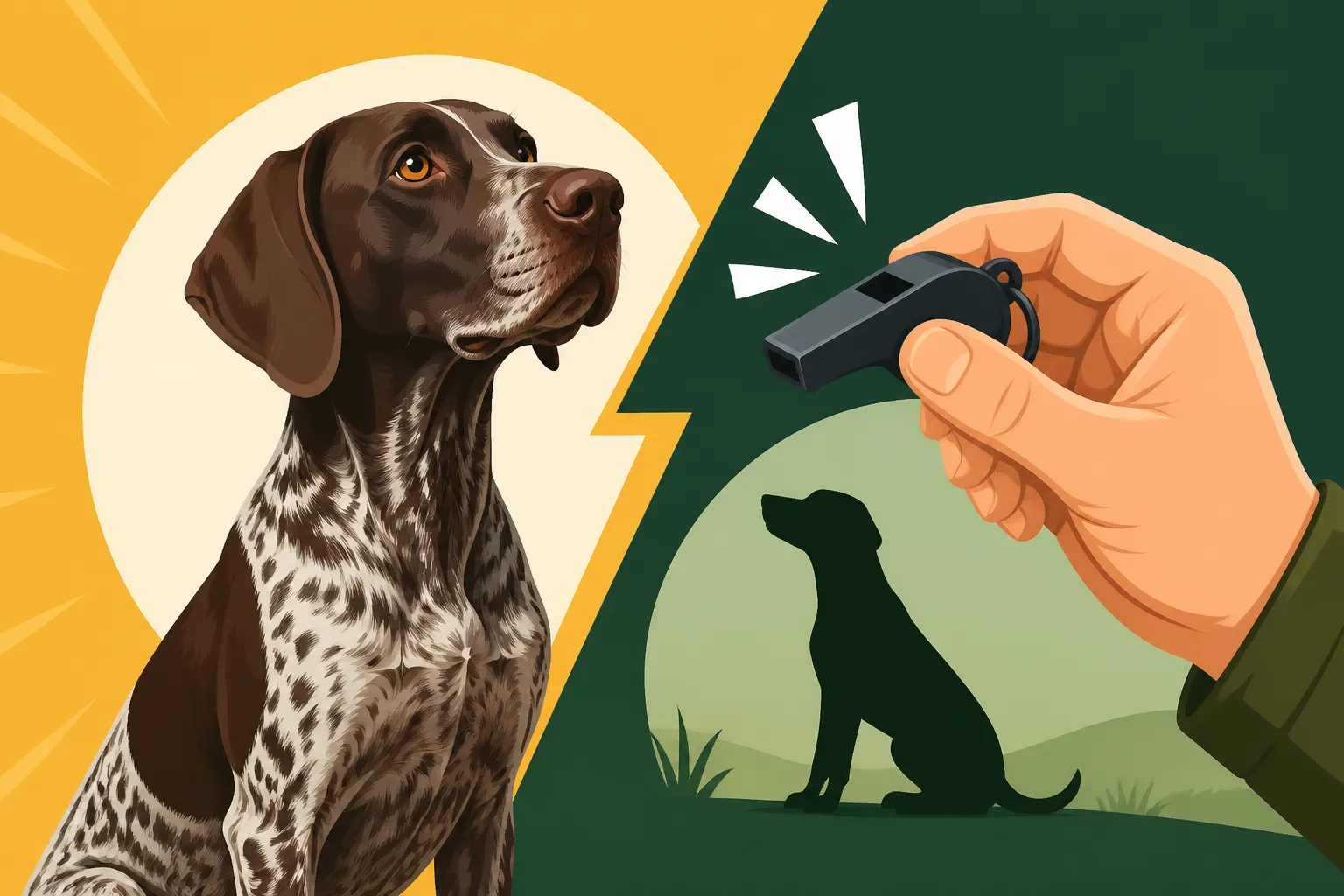
The Whistle Signals a Shorthair Learns First
One of the biggest joys, and sometimes the biggest headaches, of living with a German Shorthaired Pointer is their incredible drive and range. You might find yourself shouting yourself hoarse across an open field, feeling like your voice just isn't cutting through the excitement, or worrying about losing control when your dog's nose takes over. This guide is all about giving you the tools to communicate effectively, no matter the distance or distraction, by introducing the whistle signals that form the cornerstone of reliable control for your athletic GSP.
Why Whistle Signals are Non-Negotiable for a German Shorthaired Pointer
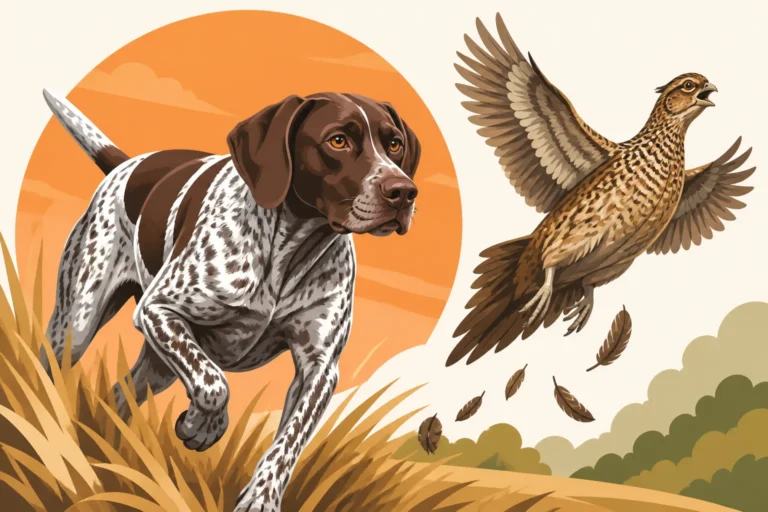
Let's be real, a German Shorthaired Pointer isn't a couch potato. They're bred to cover ground, to range out, and to pursue birds with an intensity that can make your heart pound. This incredible drive, while exhilarating to witness, also means that a simple verbal "come" or "stay" often isn't enough when they're twenty, fifty, or even a hundred yards away, lost in a scent cone or hot on a flush. Your voice simply doesn't carry as consistently or as distinctly as a whistle, especially when the wind picks up or the cover gets thick.
Imagine you're out in a sprawling field, and your GSP, utterly absorbed in its work, starts to get a little too far afield, or perhaps heads towards a road you hadn't anticipated. Yelling their name or a command can sound like just another background noise to them, especially if they're focused on prey. A whistle, however, cuts through ambient noise, travels further, and is a completely neutral, consistent sound. It doesn't carry the frustration or urgency that can sometimes creep into our voices, which can be confusing or even off-putting for a sensitive dog. It’s a game-changer for safety and control, allowing you to direct your GSP from a distance with clarity and confidence, ensuring their safety and your peace of mind.
The Problem with Voice Commands at a Distance
Our voices are fantastic for close-range communication, for expressing affection, or for giving nuanced commands. But their effectiveness drops off dramatically with distance and environmental factors. Think about trying to talk to someone across a busy street or in a strong wind – it's tough, right? The same goes for your dog. Your GSP's hearing is phenomenal, but selective attention is also a factor when they're deep in their hunting instincts. The emotional tone in our voice can also unintentionally vary, sending mixed signals to a dog. One day "come" might sound happy and inviting, the next it might sound irritated because you're tired, and your GSP picks up on that shift.
A whistle, on the other hand, produces the exact same tone and volume every single time. It's an unambiguous signal that eliminates human variability. This consistency is paramount for a dog that needs to make split-second decisions based on your direction, especially in fast-paced hunting scenarios or when their safety depends on it. Moreover, as your GSP matures and gains experience, their desire to range further becomes more pronounced. This natural expansion of their search pattern necessitates a communication method that can keep pace with their increasing independence, making whistles an indispensable part of your training toolkit.
Consistency and Clarity: The Whistle Advantage
The beauty of a whistle lies in its unwavering consistency. Every blast, every series of beeps, sounds identical, regardless of your mood, the weather, or your physical exertion. This clear, consistent signal is much easier for your German Shorthaired Pointer to interpret, reducing confusion and speeding up their response time. When you’re teaching a new concept, especially to a high-energy breed like a GSP, consistency is truly king.
Imagine you're working on recall, a critical command for any GSP owner. If your "come" sounds different every time you say it, your dog has to process those subtle variations. A whistle eliminates that variable. It means "come" or "stop" with no room for misinterpretation. This builds trust and reliability, forming a strong foundation for advanced training. Moreover, a quality whistle, easily found on platforms like Amazon, is a relatively inexpensive but incredibly powerful tool that will last for years, becoming an extension of your communication with your dog.
The Foundational Whistle Commands: Come and Stop
When you first introduce whistle training to your German Shorthaired Pointer, you want to start with the most critical commands: recall and stop. These two signals form the bedrock of safety and control, especially for a breed known for its impressive speed and range. Think of them as the emergency brakes and the steering wheel for your dog's enthusiasm. Mastering these first will pave the way for more complex commands later on.
The "Come" Command: Whistle Recall
Teaching a reliable whistle recall is arguably the most important skill your German Shorthaired Pointer will learn. It means coming back to you, no matter what captivating scent or bird has captured their attention. For the recall, a common whistle signal is a series of short, sharp toots—something like "pip-pip-pip-pip." The key is to make it distinct and always associate it with positive experiences.
Start in a low-distraction environment, like your backyard. Blow your whistle signal, and as soon as your GSP looks at you, excitedly call them over, praise them lavishly, and give them a high-value treat. Repeat this many, many times a day for short sessions. You want them to think, "Whistle means good things happen when I come back to my human!" As they get more consistent, gradually increase distractions and distance. Always celebrate their return enthusiastically, even if it takes them a moment. Never use the whistle recall for something unpleasant, like ending a fun play session or going to the vet for a shot, as this can sour their association with the command. You might find resources on platforms like BAXTER & Bella that can offer structured lesson plans for building a bulletproof recall, often integrating whistle work. Remember, Recall on a German Shorthaired Pointer That Is Locked On is a skill that takes consistent reinforcement.
The "Stop" or "Whoa" Command: The Freeze Button
The "stop" or "whoa" command is your dog's emergency brake. It tells them to stop immediately, wherever they are, and hold that position until released. This is invaluable when your GSP is heading towards danger, needs to hold a point, or you need them to wait for you to catch up. A typical whistle signal for "stop" is a long, sustained blast.
Introduce this command with your GSP on a long line in a safe area. As you blow the long whistle blast, simultaneously give your verbal "whoa" command and gently but firmly stop their forward motion with the long line. Reward them for standing still, even for a second, then gradually increase the duration. This takes patience, as it goes against their natural inclination to move. Many trainers use a "whoa post" or "whoa barrel" to teach this concept, where the dog is placed on an elevated surface to help them understand holding still without forward momentum. This early foundation is critical, as you can read more about in The Age a Shorthair Puppy Starts Whoa. Consistent repetition in controlled environments will build the muscle memory for this vital command.
Expanding the Whistle Repertoire: Directionals and Focus
Once your German Shorthaired Pointer has a solid grasp on "come" and "stop," you can start to expand their whistle vocabulary. These next-level commands are what truly unlock off-leash control at a distance, allowing you to guide your GSP through different cover, around obstacles, or towards a distant bird. This is where whistle training really shines for a versatile hunting dog, turning them into a true partner in the field.
Directional Signals: Guiding Your GSP Through Cover
Directional signals allow you to send your German Shorthaired Pointer left, right, or forward. While often taught with hand signals simultaneously, the whistle adds an extra layer of consistency and allows for guidance when your hand signals might not be visible (e.g., through tall grass or dense brush).
- Go Right: Often a series of two short, sharp toots, followed by a longer one (e.g., "pip-pip-peeeep").
- Go Left: Could be the opposite, a longer toot followed by two short ones (e.g., "peeeep-pip-pip").
- Go Forward/Hunt On: A steady, repetitive series of short toots (e.g., "pip-pip-pip").
To teach these, start with your GSP close by, perhaps on a check cord. As you give the whistle signal, use your hand signal and body language to encourage them in the correct direction. Reward them heavily when they respond. Gradually increase the distance and introduce light distractions. This type of training often integrates well with basic obedience and Group Obedience Before a Shorthair Starts Birds, where dogs learn to work in harmony with their handler. The goal is for your GSP to understand that the whistle isn't just a command, but an instruction that leads to a productive hunting experience.
Focusing Your Dog: The Attention Whistle
Sometimes, you don't need your dog to come or stop, but simply to re-engage with you, especially if they've gotten distracted by something inappropriate or are getting too far out of range. An attention whistle is a distinct signal, often a single, sharp blast, that simply means "look at me" or "check in."
This command is invaluable for keeping your GSP tuned into your movements and intentions. When you blow the attention whistle, reward them simply for orienting their ears or head towards you. You don't necessarily need them to break from what they're doing entirely, just to acknowledge your presence and readiness to give further instructions. This helps reinforce the idea that you are the center of their world, even when fascinating scents are pulling them in other directions. Think of it as a subtle way to remind them that you're still part of the equation, essential for Keeping a Shorthair in Front on Big Country.
Whistle Signals for Specific Hunting Tasks
Beyond basic directionals, whistles can be tailored for specific hunting scenarios. For instance, a particular series of short, quick blasts might mean "find dead" or "fetch." Another could be a signal to quarter in a specific pattern. The key here is consistency and clear association. Whatever signal you choose, ensure it's distinct from your other commands and is always paired with the desired action and a reward.
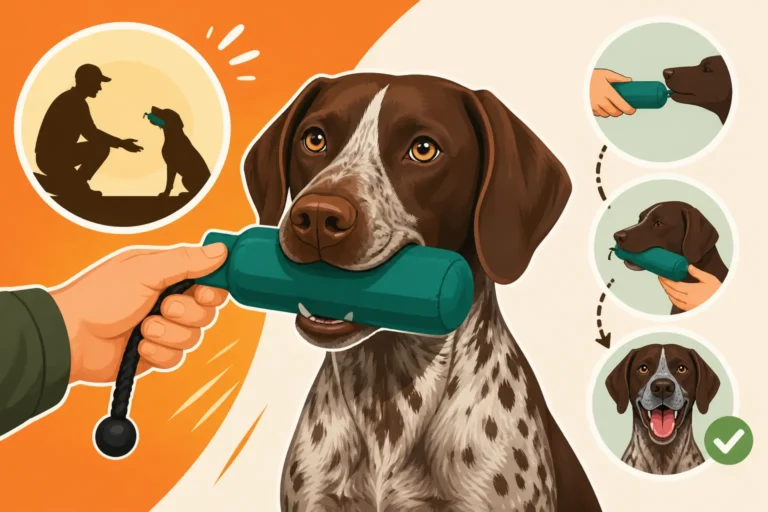
For retrieving, a specific whistle cue can tell your GSP it's time to pick up and bring back a bird. For instance, a rapid, ascending series of toots might become your "retrieve" signal. Initially, you'd pair this with an actual retrieve, rewarding them for picking up and returning the object. This is an advanced skill that builds on a strong "come" and "whoa" foundation, ensuring your GSP is controlled throughout the entire sequence, from finding the bird to delivering it to hand.
Integrating Whistle Training into Daily Life
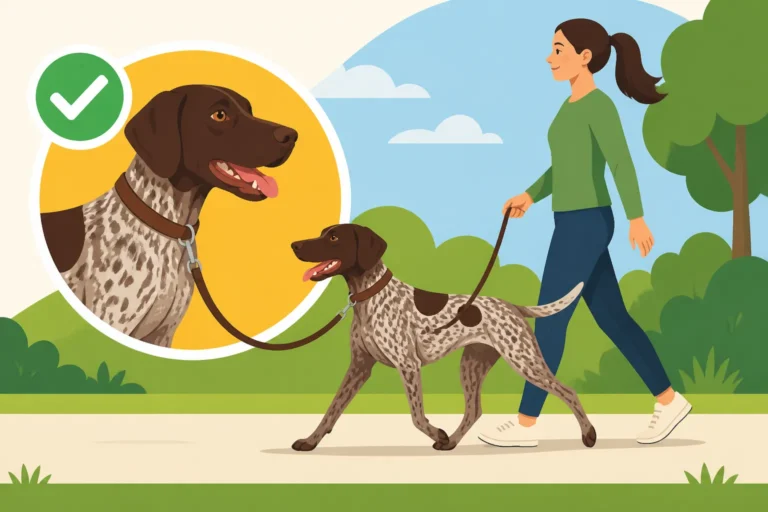
Whistle training isn't just for the hunting field; it's a powerful tool that enhances your relationship and control over your German Shorthaired Pointer in all aspects of life. By incorporating these signals into your daily routine, you reinforce their meaning and build an even more responsive, well-behaved companion. Consistency is key, whether you're in the backyard or out in the wild.
Practice Makes Perfect: Drills and Games
To solidify whistle commands, regular, short practice sessions are far more effective than infrequent, long ones. Think of it as chipping away at a block of marble, little by little. Dedicate 5-10 minutes a few times a day to running through your core whistle commands: recall, stop, and any directionals you're working on. Make it fun! Use high-value treats and enthusiastic praise.
For recall, play hide-and-seek in the house or yard. When your GSP isn't looking, blow the recall whistle, then pop out and reward them when they find you. For the stop command, try playing "red light, green light." Let them run, blow the stop whistle, reward for stopping, then release them with a "free dog!" or "okay!" command. Integrate these commands into their walks and playtime. Every successful response strengthens the association and builds their confidence in understanding your signals. Remember, the more reliably they respond, the safer and more enjoyable your adventures together will be.
Whistle Equipment and Best Practices
When it comes to whistles, there's a variety out there. A good quality plastic or metal "pea-less" whistle is often recommended for dog training because it produces a consistent tone that isn't affected by moisture or debris. Brands like Acme make excellent dog whistles that are widely available on Amazon. Experiment with different types to find one that produces a sound you can easily distinguish and that your dog responds to. Some whistles offer adjustable frequencies, allowing you to fine-tune the sound if needed, though most standard dog whistles work perfectly fine.
Here are a few best practices:
- Carry it always: Attach your whistle to a lanyard around your neck or keep it in a designated pocket. You want it readily available whenever you're with your GSP.
- Be consistent: Always use the exact same whistle signal for the same command. Don't invent new signals on the fly.
- Reward generously: Especially in the early stages, every correct response should be met with praise and a reward.
- Avoid over-whistling: Don't blow the whistle constantly. Use it purposefully. If your dog isn't responding, don't just keep blowing it. Go back to basics, reduce distractions, and ensure they understand the command.
- Introduce an E-collar thoughtfully: For advanced off-leash work, especially in wide-open spaces or with a hard-running GSP, many handlers pair whistle commands with an e-collar for reinforcement. This is not about punishment, but about clear communication and a secondary cue if the whistle isn't immediately heeded. If you go this route, ensure you learn proper, humane e-collar conditioning techniques. You can learn more about this in Conditioning a Shorthair to the E-Collar Properly.
The Benefits of a Well-Whistled Shorthair
A German Shorthaired Pointer that understands and responds to whistle commands is a joy to behold. You'll gain an unparalleled level of control, allowing your dog more freedom and opportunity to express their natural abilities safely. This enhanced communication fosters a deeper bond, built on trust and mutual understanding. Whether you're navigating urban parks, vast fields, or dense woods, whistle signals give you the confidence to let your GSP stretch their legs and explore, knowing you can always call them back or direct them when needed.
Furthermore, a well-trained GSP is a happier GSP. Being able to safely exercise them off-leash for Off Leash Time a German Shorthaired Pointer Needs Weekly fulfills their innate need to run and explore, preventing boredom and destructive behaviors. Whistle training provides the structure and clear communication necessary for your active dog to thrive, making for a harmonious partnership both at home and in the field.
| Whistle Command | Typical Signal | Purpose | When to Use |
|---|---|---|---|
| Recall | Series of short, sharp toots (e.g., pip-pip-pip-pip) | Come back to handler immediately | Any time you need your dog to return, especially in emergencies or to prevent wandering. |
| Stop / Whoa | One long, sustained blast (e.g., peeeeep) | Stop all forward motion and hold position | To prevent running into danger, hold a point, or wait for handler to catch up. |
| Attention / Check-in | Single sharp blast (e.g., pip) | Look at handler, re-engage | To get your dog's focus back, redirect attention, or signal further instruction. |
| Go Right | Two short, one long (e.g., pip-pip-peeeep) | Send dog to the right | Directing through cover, around obstacles, or towards a specific area. |
| Go Left | One long, two short (e.g., peeeep-pip-pip) | Send dog to the left | Directing through cover, around obstacles, or towards a specific area. |
| Go Forward / Hunt On | Rapid, steady series of pips (e.g., pip-pip-pip-pip) | Encourage forward movement, continue hunting | To keep your dog moving forward in cover or extend their range. |
Disclaimer
This article is for general informational purposes only and does not constitute professional advice. Laws, prices and regulations vary by location and change over time. Consult a qualified professional for guidance on your specific situation.