The German Shorthaired Pointer Against the Vizsla
Deciding between a German Shorthaired Pointer and a Vizsla can feel like an impossible task when you're dreaming of a versatile, loyal, and energetic companion. Both breeds are absolute powerhouses in the field and incredibly devoted family members, leading many prospective owners to agonize over which one is truly the best fit for their home and lifestyle. This guide will meticulously compare these two magnificent breeds, helping you understand their nuanced differences so you can make an informed choice that brings joy for years to come.
Shared Ancestry and Purpose: Versatile Hunting Companions
It's no secret that both German Shorthaired Pointers (GSPs) and Vizslas are incredible hunting dogs, often lauded for their "versatile" capabilities. This isn't just a marketing buzzword; it speaks to the very intentional breeding programs that shaped them. While they share this fundamental purpose, the specific conditions and philosophies in their respective homelands led to some fascinating distinctions.
The European Vision for a Generalist Gundog
Think about the European landscape where these breeds originated. Hunters weren't typically specialists with a whole kennel of dogs, each trained for a single task. Instead, they needed one dog, maybe two, that could do it all. They needed a dog that could point upland game birds, track wounded deer or other game, and retrieve fallen birds from both land and water. This demand for an all-around performer is what drove the development of breeds like the GSP and the Vizsla. The German Shorthaired Pointer, as its name suggests, hails from Germany, where breeders specifically blended various German pointing breeds, scent hounds, and even some English Pointers to create a dog that was robust, intelligent, and eager to please, capable of handling diverse terrains and temperatures.
The Vizsla, on the other hand, comes from Hungary, a land with its own unique hunting traditions and preferred game. Hungarian nobility sought a sophisticated, high-performing gun dog that could work closely with its master, be soft-mouthed for retrieving, and possess an excellent nose. While the exact lineage is debated, it's believed to include ancient hunting dogs, possibly Turkish Yellow Dogs, Sloughi, and various pointers. The result was a dog known for its aristocratic bearing, keen hunting instincts, and incredibly strong bond with its human. Both breeds were honed over centuries, not just to find and retrieve game, but to be truly intelligent partners in the field, capable of problem-solving and adapting to different hunting scenarios. This deep-seated drive for partnership is a hallmark you'll find in both.
"Versatile" Defined for Both Breeds
When we talk about versatility in these breeds, we're really talking about a complete package. For the German Shorthaired Pointer, this means a dog that excels at pointing pheasant, quail, and grouse; tracking rabbits, fox, or even deer; and retrieving ducks and geese from icy waters. They are often seen as rugged, all-weather hunters. You'll hear GSP owners talk about their dog's boundless energy and their ability to cover vast amounts of ground. They are truly built for endurance and hard work, requiring significant physical output. This is why many GSP owners are very focused on How Long a Working German Shorthaired Pointer Stays Sound and ensuring their dog has the proper conditioning for their rigorous activities.
The Vizsla's versatility, while equally impressive, often leans into a slightly different nuance. They are renowned for their elegant, statuesque point, their meticulous quartering patterns, and their natural retrieve. They are also excellent trackers and have a strong water drive, though perhaps not as inherently equipped for extreme cold as a GSP. Vizslas are often described as having a softer temperament and a greater sensitivity to their handler's emotions, leading to a very cooperative working style. They thrive on positive reinforcement and close partnership. Both breeds are exceptional at what they do, but the GSP is often thought of as the "tougher" utility dog, while the Vizsla is the "gentleman's" gundog, elegant yet equally effective. Ultimately, both fulfill the role of a generalist hunting dog, but with their own characteristic flair.
Physical Distinctions: Form Follows Function
At a glance, both the German Shorthaired Pointer and the Vizsla share a similar athletic, lean build, a hallmark of their pointing breed heritage. However, if you spend any time with them, the differences quickly become apparent. These aren't just cosmetic; they often reflect the environmental challenges and specific tasks their original breeders prioritized.
Coat Type and Maintenance Needs
The most obvious physical difference lies in their coats. The German Shorthaired Pointer boasts a short, dense coat that is rough to the touch. This coat is designed to be water-resistant and provide a fair amount of protection against briars, thick brush, and chilly weather. While it's short, it's incredibly practical. It sheds, of course, and sometimes quite a bit, especially seasonally, but it's generally low maintenance. A good brushing a few times a week, perhaps with a grooming mitt, can help manage the shedding. For a GSP owner, thinking about How Much a German Shorthaired Pointer Really Sheds is a constant reality. Their ears are another point of focus; while short-coated, their floppy ears can be prone to infections, especially for a dog that loves water, so regular cleaning is essential.
The Vizsla, conversely, has an equally short but much finer, silken, and close-lying coat. It's often described as feeling like velvet. This coat is incredibly elegant and contributes to their aristocratic appearance. However, it offers less insulation and protection than a GSP's coat. In very cold or harsh conditions, a Vizsla might shiver more readily and benefit from a coat or vest, especially if they're out working. Their skin is also more exposed, making them potentially more susceptible to scrapes in dense cover, or even sunburn on sparsely haired areas if they have light pigmentation. While the Vizsla's coat also sheds, the hair tends to be finer and less noticeable than a GSP's more coarse fur. Both are relatively low-odor breeds, which is a bonus for those who appreciate a cleaner-smelling companion.
Size, Build, and Overall Demeanor
While both are medium-to-large sporting dogs, there are subtle differences in their build and overall presence. A male German Shorthaired Pointer typically stands between 23 and 25 inches at the shoulder and weighs anywhere from 55 to 70 pounds, though some can be larger. Females are slightly smaller. They possess a robust, muscular, and athletic build, often appearing powerful and sturdy. Their deep chests and well-sprung ribs speak to their endurance, and their overall posture is one of readiness and strength. A GSP carries itself with confidence, a strong, purposeful gait, ready to burst into action at any moment. They often have a more substantial head and muzzle, fitting their all-around utility purpose.
Vizslas are generally a bit lighter and more refined in their build. Males typically stand 22 to 24 inches at the shoulder and weigh 45 to 65 pounds, with females again being a bit smaller. They are equally muscular and athletic, but their frame is often described as more slender and elegant, with a deep chest and well-defined musculature that gives them a graceful appearance. They move with an almost cat-like grace and agility, possessing a lighter, more springy step. Their heads are typically more chiseled, with a keen and intelligent expression in their eyes. The Vizsla's overall demeanor is one of agile elegance, always appearing poised and attentive, whereas the GSP might come across as more overtly powerful and boisterous.
Distinguishing Colors and Markings
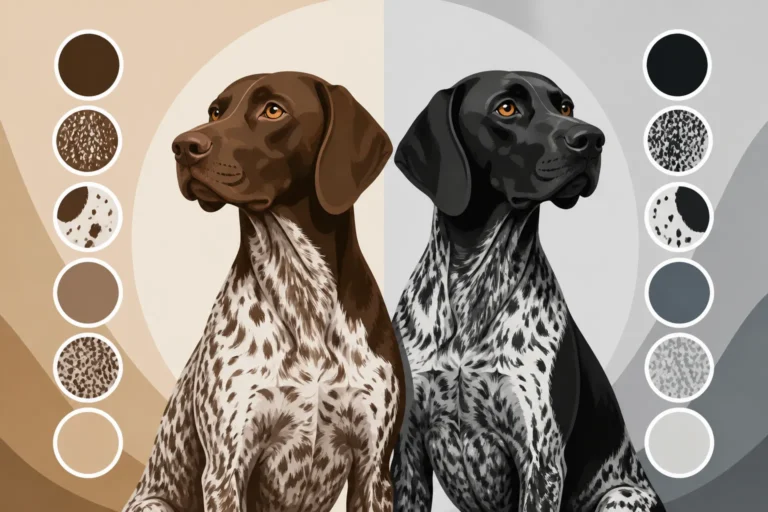
When it comes to color, both breeds have distinct palettes that help set them apart. The German Shorthaired Pointer is predominantly liver, or liver and white. This can manifest as solid liver, liver and white ticked, liver roan, or liver and white patched. Black and white, or solid black, are also accepted colors in the GSP, though historically they were less common in the US until relatively recently, and even now are less prevalent than liver. The ticking and roan patterns are quite characteristic, giving each GSP a unique "fingerprint." A GSP's eyes are typically medium to dark brown, and their nose is always liver or black, matching their coat pigment.
The Vizsla, however, is famous for its striking, single color: a rich, golden rust. This uniform color is a defining characteristic of the breed, often described as varying shades of "russet gold." From the tip of their nose to their tail, they are typically one consistent hue. Small white markings on the chest and feet are sometimes permitted, but they are generally minimal. A Vizsla's eyes usually blend with the coat color, being a shade lighter or darker than the russet. Their nose leather should also be a complementary shade of brown or self-colored, never black. This monochromatic elegance is a huge part of the Vizsla's appeal and is a dead giveaway when trying to tell the two breeds apart.
Temperament and Personality: Affectionate, Energetic, and Intelligent
Here's where the similarities often shine brightest, as both breeds are known for their incredible drive, intelligence, and deep affection for their families. However, there are nuances in their expression of these traits that can be critical for prospective owners to understand.
Energy Levels and Exercise Requirements
Let's be blunt: both of these breeds are high energy. If you're looking for a couch potato, neither a GSP nor a Vizsla is the right choice. They were bred to work all day in the field, covering miles and miles of varied terrain. This means they require significant daily exercise to be happy, well-adjusted companions. A German Shorthaired Pointer often has an almost inexhaustible reserve of energy. They thrive on long runs, intense games of fetch, swimming, and, of course, hunting. The Two Hours a Day a German Shorthaired Pointer Needs is not an exaggeration; it's a baseline requirement for mental and physical well-being. Without it, you'll likely find your GSP inventing their own entertainment, which often manifests as destructive behaviors like chewing, digging, or excessive barking. They are incredibly athletic and need an owner who can keep up with their pace, whether that's running alongside a bike or letting them gallop freely in a secure area.
Vizslas are equally energetic, but their energy can sometimes manifest differently. While they can run for miles and possess incredible stamina, they often prefer to expend that energy with their people. They are known for being incredibly "velcro dogs" – always wanting to be close by. Their exercise needs are just as demanding, requiring extensive daily activity like long hikes, trail runs, and vigorous play. However, a Vizsla might be more content to do multiple shorter, high-intensity bursts of activity interspersed with cuddle time, whereas a GSP might prefer one massive, extended outing. Both breeds can become prone to anxiety or destructive tendencies if under-exercised, with the Vizsla potentially leaning more towards separation anxiety if not given enough attention and structured activity.
Trainability and Mental Stimulation
Both GSPs and Vizslas are incredibly intelligent and eager to please, making them highly trainable for those who understand their motivations. The German Shorthaired Pointer is typically quite bold and resilient, capable of handling firm but fair training. They respond very well to consistency and positive reinforcement. Their keen intelligence means they pick up commands quickly, but it also means they can get bored if training isn't varied and engaging. Many GSP owners focus on honing their natural instincts through activities like NAVHDA (North American Versatile Hunting Dog Association) tests, which measure natural ability, utility, and more advanced skills. Introducing a German Shorthaired Pointer to Birds is often a natural progression for them. They love having a job to do and excel in various dog sports beyond hunting, such as agility, obedience, and scent work.
Vizslas are also highly intelligent and possess an intense desire to please their owners, which makes them very responsive to training. However, they are often described as being more sensitive than GSPs. They can be prone to shutting down or becoming anxious if subjected to harsh training methods or too much pressure. Positive reinforcement, patience, and gentle but consistent guidance work best with a Vizsla. Their intelligence also means they need plenty of mental stimulation; puzzle toys, scent games, and complex obedience routines can keep their sharp minds engaged. Because of their sensitivity and strong bond, they thrive on training that strengthens the partnership, making them excellent candidates for advanced obedience, rally, and tracking. Both breeds demand an owner who is willing to invest time and energy into ongoing training and mental challenges, otherwise their intelligence can lead them to outsmart their humans!
Affection and Family Life
Here's where the "velcro dog" reputation really distinguishes these two, though both are exceptionally affectionate. German Shorthaired Pointers are incredibly loyal and loving companions. They bond strongly with their families and thrive on being an integral part of daily life. They are often playful and tolerant with children, especially if raised with them, though their boisterous nature and energy mean supervision is always wise with very young kids. While they enjoy being close, they also tend to be a bit more independent than a Vizsla. They might be content to nap at your feet rather than directly on your lap, or play independently in the yard while you garden. They usually get along well with other dogs, especially if socialized from a young age. Their loyalty is unwavering, and they make excellent family dogs for active households.
Vizslas are perhaps one of the most famously affectionate breeds. The term "velcro Vizsla" is no exaggeration; they truly want to be with their person or family at all times, often seeking physical contact. They will follow you from room to room, curl up in your lap, or snuggle under the covers. This intense desire for closeness makes them incredibly devoted and loving family members. They are generally wonderful with children, often showing a gentle patience, but again, their energy means they can accidentally knock over a small child in their enthusiasm. Vizslas tend to be more prone to separation anxiety if left alone for extended periods without adequate exercise and mental enrichment. They thrive in homes where they receive a lot of attention and human interaction. While they typically get along well with other dogs, their primary loyalty and affection are almost always reserved for their human family. If you want a dog literally always by your side, a Vizsla might be your match. If you appreciate a loving companion who also has a strong independent streak, a GSP might be more up your alley.
Health Considerations: Inherited Traits and Common Ailments
Responsible ownership means understanding the potential health issues common to any breed. Both German Shorthaired Pointers and Vizslas are generally healthy dogs, but like all purebreds, they have certain genetic predispositions that prospective owners should be aware of. Reputable breeders will always perform health clearances on their breeding stock.
Orthopedic Concerns in Active Breeds
Given their athletic build and active lifestyles, both GSPs and Vizslas can be prone to orthopedic issues. Hip and elbow dysplasia are concerns in both breeds. Hip dysplasia is a malformation of the hip joint that can lead to arthritis and pain, especially as the dog ages. Elbow dysplasia is a similar condition affecting the elbow joint. Reputable breeders will have their breeding dogs screened for these conditions by organizations like the Orthopedic Foundation for Animals (OFA) or through PennHIP evaluations. While these conditions can be devastating, good breeding practices significantly reduce their incidence. You might want to research Hips and the CHIC Panel a German Shorthaired Pointer Needs to understand the comprehensive health screening recommended. For Vizslas, patellar luxation (slipping kneecaps) is another orthopedic condition seen occasionally.
Because of their boundless energy and working drive, both breeds are also susceptible to injuries from their activities. Torn cruciate ligaments, muscle strains, and pad injuries are not uncommon, especially in hunting or intensely exercised dogs. Proper conditioning, warm-ups, and cool-downs are vital. Supplements that support joint health, especially as they get older, can also be beneficial. Ensuring they have appropriate footwear for rough terrain, such as dog boots, can also help prevent injuries to their paws.
Eye and Cardiac Health
Eye conditions are another area where genetic screening is important for both breeds. Progressive Retinal Atrophy (PRA) is a degenerative eye disease that can lead to blindness and is found in some lines of both GSPs and Vizslas. Reputable breeders will often perform DNA tests for known forms of PRA, if available, or have annual eye exams (ACVO exams) performed on their breeding dogs to screen for various ocular issues. Reading a German Shorthaired Pointer's Eye Certificate is a good skill for any prospective owner.
Cardiac health is also a consideration. Subaortic Stenosis (SAS) is a heart condition that can affect German Shorthaired Pointers, sometimes leading to sudden death in young dogs. Reputable GSP breeders will have their breeding stock screened by a board-certified veterinary cardiologist to check for heart murmurs and perform echocardiograms if necessary. Vizslas can also be prone to certain heart conditions, though perhaps not as commonly discussed as SAS in GSPs. Dilated Cardiomyopathy (DCM) has been identified in some Vizsla lines, though often less frequently than in other large breeds. Both breeds benefit from regular veterinary check-ups that include heart auscultation.
Unique Genetic Predispositions
Beyond the common orthopedic, eye, and cardiac issues, each breed has some more unique predispositions. German Shorthaired Pointers, for instance, are notoriously susceptible to bloat (Gastric Dilatation-Volvulus), a life-threatening condition where the stomach twists. Their deep chests put them at higher risk. Owners often consider a prophylactic gastropexy procedure, which tacks the stomach to the abdominal wall, to prevent this. It's crucial for GSP owners to understand The Bloat Risk a Shorthair Carries Into Every Season and know the emergency signs. They can also be prone to certain skin conditions, like Lupoid Dermatosis, an autoimmune skin disease.
Vizslas, on the other hand, can be predisposed to certain types of cancers, such as Lymphoma or Hemangiosarcoma, though this is not unique to the breed. They also have a known predisposition to certain autoimmune conditions, like Polymyositis, which affects the muscles, or sometimes idiopathic epilepsy. It's a good idea to consider pet insurance from a brand like Chewy, which can help cover unexpected veterinary expenses, regardless of which breed you choose, especially given the costs associated with treating these complex conditions. Always discuss potential health concerns with a breeder and review the health clearances of the parent dogs before committing to a puppy.
Suitability for Different Lifestyles: Matching Dog to Owner
Choosing between a German Shorthaired Pointer and a Vizsla ultimately comes down to finding the best match for your lifestyle. Both breeds demand a lot from their owners, but they offer immense rewards in return. Understanding their subtle differences can help you determine which one will truly thrive in your home.
Active Households and Outdoor Enthusiasts
If you lead an incredibly active lifestyle, spending hours outdoors every day, either a GSP or a Vizsla could be an excellent fit. Both are fantastic partners for running, hiking, biking, and of course, hunting. The German Shorthaired Pointer is often described as a more "independent" worker in the field, capable of covering vast areas with incredible speed and stamina. If your ideal weekend involves long, arduous hunts in all weather conditions, or multi-hour trail runs, the GSP's rugged build and relentless drive might be slightly more aligned with your ambitions. They are incredibly tough and resilient. They do well with an owner who appreciates a dog that can run hard and then relax, without needing constant physical contact.
The Vizsla, while equally active, truly shines when their activity is shared. They want to be with you, whether you're running, hiking, or just enjoying a quiet evening. They are fantastic for active individuals or families who desire a constant companion. If your outdoor adventures involve a lot of interaction with your dog, and you appreciate a dog that stays very close by, the Vizsla's inherent "velcro" nature might be exactly what you're looking for. They might be slightly less robust in extreme cold, so if you're regularly out in bitter winter weather, you might need to invest in protective gear like a jacket or consider a GSP. Conversely, a GSP's short, dense coat is naturally more insulating than a Vizsla's fine, short coat in cooler temperatures.
First-Time Owners and Experience with Sporting Dogs
For a first-time dog owner, especially someone new to sporting breeds, the choice can be particularly tricky. Neither breed is truly suitable for a sedentary or inexperienced owner who isn't prepared for the significant commitment they require. However, if you're a first-timer who is dedicated, willing to learn, and has the time and energy, it's possible.
The German Shorthaired Pointer, with its bolder personality and higher pain tolerance, might be a bit more forgiving of minor training inconsistencies or less sensitive to handler mistakes. They respond well to clear, consistent rules and physical exercise. They might challenge boundaries, but they are generally robust enough to handle the learning curve. Their drive and intelligence make them quick learners, but they also need that mental stimulation to prevent boredom. If you're a new owner who is prepared for a high-energy dog and can provide structured training and ample exercise, a GSP can be a wonderful partner. Training classes, especially those focused on positive reinforcement and basic obedience, will be invaluable. You can find many useful training tools, from sturdy leashes to enrichment toys, on sites like Chewy.
The Vizsla, due to its sensitive nature, can be a bigger challenge for a first-time owner if not approached with the right understanding. They require a gentle touch, consistency, and a strong emphasis on positive reinforcement. Harsh corrections can easily "break" a Vizsla's spirit, leading to anxiety or shutdown behavior. While they are incredibly eager to please, their intense need for human companionship means they can develop separation anxiety more easily if not managed properly. A first-time owner choosing a Vizsla must be ready for a dog that demands a lot of emotional connection and prefers to be the center of attention. They thrive with owners who are patient, consistent, and willing to put in the time for extensive socialization and confidence-building.
Climate Adaptability
The climate you live in can also play a role in which breed might be a better fit. The German Shorthaired Pointer's denser, coarser coat provides more protection against colder temperatures and wet conditions. They are generally well-suited to working in a wider range of climates, including areas with colder winters, as long as they are actively working and not just standing around. Of course, even a GSP has its limits in extreme cold, and owners need to be mindful of things like Frostbite on a Late Season German Shorthaired Pointer.
The Vizsla's fine, short coat offers minimal protection against the cold. While they are hardy and can certainly tolerate cool weather, they are more susceptible to the cold and will shiver readily when temperatures drop, especially if they are inactive. If you live in a region with consistently harsh winters and plan to spend a lot of time outdoors, a Vizsla will likely need a warm coat or vest to stay comfortable. Conversely, both breeds handle heat reasonably well, but require constant access to water and shade, and careful monitoring to prevent Heat Exhaustion in an Early Season Shorthair or Vizsla. Neither breed is built for extreme, sustained heat without proper precautions.
Ultimately, both German Shorthaired Pointers and Vizslas are phenomenal dogs for the right owner. They are intelligent, energetic, affectionate, and born to work. The "best" breed for you will depend on your specific lifestyle, your experience with dogs, and how much you value independence versus constant companionship in your canine partner. Whichever you choose, be prepared for an incredibly active and devoted member of your family.
| Feature / Trait | German Shorthaired Pointer (GSP) | Vizsla |
|---|---|---|
| Origin | Germany | Hungary |
| Primary Purpose | Versatile hunting dog (pointing, tracking, retrieving) | Versatile hunting dog (pointing, retrieving, tracking) |
| Coat Type | Short, dense, coarse; water-resistant | Short, fine, silky; less protection from cold |
| Common Colors | Liver, liver and white (ticked, roan, patched), solid black, black and white | Russet gold (uniform color) |
| Size (Male) | 23-25 inches, 55-70+ lbs (robust, powerful build) | 22-24 inches, 45-65 lbs (leaner, elegant build) |
| Energy Level | Very high, boundless stamina, independent runner | Very high, intense energy, prefers shared activity |
| Temperament | Bold, confident, resilient, loyal, affectionate | Sensitive, eager to please, intensely affectionate, "velcro dog" |
| Trainability | Intelligent, responsive to consistent, firm-but-fair training | Highly intelligent, very responsive to gentle, positive reinforcement |
| Separation Anxiety | Moderate risk if under-exercised/under-stimulated | Higher risk due to strong bond and need for closeness |
| Cold Tolerance | Good, denser coat provides more insulation | Lower, often requires coats in cold weather |
| Major Health Risks | Bloat (GDV), Hip/Elbow Dysplasia, SAS | Hip/Elbow Dysplasia, Autoimmune issues, certain cancers |
Disclaimer
This article is for general informational purposes only and does not constitute professional advice. Laws, prices and regulations vary by location and change over time. Consult a qualified professional for guidance on your specific situation.