Whether a Show Bred Shorthair Can Still Hunt
A show-bred German Shorthaired Pointer can hunt, but a pedigree and a handsome stance do not tell you how a particular dog will handle birds, retrieve, or work in the field. If you are hoping to hunt with a show-line Shorthair, this guide explains what may come naturally, what depends on training, and how to assess your dog realistically before heading out.
What show bred means for hunting potential
Show and field lines are not different breeds
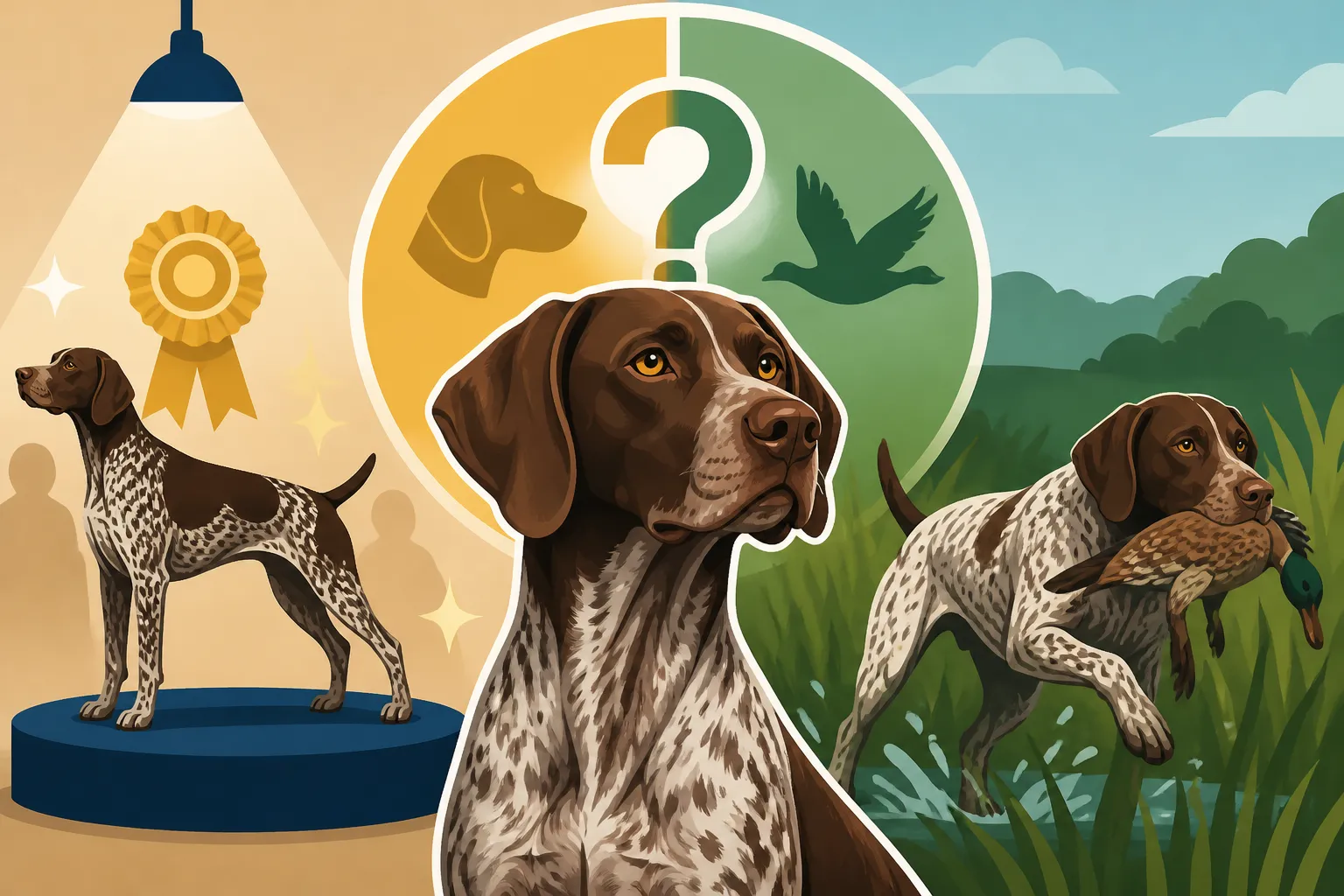
Show-bred and field-bred German Shorthaired Pointers belong to the same breed. The distinction is about breeding priorities, not a guarantee that one type can hunt and the other cannot. Show breeders generally place greater emphasis on how dogs match the breed standard and perform in the conformation ring. Field breeders tend to give greater weight to working traits and performance in hunting or field events. Individual breeders may value both.
Over time, those priorities can shape the dogs people see. Field lines may be selected for traits such as drive, range, stamina, and responsiveness in hunting situations. Show lines may be selected more heavily for structure and appearance, though that does not mean they lack ability or willingness. A dog’s individual temperament, health, experience, and training all matter.
The Split Between Field and Show Shorthairs is useful background if you are trying to understand why dogs within the same breed can look or work differently. It is better to treat “show-bred” as a clue about selection priorities than as a verdict on the dog in front of you.
A show pedigree can contain working ability
A show title tells you that a dog was evaluated in the show ring. By itself, it does not tell you whether the dog has hunted, how it responds to birds, or whether it will retrieve reliably. Likewise, a field title or hunting record gives you information about performance in particular settings, but it does not predict every detail of a future dog’s behavior.
Look beyond labels and ask the breeder what the parents and close relatives actually do. Have they hunted wild birds or planted birds? Have they retrieved on land or in water? Do they show interest in scent and birds? How do they behave around gunfire? Ask for specific examples rather than a broad assurance that the dogs are “natural hunters.” The answer may reveal both strengths and areas that would need work.
A pedigree can help put those answers in context, but it cannot replace direct observation. If hunting ability is a priority, How to Read a Shorthair Pedigree for Hunting Ability can help you think about what the family history may show—and what it cannot. A dog with show-line relatives that have worked in the field may be a more informed choice than a dog selected from lines with little known hunting experience. Either way, the individual dog still needs to be evaluated.
What your dog may do in the field
Interest is not the same as finished hunting behavior
A Shorthair may notice birds, follow scent, search cover, point, or chase without being a trained hunting companion. These behaviors can be encouraging, but they do not automatically mean the dog will hold a point, stay within a useful range, retrieve to hand, or respond when distracted by exciting scent.
For example, a dog that freezes briefly when it catches bird scent may be showing pointing instinct. If it then rushes in and flushes the bird, that is not proof it cannot learn; it means steadiness and careful bird work may be needed. A dog that charges into a pond after a thrown bumper may enjoy retrieving but still need practice locating and delivering a bird. Each skill develops separately.
It helps to think in terms of a group of abilities rather than one yes-or-no question. Hunting may involve searching, scenting, pointing, backing another dog, responding to handling, tolerating gunfire, retrieving, and working in different terrain or weather. The breed’s versatility is part of its appeal, but ability in one area does not guarantee proficiency in all of them. The overview of Pointing, Retrieving and Tracking in One Shorthair can help clarify how broad that working picture can be.
Style, range, and stamina vary by dog
Two Shorthairs from show lines may behave very differently outdoors. One may search purposefully and stay connected to its handler; another may have a shorter range or need encouragement to explore. Some dogs are keen around birds but easily distracted. Others are enthusiastic at first and tire quickly if they are not conditioned for a full day.
Do not judge a dog’s hunting potential from one outing. A puppy’s short search, an adolescent’s impulsive chase, or an adult dog’s uncertainty in unfamiliar cover can reflect age, experience, fitness, or the setting—not only inherited ability. Give the dog suitable opportunities and keep early sessions manageable. Pay attention to whether its confidence and responsiveness improve with calm, consistent practice.
Physical build can also affect comfort, though appearance alone cannot tell you how well a dog will work. A short-coated Shorthair may need protection and rest in cold or wet conditions, and any dog can be limited by injury or poor conditioning. If your dog will work in rough cover, check for burrs, cuts, and seeds afterward; Checking a German Shorthaired Pointer Over After a Hunt covers the kind of post-field inspection that can catch small problems before they worsen.
How to assess a show bred Shorthair
Ask focused questions before choosing a puppy
If you are choosing a puppy, ask what the breeder knows about hunting ability in the parents, siblings, and close relatives. Listen for observable details: whether a dog points, how it behaves around live birds, what kind of retrieving it has done, and whether it has been introduced to gunfire in a controlled way. If the breeder has no direct field experience, ask how they assess temperament and what they can tell you about the family’s working background.
Ask about the puppy as an individual, too. Which puppies are bold or cautious? Which show interest in scent or birds? How do they recover after a startling but harmless new experience? A breeder cannot promise exactly how a puppy will develop, and early signs are not a guarantee of adult performance. But thoughtful observations are more useful than a claim that every puppy will become a finished hunting dog.
If you already own an adult show-bred dog, start with what you can see. Does the dog show interest in bird scent? Can it focus on you outdoors? Is it comfortable exploring new ground? Does it come when called away from distractions? Those observations help you decide where to start without assuming that a show pedigree has settled the question. For more on the difference between breeding priorities, see How Shorthair Field Lines and Show Lines Diverged.
| What you want to assess | Useful signs to look for | What the sign does not prove |
|---|---|---|
| Bird interest | The dog notices birds or follows their scent | That it will point steadily or hunt a full day |
| Search and range | The dog explores cover while checking in with you | That its range will suit every hunting style |
| Retrieve | The dog willingly picks up and returns a toy or bumper | That it will deliver a bird reliably |
| Confidence | The dog explores new ground and recovers from mild surprises | That it is ready for gunfire or heavy cover |
| Responsiveness | The dog can turn back to you in a low-distraction setting | That recall will hold around live birds |
Match expectations to the dog in front of you
If your goal is an occasional, low-pressure hunt with a trained adult dog, a show-bred Shorthair may be a very reasonable companion. If you want a dog ready to perform demanding work with little development, a show pedigree alone is not a sound basis for that expectation. Be candid about what you want the dog to do, how much time you can spend training, and whether you are willing to work with a qualified trainer.
It is also fine if your dog’s interests point in a different direction. A Shorthair that enjoys hiking, scent games, or retrieving for fun can still be a satisfying companion without becoming a hunting dog. If you are weighing hunting against a household-focused life, Whether a German Shorthaired Pointer Suits a Non Hunting Home offers another way to consider the match. And if you are deciding between line types, Whether a Field Line Shorthair Is Harder to Live With may help you think through the everyday trade-offs beyond the field.
Avoid comparing your dog’s progress with a highly experienced field dog and concluding that yours has failed. A dog may need more time to understand the task, more exposure to birds, or training that better fits its temperament. On the other hand, enthusiasm alone does not mean every dog will be comfortable with the demands of hunting. Let the dog’s behavior, health, and welfare guide the pace.
Building hunting skills safely
Start with basics before adding birds and gunfire
A useful early foundation is reliable everyday handling. Practice recall, walking on a lead, waiting calmly, and responding to simple cues in low-distraction places before expecting the dog to listen around birds. A dog that cannot disengage from a toy or return from a quiet yard is unlikely to become dependable simply because the setting is exciting.
Build new challenges gradually. A trainer can help introduce birds in a way that lets you observe the dog’s natural response without repeatedly letting it rush in and learn to chase. If you are new to bird work, seek guidance from someone experienced with pointing breeds. Avoid improvising gunfire exposure: frightening noise introduced too close or too suddenly can create serious fear. A dog should not be exposed to a firearm as a test of courage.
Training should also account for age and physical readiness. Keep sessions short enough that the dog can succeed, provide water and rest, and stop if you notice discomfort, excessive fatigue, or unusual stress. If a dog is limping, recovering from an injury, or struggling in heat or cold, postpone field work and consult your veterinarian about safe activity.
Prepare for the conditions, not just the training plan
Before a first outing, consider the ground, weather, water access, local rules, and the dog’s experience. Dense cover may hide hazards; rough or rocky ground can injure unconditioned feet; cold water can be a poor choice for a short-coated dog that has not been prepared for it. Use appropriate identification and handling equipment, and choose a controlled place where you can work without putting the dog, other people, or wildlife at risk.
A simple gear check can prevent avoidable problems. Make sure you have a lead or check cord suited to the training setup, water and a bowl, a way to inspect the dog afterward, and any protective equipment appropriate to the conditions. When comparing basic pet supplies, retailers such as Chewy can be one option alongside local sporting-dog shops; focus on fit and purpose rather than buying gear just because it is marketed for hunting. For example, a poorly fitted vest can restrict movement, while unnecessary equipment may distract a dog that is still learning.
Plan the outing around the dog, not around the number of hours you hoped to hunt. Bring water and check the dog’s feet, ears, coat, and overall energy during breaks. If the dog is working in cold or wet conditions, reassess whether it is warm and comfortable instead of assuming that enthusiasm means it is coping well. You can compare suitable travel and care items through Chewy or another retailer, but check that each item fits your dog and the conditions you expect to encounter.
Afterward, look for small cuts, burrs, grass seeds, tenderness, or unusual fatigue. Keep a record of what the dog handled comfortably and what seemed difficult. That makes the next session more useful: perhaps the dog needs shorter exposure, more recall practice, a different surface, or professional help with a specific skill. If you use Chewy or another pet retailer to fill gaps in your basic kit, make the decision from your checklist rather than treating gear as a substitute for conditioning and training.
Know when a trainer can help
A qualified bird-dog trainer can give you a clearer picture of the dog’s strengths and help you avoid reinforcing unwanted habits. This can be especially useful if the dog flushes birds, ranges too far, ignores recall, appears worried by new situations, or is difficult to manage around other dogs. Ask the trainer how they introduce birds and noise, how they tailor sessions to an individual dog, and how they communicate progress to owners.
Look for a training approach that takes the dog’s temperament and welfare seriously. A dog that shuts down under pressure may need a different pace from one that is bold and impulsive. If you are unsure whether the dog’s behavior is normal training difficulty or a sign of fear, pain, or stress, pause field work and ask an appropriate professional for guidance.
The practical answer is that a show-bred Shorthair can still hunt, but no label can promise a particular result. Study the family background, assess the individual dog, build skills in a safe order, and keep your expectations flexible. Some show-bred dogs become capable hunting partners; others are happier with different activities. Both outcomes can be good ones when the dog’s needs and abilities are taken seriously.
Disclaimer
This article is for general informational purposes only and does not constitute professional advice. Laws, prices and regulations vary by location and change over time. Consult a qualified professional for guidance on your specific situation.