Whether a Shorthair Settles on Acreage
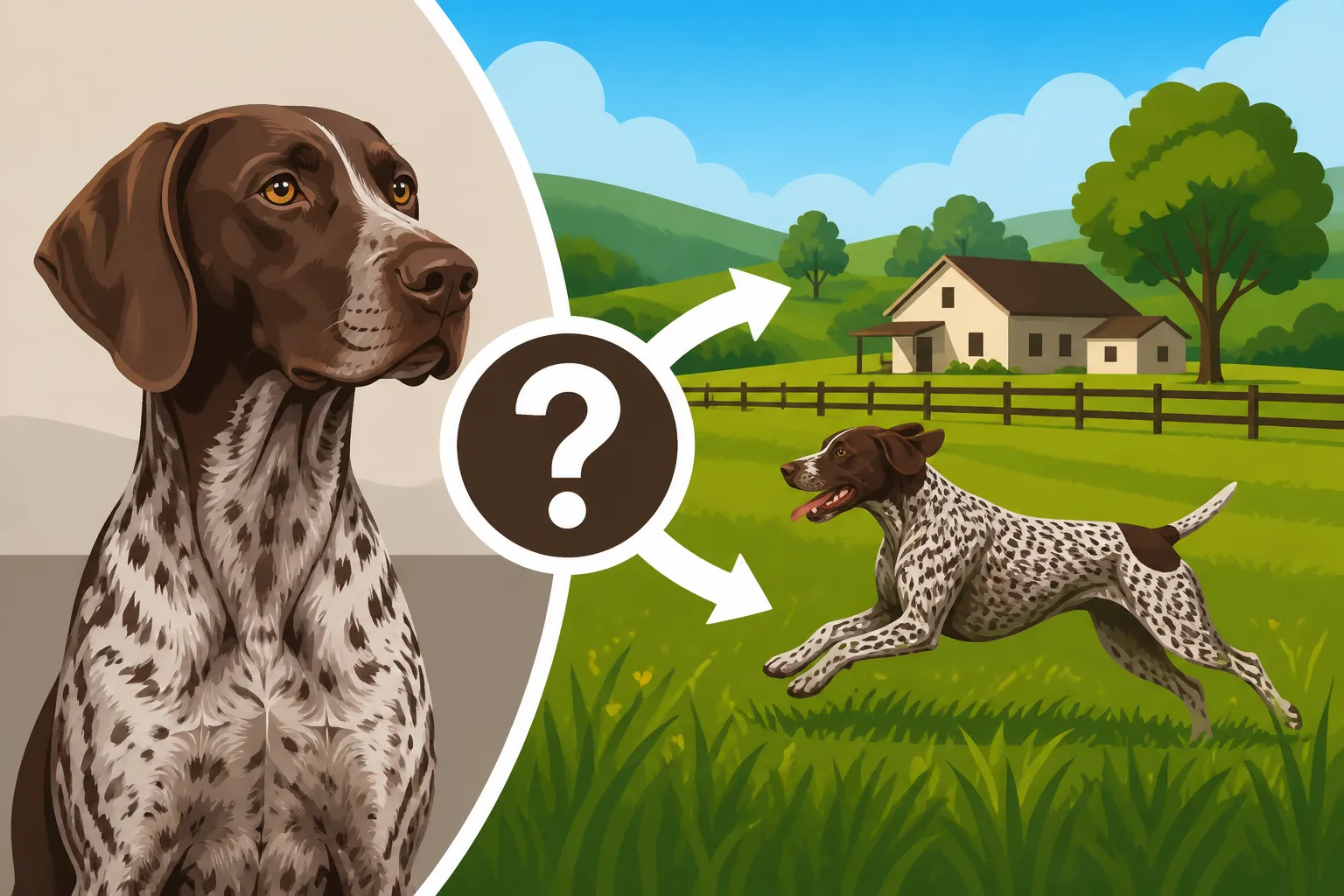
A German Shorthaired Pointer can enjoy life on acreage, but a big property does not automatically make one calm or easy to manage. Open land can bring room to run alongside tempting wildlife, livestock, roads, and escape routes. This guide explains what acreage can—and cannot—provide, and how to build a safe routine that helps a Shorthair settle.
Does acreage suit a German Shorthaired Pointer
More space helps, but it is not a substitute for a routine
Acreage can be a real advantage for a German Shorthaired Pointer. There may be room to play, train, explore on a long line, or simply stretch out somewhere quiet. A property can also make it easier to practice recalls and other skills without relying on a busy neighborhood sidewalk.
But land alone does not meet this breed’s needs. A Shorthair left to wander for hours may find its own entertainment: chasing deer, ranging after a scent, digging under a fence, or investigating a neighbor’s animals. That can be stressful for you and risky for the dog. Even a large field doesn’t automatically provide the focused exercise, interaction, and mental challenge that help a high-energy dog relax at home.
Think of acreage as useful space, not a self-running exercise plan. A daily walk, training session, scent game, or supervised run may still be part of the picture. If you’re working out what a satisfying daily routine looks like, The Structure a German Shorthaired Pointer Needs Daily is a helpful companion topic.
A property’s character matters more than its size
A fenced, open pasture beside a quiet lane presents different challenges from an unfenced property with a busy road, ponds, livestock, and thick cover. Before you decide acreage will make Shorthair ownership easier, walk the boundaries as if you were your dog. Look for gaps under gates, loose boards, drainage channels, low spots, and places where a determined dog could squeeze through or dig.
Then consider what is beyond the boundary. Deer, rabbits, ground-nesting birds, barn cats, and livestock may trigger a chase or create a conflict. A dog can be affectionate and responsive at home yet become difficult to reach when a fresh scent or moving animal captures its attention. Secure fencing and supervision matter even if the property feels remote.
| Property feature | How it can help | What to plan for |
|---|---|---|
| Secure fencing | Creates a safer area for supervised play | Inspect gates, corners, gaps, and digging spots regularly |
| Open land | Offers room for training and movement | Use recall, a long line, or other safe management before trusting off-leash access |
| Wildlife | Provides opportunities for scent-based games at a distance | Prevent chasing and protect wildlife, livestock, and the dog |
| Barns and outbuildings | Can add sheltered places to rest | Check for chemicals, tools, bait, sharp materials, and open doors |
| Ponds or stock tanks | May offer water access | Supervise swimming and keep clean drinking water available |
| A long driveway | Makes outdoor access convenient | Teach a door and vehicle routine; acreage does not prevent bolting |
Acreage does not erase the breed’s hunting instincts
German Shorthaired Pointers were developed as versatile hunting dogs, and many have a strong interest in scent, birds, and moving animals. Their instincts can show up in an ordinary country setting: freezing at the edge of a hedgerow, following a rabbit trail, or ignoring a call while tracking something through tall grass.
That behavior isn’t a sign that your dog is stubborn or ungrateful. It’s a sign that the environment is asking for more control than the dog has learned to manage. Safe training builds skills over time, but no amount of acreage makes a reliable recall automatic. For help thinking through exercise and purpose, see Whether a German Shorthaired Pointer Needs to Hunt to Be Happy.
What helps a Shorthair settle at home
Meet exercise needs without relying on unsupervised roaming
Many owners hope that letting a dog out into the yard will use up its energy. Sometimes the dog does run; sometimes it patrols the fence, watches wildlife, or asks to come back inside after a few minutes. An outdoor area can be useful, but it may not provide the structure and engagement that help a Shorthair feel satisfied.
Aim for a mix of activities suited to your dog’s age, health, training, and fitness. That might include a brisk walk, a supervised run in a secure area, a recall practice, or a short game of fetch. Add the workload gradually, particularly for a young dog, an older dog, or one returning to exercise after a break. For broader ideas on daily activity, The Two Hours a Day a German Shorthaired Pointer Needs discusses the difference between simply being outside and getting meaningful exercise.
If your dog comes back from the yard more wound up than before, that’s useful information. Try a calm transition indoors, a few minutes of basic training, or a food puzzle rather than immediately sending the dog out again. A simple routine—exercise, water, a chance to settle—can help prevent the day from becoming an endless cycle of opening the door and hoping the dog tires itself out.
Give the dog a job that fits everyday life
A Shorthair doesn’t need a hunting trip every day to have a satisfying life. It does benefit from opportunities to use its nose and learn. Hide treats around a room, scatter a small portion of food in safe grass, practice a few obedience cues, or teach the dog to find a familiar toy. These activities can be short and still give the dog something worthwhile to focus on.
Scent games are especially handy when weather, work, or muddy acreage makes a long outdoor session impractical. A puzzle feeder can also turn part of a meal into a problem-solving activity. If you already shop at Chewy, you may find it convenient to look for basic enrichment items there, but you can also make simple games at home with dog-safe household items. Choose activities that match your dog’s chewing habits and supervise anything that could be swallowed or torn apart.
For more ideas, Mental Work That Tires a Shorthair Out offers options beyond trying to add another mile to the day. Mental work does not replace physical exercise, but combining the two often creates a more settled dog than relying on free access to a field alone.
Make the house a place where resting is part of the routine
Some Shorthairs struggle to switch off, especially when they’re young or used to constant activity. A predictable resting place can help. Choose a comfortable bed or crate in a calm part of the home, and reward relaxed behavior there. Start with short, easy periods rather than expecting the dog to settle for a long stretch immediately.
A quiet indoor routine matters because acreage can be exciting. If the dog spends the afternoon chasing fence-line scents, watching animals, and reacting to every sound, it may come inside overstimulated instead of tired. Close curtains where needed, give the dog a chew or enrichment activity, and allow a wind-down period after exercise. Rest is not a punishment; it is a learned part of the day.
If you use Chewy for dog food, treats, or enrichment supplies, keep your dog’s feeding and activity routine in mind when choosing items. A treat used during a training session should fit into the overall diet, and new foods or chews should be introduced thoughtfully. For advice tailored to your dog’s health or diet, ask your veterinarian.
How to make acreage safer and more manageable
Set up boundaries before granting more freedom
Do not assume that a dog understands where the property ends just because it has been walked around the land. Start with a leash or long line, show the dog the boundary, and practice returning to you around low-distraction areas first. Gradually add distractions only when your dog is succeeding. If wildlife appears or the dog is already locked onto a scent, that is not the moment to test a new recall.
Use gates and doors carefully. A dog that bolts out of the house may be headed for an open pasture, a road, a pond, or an animal pen before you can catch up. Teach the dog to pause while a door opens, and use a leash or another physical barrier when visitors, deliveries, or farm work make doors harder to control. Stopping a Shorthair From Bolting Out the Door covers this common problem in more detail.
Fencing can make a secure exercise area possible, but it is not a replacement for supervision. Check it after storms, mowing, repairs, or changes to the property. A gap that seems minor to you can become an invitation to a curious dog. Likewise, an electronic boundary should not be treated as a dependable barrier against roads, wildlife, or other serious hazards.
Plan for livestock, wildlife, and outdoor hazards
If your property includes chickens, horses, sheep, or other animals, assume introductions need careful management. Keep the Shorthair leashed at first, reward calm behavior, and provide physical separation whenever you cannot supervise closely. A dog’s good behavior around animals one day does not guarantee it will stay calm when a flock suddenly runs or a bird flaps.
Acreage also increases exposure to hazards that can be easy to miss during a casual yard check. Keep pesticides, fertilizers, rodent bait, fuel, and other chemicals secured. Check sheds and barns for sharp tools, open feed containers, and spaces where a dog could become trapped. After time in long grass or brush, inspect the coat, ears, paws, and between the toes for ticks, burrs, and grass seeds. The guide Checking a German Shorthaired Pointer Over After a Hunt offers a useful check-over routine, even if your dog’s outing was play rather than a hunt.
Water deserves its own safety plan. A pond or stock tank may look inviting, but the dog should not be left to swim unsupervised. Provide fresh drinking water, and take care around unfamiliar or stagnant water. If your Shorthair is a frequent swimmer, Blue Green Algae and a Swimming Shorthair can help you understand one hazard worth watching for.
Build freedom in stages instead of all at once
A Shorthair’s freedom should grow as its skills and the property’s safety allow. Begin with supervised, leashed exploration. Practice coming when called in a quiet area, then try again with mild distractions. Use a long line if you want to give the dog more room while keeping a physical backup. Be generous with rewards when the dog checks in or responds promptly.
If your dog ranges too far, don’t chase it or keep calling while it disappears over a rise. Secure the dog again and make the next practice easier. Work in smaller spaces, use a long line, and reward staying within a comfortable distance. Shortening a Shorthair That Ranges Too Far is relevant if your dog’s enthusiasm repeatedly carries it beyond your control.
Keep your expectations realistic. A young dog, a newly adopted adult, and an experienced dog with reliable training are not starting from the same place. Even a well-trained Shorthair may need to be leashed near livestock, roads, or wildlife. The goal is not to prove the dog can roam everywhere; it is to give it appropriate freedom without making safety depend on perfect obedience.
How to tell whether acreage is working for your dog
Look at the dog’s behavior, not just the amount of land
A Shorthair who has enough suitable activity often shows a pattern of engagement outdoors followed by the ability to relax indoors. That doesn’t mean the dog will be quiet all day. It may still want interaction, training, and companionship, but it can gradually learn that not every moment calls for action.
By contrast, constant pacing, fence-running, digging, barking at every passerby, or repeated escape attempts may mean the setup needs adjustment. So can a dog that gets more agitated after being left outside. These signs don’t prove the dog needs more land; they may point to unmet exercise needs, too many environmental triggers, limited supervision, or a lack of training and rest.
Keep a simple note for a week: when the dog exercised, what activities it did, how it behaved outside, and whether it settled indoors afterward. Patterns can clarify the problem. For instance, you may discover that a structured morning walk and a short scent game lead to a calmer evening than several unsupervised yard breaks.
Be honest about the demands on your household
Acreage can make life easier when the humans have time to train and supervise, but it can also create extra work. Fences need checking, gates need managing, and outdoor hazards need attention. A Shorthair may still need company and interaction even if it has plenty of room to roam.
If the household schedule is tight, think through who will provide exercise, training, and supervision on workdays and during bad weather. A large property does not solve the practical problem of a dog left alone for long stretches. Whether a German Shorthaired Pointer Suits an Owner Who Works Full Time may help you consider how routine and availability affect the match.
If you buy routine supplies through Chewy, such as food puzzles or training treats, use them to support a plan rather than expecting a product to replace time with your dog. The most useful setup is the one you can maintain consistently: safe boundaries, regular activity, short training sessions, and a dependable place to rest.
A Shorthair can settle on acreage when the property is safe and the dog’s daily needs are met. The land is a helpful setting—not a substitute for training, exercise, supervision, or companionship. If your dog is still restless despite a thoughtful routine, or its behavior changes suddenly, speak with a veterinarian or qualified trainer to work out what may be going on.
Disclaimer
This article is for general informational purposes only and does not constitute professional advice. Laws, prices and regulations vary by location and change over time. Consult a qualified professional for guidance on your specific situation.